How is your Bible reading coming along? Do you remember what you read yesterday? Are you reading large sections of scripture, but not getting any new insights? Is your Bible reading a chore?
We all know the importance of reading our Bibles, but are we using this time profitably? One day, I was at a Christian book store and I saw a series of books that I had never seen. The title of the series was the “The Journibles: 17:18 Series”. I looked inside and the pages were all blank with just numbers on the page on the right. “What kind of book is this?” I asked myself.
I went to the introduction and discovered that “The Journibles: 17:18 Series” comes from Deuteronomy 17:18: “And it shall be, when he sitteth upon the throne of his kingdom, that he shall write him a copy of this law in a book out of that which is before the priests the Levites:” The Lord commanded the kings of Israel to write out their own copy of the Word of God. This enabled them to learn the Word, gain understanding in its truth, and become more sensitive to the will of God.
I thought I would buy one of these books and give it a try. I bought the book for
1 Timothy thru Hebrews. The layout of the book is to write out the verse on one side of the page and then on the other side write an observation, prayer or an application.
I now find myself profiting more from my Bible reading. I am seeing things that I had never seen before because I am taking more time with each verse, and allowing God to speak to me. As I write down my thoughts, I am actually writing my own personal commentary of the Bible.
This morning, I finished my first “Journible” book. I am now going to use it for Psalms 1-72! This series has been the best Bible reading help that I have ever used. The format is extremely simple. Who would have thought about writing out the words of scripture in this age where we don’t write anything with paper and ink?
You can find more information on this great series of books at this address: http://www.the1718series.com. This web site has a video and other information about this series. You won’t regret purchasing one of these books. I am glad that I purchased my first “Journible”. If you have any comments or questions, please write me a comment.
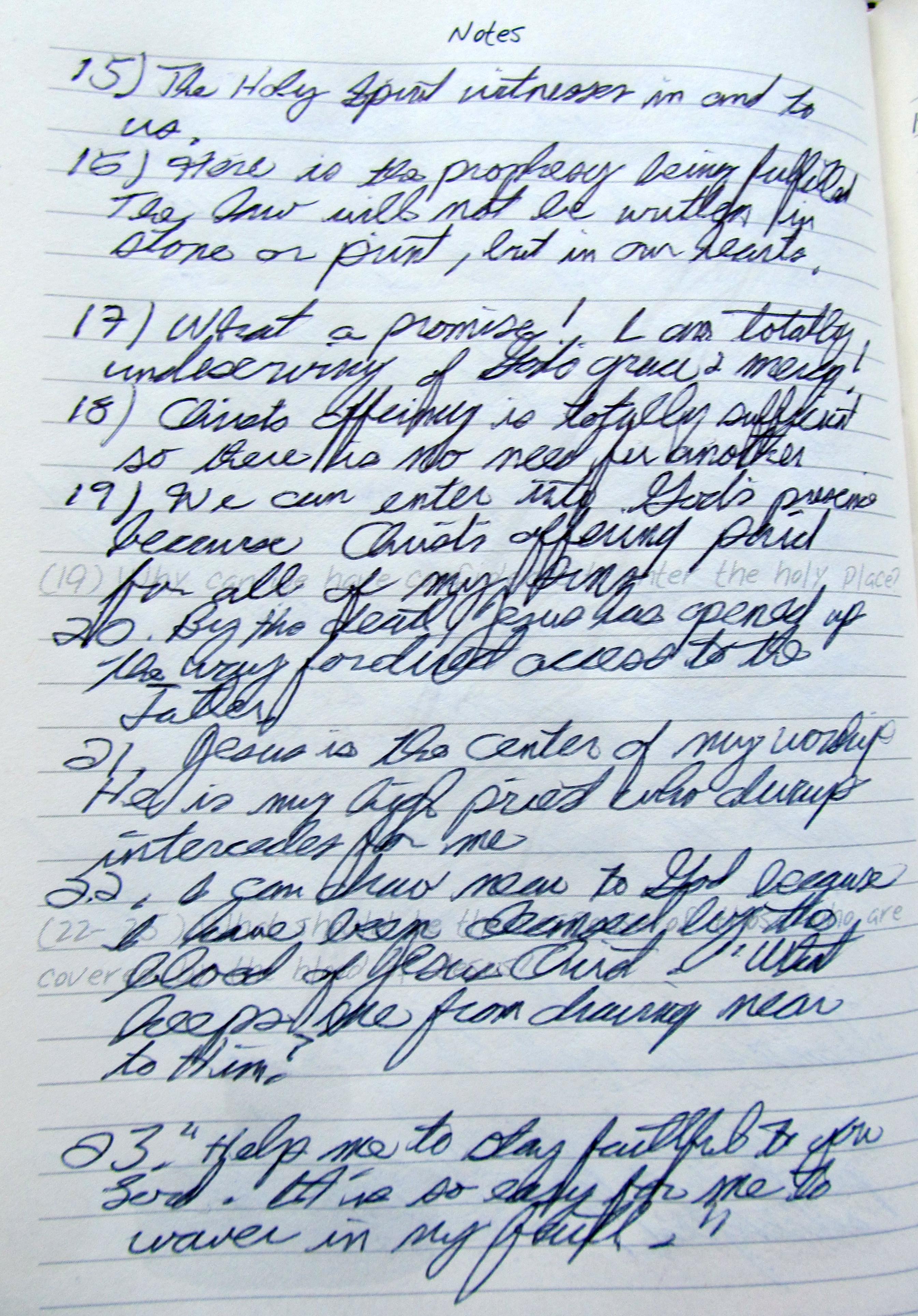
P.S Here are a couple of sample pages with my notes. Please excuse my poor penmanship.
This page is for writing out the verses.
This page is for writing out thoughts, prayers or applications.
“What’s wrong with you Mark?” This was almost a weekly question from Mrs. Randall, the nurse at Midland Elementary School. Every Tuesday, I would literally develop an upset stomach because I was afraid to go to swimming class. My fear of water was affecting me both emotionally and physically. This fear would not abate until later in my life.
Fear comes in many forms, but it still has the same effect. Our fears can dominate us spiritually, emotionally, mentally and even physically. As our fears increase, our faith in God decreases. We lose confidence in His promises, presence and power. Fear keeps us from enjoying our daily walk with God and others.
Isaiah 41:10 gives us four great promises from God that enable us to conquer whatever fear is crippling our lives. “Fear thou not; for 1) I am with thee: be not dismayed; for I am thy God:2) I will strengthen thee; yea, 3) I will help thee; yea,4) I will uphold thee with the right hand of my righteousness.”
1. When I am lonely, He promises his presence. He will never leave me. How can I be fearful, if I know that my loving Father is with me?
2. When I am weak and feel that I can’t continue, He will strengthen me. How can I be fearful when I remember that: “I can do all things through Christ which strengtheneth me.” (Philippians 4:13)? He will give me His strength to bear whatever comes into my life.
3. When I am in need of spiritual, emotional or physical help, He will help me. How can I be fearful when I know that I am not facing this situation by myself? The Lord is right there with me. He is my help no matter how fearful the future is.
4. When I stumble or fall, He will pick me up. How can I be fearful when I know that God will pick me up when I fall or stumble? When Peter sinned, stumbled and fell, Jesus picked him up and restored him. Our fear of failure often keeps us from moving forward in our spiritual lives. This promise assures us that when we stumble, God is right there to keep us going.
In times of great fear, He is there. God is greater than any fear that may be dominating our lives. He is our God. He will never forsake us. The decision is ours. Will I allow God to conquer my fears with His presence, promises, strength and great patience; or will I continue to allow my life to be controlled by my fears? “Lord, help me to believe your promises. May I know that you are greater than any fear that is dominating my life. Thank you for your presence and power that conquer my fears. Amen”
Note: A special thanks to Karla Da Silva for the photo. The photo was taken
at Waterfall Gully in South Australia.
I have enjoyed riding a bicycle since I was a child. There are three things that can make a bike ride an unpleasant experience: Careless drivers, dogs,
and bumpy roads.
Eaton County (where I live) has many unpaved roads that are quite bumpy. These roads may have some attractive scenery, but they also can make a bike ride an unpleasant experience. Likewise, in the road of life, people that we know face bumpy roads. These roads can bring discouragement, heartache, pain, danger and failure.
How sensitive are we to people who are traveling a bumpy road? How can we smooth out the bumps in the lives of others? A gentle spirit can smooth out the bumpy roads in the lives of others. The Apostle Paul says: “Let your moderation (gentleness) be made known unto all men. The Lord is at hand.” (Philippians 4:5) One Person defined gentleness as: “Showing personal care and concern in meeting the needs of others.” Do we interact with people in gentleness or in harshness?
I am glad that Jesus deals with me in gentleness when I face some bumpy roads in my life. However, how often do I make the effort to deal with others in a spirit of gentleness? Here are some of the ways that we experience Christ’s gentleness in the bumpy roads of our life.
1. He forgives me when I sin against Him. “If we confess our sins, he is faithful and just to forgive us our sins.” (1 John 1:9) Do I forgive others willingly when they sin against me?
2. He never leaves me when life gets rough. “I will never leave thee, nor forsake thee.” (Hebrews 13:5) Do I stick by others when the going gets tough in their lives?
3. He gives me strength to carry on. “I can do all things through Christ which strengtheneth me.” (Philippians 4:13) Do I help others carry their burdens or do I add to their burdens? “Bear ye one another’s burdens, and so fulfil the law of Christ.” (Galatians 6:2)
4. His Word encourages me to move forward. “Therefore, my beloved brethren, be ye stedfast, unmoveable, always abounding in the work of the Lord, forasmuch as ye know that your labour is not in vain in the Lord.”
(1 Corinthians 15:58) Do I encourage others with my words? Some of these words can be: “You can do it.” “I am praying for you.” “I thank the Lord for you.” 5. His Love is unconditional. Christ’s love is always there because his love is not based upon my behavior, but upon His character.“Who shall separate us from the love of Christ? shall tribulation, or distress, or persecution, or famine, or nakedness, or peril, or sword?” (Romans 8:35) Do I continue to show love to others even when it would seem easy to turn away from them?
There are many people who are facing a bumpy ride in this life. Are we willing to go the extra mile and show gentleness towards them? This will be a great way to smooth out their bumpy ride. Our gentleness can be considered the shock absorber of life.
Some thought questions about gentleness
(From “Character Clues BookshelfGame“)
1. Do those you correct walk away motivated or discouraged?
2. Do people avoid you when they know they have disappointed you?
3. Do you take the time to build a friendship along with correction?
4. Do those who work with you feel that you are committed to them or to getting the job done?
Have you ever studied the Word of God; and God brought great conviction upon your heart? Yesterday, while I was studying Jeremiah, God convicted me of something that I hadn’t thought about in a while.
The Book of Jeremiah is full of contrasts, disappointments, tears, God’s judgment, God’s love and future prophecy. In Jeremiah 20, Jeremiah experiences forty lashes from a whip. He also is tortured throughout the night in a public setting. He is ridiculed and hated because of his proclamation of God’s Word.
While studying this portion of scripture, I became convicted about my life. “Have I ever suffered like Jeremiah?” “Why do I complain so much?” I was deeply convicted that I often fall into the trap of a complaining spirit. I complain about circumstances, demands upon my time, people, the weather and many other matters. How can I enjoy God’s presence and complain at the same time?
God knows that many of us struggle with a complaining heart. He tells us “Do all things without murmurings and disputings: That ye may be blameless and harmless, the sons of God, without rebuke, in the midst of a crooked and perverse nation, among whom ye shine as lights in the world;” (Philippians 2:14,15) My complaining spirit not only affects my relationship with God, but also with others. How can I minister to others about God’s love, wisdom, and faithfulness, when inside my heart, I have a complaining spirit?
Paul understood the antidote to a complaining spirit when he wrote these words while in prison. “Not that I speak in respect of want: for I have learned, in whatsoever state I am, therewith to be content. I know both how to be abased, and I know how to abound: every where and in all things I am instructed both to be full and to be hungry, both to abound and to suffer need.” (Philippians 4:11,12) Paul didn’t complain because he knew that God had given unto him all that he needed for his present happiness. Paul had the presence of God!
When I look at what others have suffered or are suffering, why should I complain? My complaining spirit is a sign of selfishness. It is also a sign that I am not content in all that I have in Jesus Christ.
“Dear Lord, thank you for convicting me of my complaining spirit. In your Word, I see so many who followed you without complaining. They suffered greatly for you and your cause. Thank you for their testimony that shows me that I can live my life without complaining. Help me, to see your presence in every circumstance, every task, and every social encounter. Thank you for your loving-kindness in convicting me of this sin. Amen”
“God is a Spirit: and they that worship him must worship him in spirit and in truth” (John 4:24) A worship service in a small village in Romania
You are in church on a Sunday morning, have you ever found yourself……..
1. wishing that you weren’t in church?
2. thinking about the week ahead during the message?
3. fighting off sleep?
4. making negative mental notes about the people in the service?
5. singing and not paying attention to the words or our hearts?
6. picking apart the message being preached?
7. forgetting the sermon by the time you eat Sunday dinner?
What is the problem with our time of worship on Sunday morning? Could it be that we arrive totally unprepared to worship God? How can we have prepared hearts to worship the Living God?
Look unto God in preparation to worship Him.
Do I study and meditate upon His Word during the week? How can we expect to receive something from the Word of God during the worship service if we are not bathing our hearts in the Word of God during the week? “O how love I thy law! it is my meditation all the day.” (Psalm 119:97) Our love for the Word during the week will be evident in our response to the Word on Sunday. The message is only the beginning of allowing the Word to work in our minds and hearts.
Do I seek the Lord in prayer during the week as I prepare to worship Him? Yes, the pastor should have a prayerful heart as he enters the pulpit on Sunday morning; however, each listener should have prayerful heart as well. We should pray with the Psalmist. “Open thou mine eyes, that I may behold wondrous things out of thy law.” (Psalm 119:18)
Do I desire to glorify God as I worship Him? Often people say: “I didn’t get anything out of the service? What is the reason? Could it be that they did not put anything into the service? Their goal was to receive a blessing instead of giving glory to their Heavenly Father. Does our attitude on Sunday reflect these words: “O magnify the Lord with me and let us exalt His name together.” (Psalm 34:3) Look at Yourself in Preparation to WorshipGod
1. Do I have the right attitude about attending the worship service of the church? Our attitude determines the richness of our worship experience. If we arrive at the worship service with a negative attitude, our time of worship will be a negative experience. The Psalmist says: “I was glad when they said unto me, Let us go into the house of the Lord. “(Psalm 122:1) When we enter the worship with a spirit of joy and gratefulness, our worship experience will be one of joy.
2. Do I have the right relationship with God as I attend the worship service? Sin will keep us from having an encouraging, joyful worship experience with God. How can we worship God with our hearts, if we have unconfessed sin ruling in our hearts? “Draw nigh to God, and he will draw nigh to you. Cleanse your hands, ye sinners; and purify your hearts, ye double minded.” (James 4:8) We make sure our outer person is clean before we attend the worship service, but what about our hearts?
3. Do I have the right understanding of the need to attend the Sunday morning worship service? There are many people who attend church who don’t really understand why they are there. Maybe, it is out of habit. Maybe, they feel it is the right thing to do. However, God makes it clear that we as His children need to meet to together. This is not only to worship Him, but also to minister one to another. The church service is not only an opportunity to have people minister unto us, but it is also an opportunity to minister unto others. God says: “And let us consider one another to provoke unto love and to good works: Not forsaking the assembling of ourselves together, as the manner of some is; but exhorting one another: and so much the more, as ye see the day approaching.” (Hebrews 10:24-25)
Look at others in preparation to worship God
1. Do I have the right relationship with those around me? Jesus taught that you can’t come before God’s altar and offer your gift if you have a problem with others. (Matthew 5:23-26) How can we worship God on Sunday, when we have unresolved conflict in our family, or in our church family?
2. Do I see the opportunities of ministry within my family and my church family? God has given every believer a spiritual gift. We are to use our gift within His Body (Romans 12:3-8). These gifts are not for our own benefit, but for the benefit of others. The worship time gives us an opportunity to have a sensitive heart towards others, to pray for others, and to be an encouragement to others.
Worship means to give worth to His name. The Sunday morning worship service can be a negative experience, a boring experience, a tedious experience or it can be a time of enjoying and honoring the presence of the Living God. The choice is our. Next Sunday, will we come to worship Him with a prepared, and surrendered heart? Will our worship be worthy of our great and mighty God?
Worry and Anxiety: A Life Being Pulled in Different Directions Photo by: Karla Da Silva (Used by Permission)
Have you ever felt pulled in several directions at once? You know you should have faith in God, and yet worry and anxiety have a chokehold upon your whole life. The future seems dim. Your life is at a standstill. Sleep escapes you. God seems very distant. Despair is ruling your life. What can you do?
The word “worry” comes from the West Germanic word, “wrygen” which means “to strangle” or “to choke”. Worry not only chokes our spiritual life, but also our emotional, social, and physical life. God knows the power that worry and anxiety have upon us. He tells us in Philippians 4:6-7: “Be careful for nothing; but in every thing by prayer and supplication with thanksgiving let your requests be made known unto God. And the peace of God, which passeth all understanding, shall keep your hearts and minds through Christ Jesus.”
How do we break this chokehold that worry and anxiety have upon us? God gives us several ways to break this chokehold.
1. Understand the consequences that worry and anxiety have upon our lives. The words “be careful for nothing” have the idea of “stop being pulled in different directions”. Worry is sin because it keeps us from giving glory to God. It also keeps us from serving God and others to our full capacity. Worry causes us to doubt the goodness of God. This creates confusion in our lives. For these reasons and many others, God commands us to stop worrying.
2. Focus upon God and not upon our circumstances. The above passage says, “Let your request be made known unto God.” God is the source of peace. When our eyes turn from our trials and are focused upon God, we will see the greatness of God’s power, wisdom, love and sovereignty. We know that we can trust Him regardless of what comes our way. God is greater than any circumstance in our lives.
3. Talk to God about the source of our worry and anxiety. The passage says: “but in everything by prayer and supplication”. God, our loving Father, wants us to take every hurt, misunderstanding, health issue, family issue, financial problem, doubt, and personal issue unto Him. He alone can carry that burden. “Casting all your care upon him; for he careth for you.” (1 Peter 5:7) Worry and anxiety say I will carry my burden. Faith says I will take that burden to the Lord and leave it there.
4. Learn to give thanks to God in everything. Many problems and heartaches that choke us can be turned into blessings when we learn to give God thanks in everything that happens. “In every thing give thanks: for this is the will of God in Christ Jesus concerning you.” (1 Th 5:18) This doesn’t mean we thank God for everything. When we thank Him in everything, we are saying to God: “I commit this circumstance, person or problem that is choking my life unto you. I thank you that you are fulfilling your great purpose in my life even in the midst of this great trial or burden.”
5. Enjoy God’s promise of His Peace. God tells us that His peace “passeth all understanding”. God’s presence and peace shine forth in those who face their deepest trials with faith in Him. I have been beside many people who are facing death and yet they had a peace that passes all human wisdom. God’s peace doesn’t make sense to people around us because His peace isn’t based upon circumstances. It is based upon the enjoyment of His presence.
God doesn’t want any of us to be continually pulled in two directions. He wants us to turn our faces directly towards Him. The songwriter wrote: “Turn your eyes upon Jesus, and look full in his wonderful face and the things of earth will grow strangely dim in the light of His Glory and Grace.” God will break the chokehold of anxiety and worry in our lives. Will we trust Him to do so? “The truth shall make you free.”
Nineteen years ago, I said goodbye to my father. He had suffered a stroke and I returned to the States to see him one last time. He probably recognized me, but he couldn’t communicate with me. My heart was heavy as I returned to Portugal. I would never see me father again. My father didn’t leave me by choice, but he was gone. I miss my father greatly.
In life, we all face separation from one that has loved us. This separation is painful; however, there is One who will never leave us. Our Heavenly Father is always with us. Hebrews 13:5 says: ” Let your conversation be without covetousness; and be content with such things as ye have: for he hath said, I will never leave thee, nor forsake thee.” God is with us in the good times and He is with us in dark times. How does His presence affect our lives?
God’s presence gives us a contented heart in dark times. The tendency in life is to complain about everything. We want more. We want it faster. We want it our way. When things don’t happen the way we desire, we become bitter and complain. Our lack of contentment is saying that God is doing a poor job of taking care of us.
Contentment means that we find our joy and happiness in a right relationship with our Living Lord. In spite of the tough times, we know that He is right there with us. He will not leave us. He will walk with us through any valley. As the Psalmist says: “I will fear no evil, for thou art with me.”
God’s presence gives us strength in the dark times. The Word of God informs us that Our Heavenly Father will never leave us. “So that we may boldly say, The Lord is my helper. ” (Hebrews 13:6) The dark times in this life weaken us spiritually, emotionally and even physically. We may feel like quitting. God’s presence gives us strength to carry on. God told Paul: “For my strength is made perfect in weakness.” (Hebrews 13:6) Our weakness says to God: “I need your strength.” God will respond.
God’s presence gives us courage in the dark times. Dark times can bring out the coward in us. We become fearful of people. We become fearful of the future. We become fearful of failure. Where do we find the courage to move forward. “I will not fear what man shall do unto me.” (Hebrews 13:6) God’s presence and love will cast out the fear that so easily torments us.
As a child, I developed a fear of crossing the street. The one street that brought out the most fear was Woodward Ave. This street had three lanes of traffic each way. However, when my Dad had my hand the fear dissipated. Likewise, no matter how difficult a road we travel, Our heavenly Father has us by the hand.
My Dad has left, but my Heavenly Father will never leave me. He is with me in the good times and the dark times. Yes, the clouds of darkness may dim my view of God, but He is still with me. May I lean upon Him in the darkest night so that I may see his presence in midst of the darkness.
Trouble, trials, and tragedy strike every person who has ever walked upon the earth. When trouble comes, do we blame God? Do we ignore God; or do we trust Him?
King David had his share of problems, but he never forgot the Goodness of the Lord. He writes: “O taste and see that the LORD IS GOOD: blessed is the man that trusteth in him.” (Psalm 34:8) How does God show His goodness in the troubles, trial, and tragedies of life?
1) God shows His goodness in His attributes. “The Lord is Good” Every attribute reflects His Goodness (How well do I know Him?)
2) God shows His goodness in His promises. “Whereby are given unto us exceeding great and precious promises: ” (2 Peter 1:4) (Do I know and believe His promises?)
3) God shows His goodness in His Actions. “Thou art good, and doest good” All that God does is Good. (Psalm 119:68) (Do I believe that “All things work together for good to those that love God.” (Romans 8:28)
4) God shows His goodness in His Love. “The LORD hath appeared of old unto me, saying, Yea, I have loved thee with an everlasting love: therefore with lovingkindness have I drawn thee.” (Jeremiah 31:3) God’s love is His motive for what He is doing in our lives (Do I believe that God loves me with an unconditional and unending love?
5) God shows His goodness in His Wisdom. ” In whom are hid all the treasures of wisdom and knowledge.” (Colossians 2:3 ) God’s thoughts are way beyond our comprehension. (Do I trust in God’s wisdom or mine own wisdom?)
In the midst of trouble, trials and tragedy, remember the Goodness of God. God’s plan for our lives is the result of His goodness, even when there is pain in the process. Will we trust in His Goodness today?
Ruins tell the story of decay, neglect and destruction. Our spiritual lives can also face times of ruin and decay. We feel hopeless and in despair. The Prophet Jeremiah faced a time in his life when he was in the midst of the ruins of Jerusalem. Babylon had completely destroyed the city. All hope was gone. How did Jeremiah handle this hopeless condition? How can we handle our hopeless condition?
Jeremiah, in the midst of the ruins of Jerusalem, looks up to God. He says in Lamentations 3:21: “This I recall to my mind, therefore have I hope.” He knows in himself there are no answers: ” My strength and my hope is perished from the LORD:” (Lam 3:18) However, he knows that his hope is in God alone.
When we are facing hopelessness in our lives, our only hope is in the Lord alone. We must take our eyes off the ruins around us and in us, and focus on the Lord. Jeremiah focuses on five attributes of God that brings great hope in his life in spite of the ruins around Him.
1. God is Merciful– “It is of the LORD’S mercies that we are not consumed, ” (Lamentations 3:22) We find hope in His forgiveness, as we come to Him with a repentant heart.
2. God is Compassionate. “because his compassions fail not.” (Lam. 3:22b)
We find hope in his compassion. He does love us even in the midst of our hopeless situation.
3. God is Faithful– “They are new every morning: great is thy faithfulness“. (Lamentations 3:23) We find hope in His faithfulness to keep all of His promises.
4. God is Omnipresent. (He is with me) ” The LORD is my portion, saith my soul; therefore will I hope in him.” Lamentations 3:24 We find hope in His presence. He walks with us in the midst of the ruins and the rebuilding thereof.
5. God is Good. “The LORD is good unto them that wait for him, to the soul that seeketh him.” Lamentations 3:25 We find hope in the will of God, which is always for our good.
What will we do in the midst of our hopelessness? Will we stay defeated and discouraged or will we look up to our great and mighty God? Jeremiah discovered great hope in a hopeless situation and so can we!!
Temptation to sin is something every believer experiences. Our Lord Jesus Christ faced direct temptation from Satan; yet He never yielded to the temptation. (Matthew 4:1-11)
THE SOURCES OF TEMPTATIONS
Temptation comes in many forms; but the three main sources of our temptations are:
1. The flesh-” The heart is deceitful above all things, and desperately wicked: who can know it?”
2. The devil-Genesis 3:1-10 (The tempting of Eve)
3. The world, which refers to the system of thinking that is against God. “
“And be not conformed to this world” (Romans 12:2)
Temptations can come upon us in a very subtle fashion to cause us to sin against God; or they can come suddenly with great strength. Are we prepared to face the temptations that will come our way?
THE RIGHT PREPARATION FOR TEMPTATIONS
Before any temptation strikes, we need to be prepared by means of our daily walk with God. These questions should help to see how prepared we are to face temptations that will come our way.
1. Is my whole heart seeking after God out of my love for Him? “With my whole heart have I sought thee:” (Psalm 119:10)
2. Is the Word of God implanted in my heart? ” Thy word have I hid in mine heart, that I might not sin against thee.” (Psalm 119:11)
3. What brings the most delight in my life? “I delight to do thy will”
(Psalm 40:8)
4. How is my prayer life? ” Praying always with all prayer and supplication in the Spirit, and watching thereunto with all perseverance and supplication for all saints;” (Ephesians 6:18)
5. Am I in regular fellowship with other believers? “And let us consider one another to provoke unto love and to good works: Not forsaking the assembling of ourselves together, as the manner of some is; but exhorting one another: and so much the more, as ye see the day approaching.” (Hebrews 10:24-25)
6. Have I laid aside every thing that hinders my Christian growth? “Let us lay aside every weight, and the sin that so easily besets us”. (Hebrews 12:1)
Joseph, Daniel and others were able to resist temptation because they were prepared beforehand. What about us? Are we prepared for the temptations that will come our way?









 Bible Treasures for Today