Moving Beyond Bitterness to Forgiveness

Canadian Rockies-Photo by: Mark J Booth

“I can’t forgive them.” “What they did to me is unforgivable.” “I won’t ever speak to them again.” ” I can’t forget how much they hurt me.” What do all these statements have in common?  They show an individual who has a bitter spirit.

Bitterness has destroyed many people because it enslaves them to the object of their bitterness.  They have no freedom to enjoy their walk with God and others.  A bitter person can infect their family, their workplace or even their church with their attitude.  “Looking diligently lest any man fail of the grace of God; lest any root of bitterness springing up trouble you, and thereby many be defiled;” (Hebrews 12:15)

God has not only given us a cure for bitterness, but He has also modeled this cure.  This cure is called forgiveness.  The word forgiveness means “to send away”.  The idea is that we throw the bitter attitude out of our lives; never to retrieve it again.  “Let all bitterness, and wrath, and anger, and clamour, and evil speaking, be put away from you, with all malice:” (Ephesians 4:31)

God gives us three reasons to cast out bitterness and embrace forgiveness.

1. Christ has forgiven us.  “And be ye kind one to another, tenderhearted, forgiving one another, even as God for Christ’s sake hath forgiven you.” (Ephesians 4:32)  No matter what anybody has done to us, it is nothing compared to all of our sinful offenses towards God.

The Parable of the Unforgiving Servant is a great illustration of the above truth.  The landowner forgives his servant an enormous debt; yet this forgiven debtor is unwilling to forgive his follow servant a very small debt. (Matthew 18:21-35)  How can we talk about God’s mercy and not share that mercy with others?

2. Christ commands us to forgive others. Forbearing one another, and forgiving one another, if any man have a quarrel against any: even as Christ forgave you, so also do ye.(Colossians 3:13)  A bitter spirit is a disobedient spirit.  When we forgive a person in our heart, we are walking in obedience to Christ.  

3. Christ is our example of demonstrating forgiveness.  When Christ was being mocked upon the cross, He didn’t respond with anger and bitterness.  He called out to His Father: “Father, forgive them; for they know not what they do.” (Luke 23:34) When we forgive those who have hurt us, we are acting like our Savior.  These people didn’t ask Christ to forgive them, but yet Christ poured out His forgiveness towards them.

Forgiveness is difficult for us because we think that the offended party  is “let off the hook”.  In reality, we are let off the hook.  We are now free to live our lives without being controlled by our bitterness.  God shows us the following blessings of extending forgiveness to others.

  • We have a testimony before others. “The discretion of a man deferreth his anger; and it is his glory to pass over a transgression.” (Proverbs 19:11)
  • We show God’s love towards others.  Charity “rejoiceth not in iniquity, but rejoiceth in the truth; Beareth all things, believeth all things, hopeth all things, endureth all things.” (1 Corinthians 13:6-7)
  • We will have a joyful heart. Blessed are the merciful; for they shall obtain mercy.” (Matthew 5:7)
  • We will enjoy true Christian fellowship. “To whom ye forgive any thing, I forgive also: for if I forgave any thing, to whom I forgave it, for your sakes forgave I it in the person of Christ;” (2 Corinthians 2:10)

Forgiveness is our choice.  We can continue to feel hurt and embittered, or we can choose forgiveness.  The offending party may never ask for forgiveness, but we can forgive them in our heart.  Many persons have lived a miserable life because they chose not to forgive someone.  Is your bitterness worth it?

“Dear Lord, you felt the pain of rejection, hatred, misunderstanding and ridicule; yet you forgave.  Help me, to forgive those who have hurt me.  My bitter spirit has not only hurt me, but those around me.  I have lost the joy in my life.  Lord, in my heart I now forgive _____________.   Thank you for your forgiveness towards me when I don’t deserve it.  From now on, help me to exercise love towards even those who have hurt me. Amen.”

NOTE: This is the sixth post in the series “Moving Beyond”.  Please check out the other posts in this series.
Prayers of Comfort from Psalm 37

Near Marshall, MI: Photo by: Mark J Booth

Trials are a part of every person’s life.  These trials can be self-induced or they can be caused by events beyond our control.  The question isn’t if we will have trials, but how will we face these trials.  Psalm 37 is written from the perspective of a man filled with trials.  God shows him the way he is to navigate through these trials.  Here are some prayers that go along with this very encouraging Psalm.  May God use Psalm 37 to help give direction and comfort to each of us.

“Fret not thyself because of evildoers, neither be thou envious against the workers of iniquity.” (Psalm 37:1)  “Lord, I find myself filled with worry.  I worry about my walk with you.  I worry about my family, and the church.  I worry about my future.  I sometimes look at others and feel as though I am lacking something.  I also fret because evil seems to be gaining ground every day in our nation.  Help me to gain perspective upon the things that trouble me.  I need to grow in faith; so that I know in my heart that you are in control of everything.  I can trust you with my life and with what is happening in the world around me.  Amen”

“Delight thyself also in the LORD: and he shall thee the desires of thine heart.” (Psalm 37:4) “Lord, I often focus on my circumstances instead of focusing upon you. I forget to take delight in all that you are. Help me to focus upon all that you are and all that you do. May I delight in you today regardless of my circumstances. Amen.”

“Commit thy way unto the Lord; trust also in Him; and he shall bring it to pass.” (Psalm 37:5) “Lord, I often want to chart my own course in life.  I look at my future from my perspective and not from yours. Why do I find it difficult to commit my way to you? Lord, you do know what is best for my life. Your love for me is beyond question.  For this reason, I need to commit unto you everything I do.  Help me to trust you regardless of what may happen in my life. Amen”

“Rest in the Lord, and wait patiently for him.” (Psalm 37:7) “Dear Lord, I often live in anxiety because I don’t place my burdens upon you. I often run ahead of you instead of waiting for your perfect timing. Help me, to trust you enough to allow you to work in and through my life.  In the midst of my busyness, enable me to stop and remember that you are right here with me. Thank you for allowing me to rest in your everlasting arms! Amen”

“Cease from anger, and forsake wrath:fret not thyself in any wise to do evil.” (Psalm 37:8)  “My Lord, when I face difficult circumstances and people, I can easily become angry.  Usually I keep this anger within, but it does affect me.  It keeps me from pleasing you and ministering to others.  Thank you for your great example on the cross how you forgive those who placed you upon the cross.  Teach me to respond to others with graciousness and love.  Teach me to yield my rights unto you, because my anger is often a warning sign of some right that I haven’t yielded unto you.

“Though he fall, he shall not be utterly cast down: for the Lord upholdeth him with his hand.” (Psalm 37:24) “Lord, I have stumbled and even fallen many times in my life; yet, you are always there to pull me up with your loving hand. Help me to never let go of your hand as I walk through this life. Thank you for your great love in watching over me. Amen.”

“And the Lord shall help them, and deliver them: he shall deliver them from the wicked,and save them, because they trust in him.” (Psalm 37:40)  “Thank you for the concluding words of this Psalm of comfort and guidance.  Thank you for the times that you have delivered me from myself and others.  Thank you for all that you are, because you are truly worthy of my trust.  I gladly commit my ways to you today. Amen”

P.S. I often write prayers with the verse that I write out in my Journible.  If you are interested in learning more about the Journibles, here is my post about this excellent Bible study tool.
http://markjemilbooth.com/2012/07/29/how-to-profit-more-from-your-bible-reading-the-journibles/

Five Things that Will not Change after Today’s Election

“Jesus Christ the same yesterday, and today, and for ever.” (Hebrews 13:8)

Election Day is finally here. The money has been spent by the candidates,  The commercials are done.  The phone calls have ended.  Now, it is up to the American people to decide who will lead our nation for the next four years.

Tomorrow, there will be joy for many people and there will be sadness for many others. Whether your candidate wins or loses, it is important that we remember that the most important things in life will not change after today.

1. Jesus Christ has not changed. He is still the Savior of the world.  He is still the Good Shepherd that cares for His sheep.  He still is “the way, the truth and the life.”  Our presidents change, governmental policies change, but Jesus Christ is our Rock who will never change.  “Jesus Christ the same yesterday, today, and for ever.” (Hebrews 13:7)

2. The Word of God has not change.  The laws of our land may change.  The Supreme Court may uphold laws or reject them. However in the midst of our changing laws, God’s Word never changes.  The promises of God do not change.  The doctrines of the Word of God do not change.  The Word of God should always remain in our hearts. “O how love I thy law! It is my meditation all the day.” (Psalm 119:97)

3. The Promise of Christ’s Second Coming has not changed.  One day, there will be no elections. There will be only one ruler, Jesus Christ.  The promise of His coming is seen throughout the Word of God.  “And he hath on his vesture and on his thigh a name written, KING OF KINGS, AND LORD OF LORDS.”  (Revelation 19:16)  When Jesus reigns, it will be with total righteousness!

4. The Mission of the Church has not changed.  The mission of the church is not to change society by political means.  We often get carried away with politics that we forget that our main mission is to reach the world with the Gospel of Jesus Christ.  Christ’s final command has not changed.  “Go ye therefore, and teach all nations, baptizing them in the name of the Father, and of the Son, and of the Holy Ghost.”  (Matthew 28:19) The Gospel changes people, but we mustn’t let people change the Gospel.

5. God’s plan for the family has not changed.   Our laws may change concerning marriage, but we can still follow what God’s Word says concerning our family.  Yes, husbands and wives are to love another. We can still be committed to the permanance of our own marriage. The family can still worship the Lord together. The family can still be a place of learning about the Lord and life itself.  God’s view and purpose for your family will not change after this election.  

No matter who wins the election tonight, I am fully confident that God is on the throne.  His Word has not changed.  His plan has not changed.  This is a great time to put our focus back on those things that are above.  “If ye then be risen with Christ, seek those things which are above, where Christ sitteth on the right hand of God!”

‘Dear Lord, help me to keep my eyes on you.  I do not what the future holds for my life or for our nation, but I do know that your ways are best.  Help me, to surrender my heart completely unto you. Amen”

Enjoying Life or Enduring Life?

Evening Sky-Photo by: Mark J. Booth

The jail cell was damp and cold.  The quality of the food was dismal.  The Apostle Paul didn’t know if he would soon be executed.  How could he enjoy life in the midst of such dismal circumstances?

The Apostle Paul faced many trying times in his life, but he enjoyed life instead of enduring life.  Many of us no longer enjoy life. We complain about our circumstances. Self-pity controls our thought patterns.  Anxiety keeps us from enjoying God’s presence.  We have the idea that enjoying life is based upon our circumstances.  Paul’s circumstances were dismal in the Roman jail; yet he enjoyed his life.  Let’s look at why Paul enjoyed life even while he was suffering in a Roman jail.

1. Paul enjoyed his life because he had a purpose in life.  “Paul and Timotheus, the servants of Jesus Christ” (Philippians 1:1)

Many people don’t have a life purpose.  They have a vague idea that they should be doing something for themselves, for their family. and for their community; however, they have no real purpose.  Paul enjoyed his life because he had a purpose!  His purpose was to serve His Lord and Savior, Jesus Christ.  Paul enjoyed life because he knew that he belonged to the King of Kings. Paul wasn’t pulled in many different directions.  He received his directions from Christ.  He even understood that his time in prison was for the glory of His Master.  He wrote in another letter.  “Paul, a prisoner of Jesus Christ”.   We will enjoy life when we live each day in light of the fact that “I am a servant of Jesus Christ”.

2. Paul enjoyed his life because he experienced God’s grace and peace.  “Grace be unto you, and peace from God our Father and from the Lord Jesus Christ.” (Philippians 1:2)  

Paul wasn’t alone in his jail cell.  The Lord was with him.  Paul enjoyed his life because he was aware of God’s presence even in the most difficult of times.  God’s grace enabled Paul not only to survive in his trials, but also to thrive.  God’s peace gave him the knowledge that no matter what was happening in his life, God was in control.  We enjoy  life when we experience God’s grace and peace in even the greatest storm of our life.

3. Paul enjoyed his life because he invested his life in others“I thank my God upon every remembrance of you,” (Philippians 1:3)

Even in prison, Paul was ministering to others.  He wrote his letter to the believers at Philippi to encourage them.  He was willing to sacrifice his life for others.  He prayed for others.  He shared the Word of God with others.  He loved others.  Paul didn’t focus upon his problems, but he used his problems as a means of ministering to others.  There is great enjoyment in seeing God use us in the lives of others.  We minister to others through our testimony, our prayers, our words of encouragement, our expressions of love, and our sharing the truths of God’s Word.

4. Paul enjoyed his life, because he understood that his trials brought glory to God.  “But I would ye should understand, brethren, that the things which happened unto me have fallen out rather unto the furtherance of the gospel” (Philippians 1:12)

Paul’s time in jail was part of God’s overall plan.  God used Paul as a witness to the many people with whom he came into contact.  God also used Paul’s imprisonment to encourage other believers to go out and share the gospel.  God doesn’t allow things to enter into our lives for our harm, but for the good of ourselves and others.  We can enjoy life when we surrender to God’s purpose for our trial.

5. Paul enjoyed his life because he knew the future.  “For to me to live is Christ, and to die is gain.” (Philippians 1:21)

Paul showed joy even in facing death, because he knew that death was the door through which he would enter heaven.  We enjoy our life on earth when we live for Christ and keep our focus upon the eternal reward that waits for us in heaven.  When we live our lives for ourselves, our focus is upon this life alone.  Paul saw the big picture, do we?

“Dear Lord, I often feel as though I am enduring life.  I focus on my problems.  I focus on my needs.  I focus on the faults of others. Thank you for Paul’s example to me of a man who enjoyed his life in spite of the dire circumstances he faced.  Please help to enjoy my life in you regardless of the circumstances that I face. Thank you for your great patience and love towards me.  Amen”

A Heart to Walk with God

Sleepy Hollow State Park-Michigan USA-Photo by: Mark J. Booth

Imagine taking a walk with God. One of the most unusual people in the Bible is Enoch.  He is one of two Old Testament characters who never died.  What is it that makes Enoch unique?  The Bible says:  “And Enoch walked with God: and he was not; for God took him.” (Genesis 5:24)  Enoch loved listening to God.  He enjoyed sharing his heart with God. He made his relationship with God the number one priority in his life.  Enoch’s walk with God meant that he had an intimate relationship with God.

We often find ourselves too busy to take time to walk with God.  Our culture focuses on  instant gratification.  We don’t like to slow down.  We have fast food, fast cars, instant photos, instant communication and microwave ovens.  We think that we can also have a microwave relationship with God.  We  read a few verses, and say a quick prayer and think that we have a close relationship with God.  We have lost the joy and the benefit of slowing down and learning to walk with God.

How can we develop a heart that longs to walk with God?  Here are five ways that we can cultivate a heart that desires to walk with God.

1. We need to develop a heart that agrees with God.  Agreeing with God enables us to view our life from His perspective.  We enjoy our time with God because we aren’t arguing with Him. We are learning from Him.  The nation of Israel had a problem of agreeing with God.  They wanted to go their own way.  The prophet Amos said: “Can two walk together, except they be agreed?” (Amos 3:3) Do we agree with God concerning our goals, our future, our family, our time, our money and other areas of our lives? We can’t walk in our own way and walk with God at the same time. 

2. We need to develop a heart that is humble before God.  Pride causes us to think that we don’t need to walk with God.  We are able to handle our life without God.  The prophet Micah says:  “He hath shewed thee, O man, what is good; and what doth the LORD require of thee, but to do justly, and to love mercy, and to walk humbly with thy God?(Micah 6:8) A humble spirit is a dependent spirit.  A dependent believer sees their great need to walk very close with God.

3. We need to develop heart that is pure before God.  Because God is holy, sin keeps us from walking with God.  The Apostle John says: “If we say that we have fellowship with him, and walk in darkness, we lie, and do not the truth: But if we walk in the light, as he is in the light, we have fellowship one with another, and the blood of Jesus Christ his Son cleanseth us from all sin.(1 John 1:6-7) Sin is choosing to walk in darkness, instead of walking in God’s light.  However, God has provided the way of restoration in our walk with Him. “If we confess our sin, he is faithful and just to forgive us our sin, and to cleanse us from all unrighteousness.” (1 John 1:9) A pure heart is a heart that enjoys walking with God, who is Light. 

4. We need to develop a heart that loves as God loves.  When our hearts are full of anger, bitterness, hatred, and selfishness, we are unable to walk with God, who is love.
And walk in love, as Christ also hath loved us, and hath given himself for us an offering and a sacrifice to God for a sweetsmelling savour.” A believer that loves God and others feels very comfortable walking with God.  They look for opportunities to pour out the love they receive from God unto others. 

5. We need to develop a heart that is quiet before God.  God’s Word encourages us to slow down and be still.  We need to learn the art of waiting upon God. “Be still, and know that I am God:” (Psalm 46:10) A patient and quiet heart is saying to God: “I am ready to walk with you with my undivided attention.” 

Woldumar Nature Center-Lansing, Michigan (Photo by: Mark J. Booth)

Enoch made a choice that he would walk with God.  This meant the sacrifice of his time.  It meant that he would be misunderstood by others.  However, he desired a close walk with His God. God took pleasure in His time Enoch. As a result, He just took Enoch right up to heaven to be with Him.  What about us?  How is our walk with God?

“Dear Lord, I am tempted to hurry my time with you.  I find myself walking this life without you.  Then something happens and I wonder where are you.  Help me, to see my need to walk close with you.  I know that the greatest enjoyment in life is when I take the time to walk with you.  Thank you for always being available to walk side by side with me.  I love you, Lord. Amen”


Making the Debates Personal

Photo by: The Washington Post

The first two debates are now history.  The debates have been helpful to hear the candidates and learn their positions.  They have also been helpful to see how the candidates interact with each other. Many people have written about the debates, but no one has asked the question:  “What can we learn about ourselves from the debates?”  Here are several questions that we can ask to help us make these debates personal.

1. What is the most important thing in my life? 

The debates, thus far, have focused a lot upon our economy.  The candidates in their own way are saying that money is the most element for being a happy, contented citizen. Is this correct? God says:  “For the love of money is the root of all evil: which while some coveted after, they have erred from the faith, and pierced themselves through with many sorrows.” (1 Timothy 6:10)

When money becomes the main focus in our life, it keeps us from focusing upon God.  Jesus understood this when He said:  “But seek ye first the kingdom of God, and his righteousness; and all these things shall be added unto you.” (Matthew 6:33)
The Lord desires our focus to be upon Him, anything else can quickly become an idol in our life.

2. Do I have a fear of man or a fear of God? 

The candidates use the debates to state their positions to please a certain group of people.  The candidates develop a fear of man because they are looking for votes.  We can often be controlled by the fear of man as well.  The Bible says: “The fear of man bringeth a snare: but whoso putteth his trust in the LORD shall be safe.” (Proverbs 29:25) The fear of man keeps us from pleasing God.  It keeps us from serving God fully.

True freedom is found when we have a fear of God instead of a fear of man.  When we fear God, He is the one that we need to please. “Be not wise in thine own eyes: fear the LORD, and depart from evil.” (Proverbs 3:7) Unlike the politicians, the opinion of others should not enslave our thoughts and actions.  We find true freedom in submission to Our Lord and Savior, Jesus Christ.

3. Do I build people up or do I tear them down?

The debates have illustrated the great art of tearing down another person to build up one self.  We find this to be great entertainment.  We cheer for “our side” to win.  Is it Biblical to tear down another person?  Is this pleasing to God?  Do we have the habit of running over people?  There are many examples in the Bible of people who made it their goal to tear people down.  Ahab hated Elijah.  Saul was out to get David.  Satan wanted to destroy Jesus’ ministry.

Unlike the candidates, we are to seek to build up others.  The word “discourage” has the idea of taking the heart out of a person.  Encouragement means “to put the heart into a person” Barnabas was a biblical character who encouraged others.  He encouraged the early church by his example. He encouraged Paul by befriending him.  He encouraged the church at Antioch by his teaching.  He encouraged John Mark by helping to restore him after his failure.  Love means to encourage others.  We don’t see a lot of love in the debates, but do we see this love and encouragement in our own lives?

4. Am I self-centered or God-centered?

By listening to the debates, you would think that Americans are the most self-centered people in the world.  Our politicians keep trying to pander to what each of us wants.  They appeal to our selfish nature.  I haven’t heard President Kennedy’s quote: “And so, my fellow Americans: ask not what your country can do for you — ask what you can do for your country.

It is easy for a Christian to develop this attitude of self-centeredness in this culture: however Christ has called his disciples to a life of self-denial.  “Then said Jesus unto his disciples, If any man will come after me, let him deny himself, and take up his cross, and follow me.” (Matthew 16:24).  Our lives are to be centered upon Christ.  Our goal is not to follow our desires, but His will. 

5. Am I more concerned about my physical well-being or my spiritual well-being?

One of the greatest issues of the debates and this campaign is the health care crisis in this nation.  Yes, we do have crisis in America concerning our health care. The physical health of Americans in general is quite poor.  However, the greatest crisis is not the physical well-being of Americans, but our spiritual well-being.

How healthy am I spiritually is a question, that we often neglect.  God is very concerned about our spiritual health.  He has given us His Word as food that will nourish our soul.  Here are some questions to help us evaluate our spiritual health:

  • Do I truly desire to walk with God daily?
  • Do I read the Bible with an open heart and mind?
  • Am I quick to obey the commands of Christ?
  • Do I quickly confess my sins to God?
  • Do I love God with all of my heart?
  • Do I love others as God loves me?

There are two more debates in this election cycle.  However, let’s not just look at President   Obama and Governor Romney in these debates, but also we need to think about our own lives and our relationship with God

“Dear Lord, I am thankful that I live in a nation in which I can worship you freely.  I also thank you for the great salvation that I have in your Son, Jesus Christ.  Help me to view this life from your perspective.  Help me to center my life upon you because it is easy to take my focus from you.  While you are working in my life, please guide the leaders of our nation to make wise decisions. Amen”

Moving Beyond Covetousness to Contentment

Woldumar Nature Center (Lansing, Michigan USA) Photo by: Mark J. Booth

Discontentment is found everywhere, including our own hearts.  People are discontent with their marriages, with their jobs, with their health, with their relationships, as well as their possessions.  The root of discontentment is covetousness.  Covetousness is defined as the inordinate desire to have something.  It is also defined as the desire to have something that belongs to another.

Covetousness is a sin that creates a warped view of God.  We feel that God has cheated us out of something.  Satan used this approach with Eve when he told her that God was wrong to withhold the fruit of the tree of the knowledge of good and evil.  Eve coveted the fruit and ate it.  The tenth commandment says: “Thou shalt not covet thy neighbour’s house, thou shalt not covet thy neighbour’s wife, nor his manservant, nor his maidservant, nor his ox, nor his ass, nor any thing that is thy neighbour’s.” (Exodus 20:17)

God’s gives this commandment for two reasons.  First of all, God hates covetousness because it places the coveted object above Him, which is a form of idolatry.  It also causes us to have the wrong view of His person and blessings. “For the wicked boasteth of his heart’s desire,and blesseth the covetous, whom the Lord abhorreth.” (Psalm 10:3)

Secondly, covetousness brings harm to us and to those around us.  The Bible teaches us that covetousness leads to:

  • injustice: “And they covet fields, and take them by violence;and houses, and take them away: so they oppress a man and his house, even a man and his heritage.” (Micah 5:2)
  • harm to ourselves: “But they that will be rich fall into temptation and a snare, and into many foolish and hurtful lusts, which drown men in destruction and perdition.
    (1 Timothy 6:9)
  • departure from the faith: “For the love of money is the root of all evil: which while some coveted after, they have erred from the faith, and pierced themselves through with many sorrows.” (1 Timothy 6:10)
  • many sorrows-See the above verse
  • family problems: “He that is greedy of gain troubleth his own house;”
    (Proverbs 15:27)

Covetousness is clearly a problem many of us face.  The solution to this problem is having a spirit of contentment.  The secret of a growing, joyful Christian life is being content in our relationship with God in spite of the circumstances.  One person defined contentment as: “Realizing that God has provided everything I need for my present happiness.”  How do we go from a spirit of covetousness to a spirit of contentment?

We move beyond covetousness to contentment when:

1. We know that our Heavenly Father will take care of us.  Covetousness says: “I want something beyond what God gives me.”  Contentment says: “My Heavenly Father loves me and He takes care of all of my needs.” “Therefore take no thought, saying, What shall we eat? or, What shall we drink? or, Wherewithal shall we be clothed? 32 (For after all these things do the Gentiles seek:) for your heavenly Father knoweth that ye have need of all these things.” (Matthew 6: 31-32)

2. We know that God is with us even in the most difficult situations we face.  Covetousness looks at others and thinks that they have a better situation than we have.  Contentment doesn’t look at others, but looks to God.  God is with us.  What more do we need?  “Let your conversation be without covetousness; and be content with such things as ye have: for he hath said, I will never leave thee, nor forsake thee.”
(Hebrews 13:5)

3. We focus on our spiritual lives above all else.  A covetous person focuses upon the physical realm.  He doesn’t make his spiritual life a priority.  Jesus reminded His hearers; “But seek ye first the kingdom of God, and his righteousness; and all these things shall be added unto you.” (Matthew 6:33)  A contented person understands that in this life we will have difficulties, but he knows that life is more than this material world.  His desires are focused upon his soul and his relationship with God.

4. We give God all of our burdens.  A covetous person attempts to find security through their own efforts.  They always feel that there is something missing in their life to have total security.  A contented person gives all of their cares and burdens to the Lord.  He is their security. “Casting all your care upon him; for he careth for you.” (1 Peter 5:7)

Our Heavenly Father has blessed us beyond what we will ever know or understand.
“Dear Father, thank you for your many blessings.  Help me to see you in every circumstance in my life.  Help me to trust you to meet all of my needs.  May your presence, love, and provision be the focus of my daily life.  Thank you for adopting me into your family.  Amen.”

Our Own Debate with God


This evening many of us will be watching the big debate between President Obama and Governor Romney.  We will be pulling for our favorite candidate in the debate.  In the end, we will probably conclude that our candidate has won.

Debating has been around since the fall of man.  When Adam and Eve fell in sin, they debated God by blaming Him for their sin.  Moses debated with God when He had called Moses to go to Egypt.  Peter debated with the Lord Jesus when Peter told Jesus that he wasn’t suppose to die on the cross.  Satan also debated with God when he discussed Job’s life.  We also have had our debates with God.  We have questioned God about various areas in our lives.  Here are a few of our debate questions for God and His answers.

1. Why did you give me the family you gave me?  God answers: “I will praise thee; for I am fearfully and wonderfully made: marvellous are thy works; and that my soul knoweth right well.” (Psalm 139:14)

2. Why did you allow this tragedy in my life? God answers: “And we know that all things work together for good to them that love God, to them who are the called according to his purpose.”  (Romans 8:28)

3. Why don’t you get rid of this problem in my life? God answers: “And he said unto me, My grace is sufficient for thee: for my strength is made perfect in weakness. Most gladly therefore will I rather glory in my infirmities, that the power of Christ may rest upon me.”
(2 Corinthians 12:9)

4. I don’t understand what you are doing in my life. Can you tell me? God answers: “For my thoughts are not your thoughts, neither are your ways my ways, saith the LORD.  For as the heavens are higher than the earth, so are my ways higher than your ways, and my thoughts than your thoughts.” (Isaiah 55:8, 9)

5. How should I respond to those who have hurt me? God answers: “But I say unto you, Love your enemies, bless them that curse you, do good to them that hate you, and pray for them which despitefully use you, and persecute you;” (Matthew 5:44)

6. Have you really forgiven me of my sin? I still feel guilty! God answers: “He hath not dealt with us after our sins; nor rewarded us according to our iniquities.  For as the heaven is high above the earth, so great is his mercy toward them that fear him. As far as the east is from the west, so far hath he removed our transgressions from us” (Psalm 103:10-12)

7. Why aren’t you answering my prayer? God answers: “I waited patiently for the LORD; and he inclined unto me, and heard my cry.” (Psalm 40:1)

8. Where can I find satisfaction in my life? God answers: “For he satisfieth the longing soul, and filleth the hungry soul with goodness.” (Psalm 107:9)

God always has the right answer for each of our questions. Don’t be afraid to take your own questions to God.  He is always ready to answer them.  By the way, He doesn’t need any prep time!


Moving Beyond Selfishness to Love

New York City-Photo by: Mark J. Booth

True love has many enemies.  Some of these enemies are hatred, lust, ignorance, and jealousy; however, the greatest enemy of love is selfishness.  Love gives.  Selfishness takes.  Love thinks of others.  Selfishness thinks of self.  Selfishness is: “The desire for one’s own gain without regard for God and others.”  Selfishness has destroyed marriages, families, work relationships, individual lives and even churches.

Do I show evidence of selfishness in my life?

  • Am I a lover of self?  “For men shall be lovers of their own selves.” (2 Timothy 3:2) The last days will be a time when people’s self-love will reach new heights; however, selfishness is rampant even today.
  • Do I seek to please self? “We then that are strong ought to bear the infirmities of the weak, and not to please ourselves.” (Romans 15:1) Selfishness says: “I will please myself.  I don’t care what God and others think.”
  • Do I seek my way? “For all seek their own, not the things which are Jesus Christ’s.” (Philippians 2:21) Selfishness says: “It’s my way or the highway”  Frank Sinatra sang a song glorifying selfishness: “I Did it My Way”. Is this our life theme as well?
  • Do I seek my gain?  “But whoso hath this world’s good, and seeth his brother have need, and shutteth up his bowels of compassion from him, how dwelleth the love of God in him?” (1 John 3:17)  Selfishness says: “What is mine is mine.”  This was the philosophy of the scribe and Levite that passed by the man who was dying in the Parable of the Good Samaritan.
  • Do I seek first place?  “They said unto him, Grant unto us that we may sit, one on thy right hand, and the other on thy left hand, in thy glory.” (Mark 10:37) James and John, ignoring the other disciples, sought the most important places in Christ’s kingdom. Selfishness runs over others; so that we can be first.  Our goal becomes not the success of others, but our success. 

People dismiss selfishness as something that exists in our lives.  We may try to control it a bit, but we love to satisfy ourselves; however, this selfish spirit destroys our relationship with others, including God. Are we prepared to replace selfishness with love?

How can I move beyond selfishness to love?

  1. Have an intimate relationship with God, the source of love.  “God is love.”  He is the author of love.  He showed his love toward us by sending His Son to die on the cross for our sins.  John 3:16 says: “For God so loved the world, that he gave his only begotten Son, that whosoever believeth in him should not perish, but have everlasting life.”  When we place our faith in Christ as Savior, we become a child of God.  This loving relationship enables us to share the love we receive from the Father towards others.  We are like a water hose.  A hose doesn’t produce the water, but it disperses the water.  We don’t produce love, but we disperse God’s love to those He brings into our lives.
  2. Learn and apply the qualities of love in your life.  1 Corinthians 13:4-7 show the qualities of love.  Take the time to meditate upon each quality.  Think about how Christ demonstrated each of these qualities.  Also, think about how you can demonstrate these qualities in your life. “Charity suffereth long, and is kind; charity envieth not; charity vaunteth not itself, is not puffed up, Doth not behave itself unseemly, seeketh not her own, is not easily provoked, thinketh no evil; Rejoiceth not in iniquity, but rejoiceth in the truth; Beareth all things, believeth all things, hopeth all things, endureth all things.”  (1 Corinthians 13:4-7)
  3. Look unto Christ as your example of love. “This is my commandment, That ye love one another, as I have loved you.” (John 15:12)  Christ demonstrated love in spite of the hatred that was demonstrated against Him. How does Christ show His perfect love towards us?
  • The sacrifice of His love.  Christ gave his life for us.  How about our love for others?  Are we willing to sacrifice for those God places into our lives.  “Hereby perceive we the love of God, because he laid down his life for us: and we ought to lay down our lives for the brethren.” (1 John 3:16)
  • The permanence of His love.  “Who shall separate us from the love of Christ? shall tribulation, or distress, or persecution, or famine, or nakedness, or peril, or sword?” (Romans 8:35)  Nothing stops Christ from loving us.  What about our love for others?
  • The edification of His love.  When Christ walked upon the earth, he was always encouraging people.  His teaching helped people to grow and understand the truth.  When we love others, we want to build them up and not tear them down.
  • The forgiveness of His love.  Christ said of those who were mocking him: “Father forgive them, for they know not what they do.”  Christ forgave even in His darkest hour.  Forgiveness is a great act of love.

Love is more than a feeling, It is a choice.  We can live a life of love.  Selfishness doesn’t have to rule in our relationships.  We can look up to the God of love and seek to apply His love to others.

“Lord, thank you for your great love towards me.  Thank you for your Son who died on the cross for my sins.  Thank you for adopting me into your family.  Lord, I still struggle with selfishness in my life.  Help me, to apply your love to those you bring into my life.  Amen.”

Note: This is the third article in the “Moving Beyond” series.

Moving Beyond Fear to Courage

Sleepy Hollow State Park, MIchigan- By Mark J. Booth

When fear takes its grip upon our lives, it affects our view of circumstances, of others and of the future.  Fear causes us to doubt the love of God, the presence of God, the provision of God, and even the protection of God.  Fear keeps us from doing what God has called us to do.  How can we move beyond our fears and approach life with courage?

Courage is the willingness to move forward with our lives in spite of the obstacles and dangers that we face.  The nation of Israel, including King Saul, was paralyzed by fear on account of Goliath.  His size was overwhelming.  However, David had moved beyond his fear to courage.  David didn’t see the power of Goliath. He saw the power of His God. His courage has inspired us to face life’s situations with the understanding that God is greater than anything that is happening in our life.

How Can I Move Beyond Fear to Courage?

1. Remember the presence of God.  God is with us as we travel through this life. His presence brings courage because we know that we are not alone.  If we are passing through the shadow of death. we are not alone.  If we are facing some great trial, we are not alone.  If we are facing an unknown future, we are not alone.  “Fear thou not; for I am with thee:be not dismayed; for I am thy God: I will strengthen thee; yea, I will help thee; yea, I will uphold thee with the right hand of my righteousness.” (Isaiah 41:10)

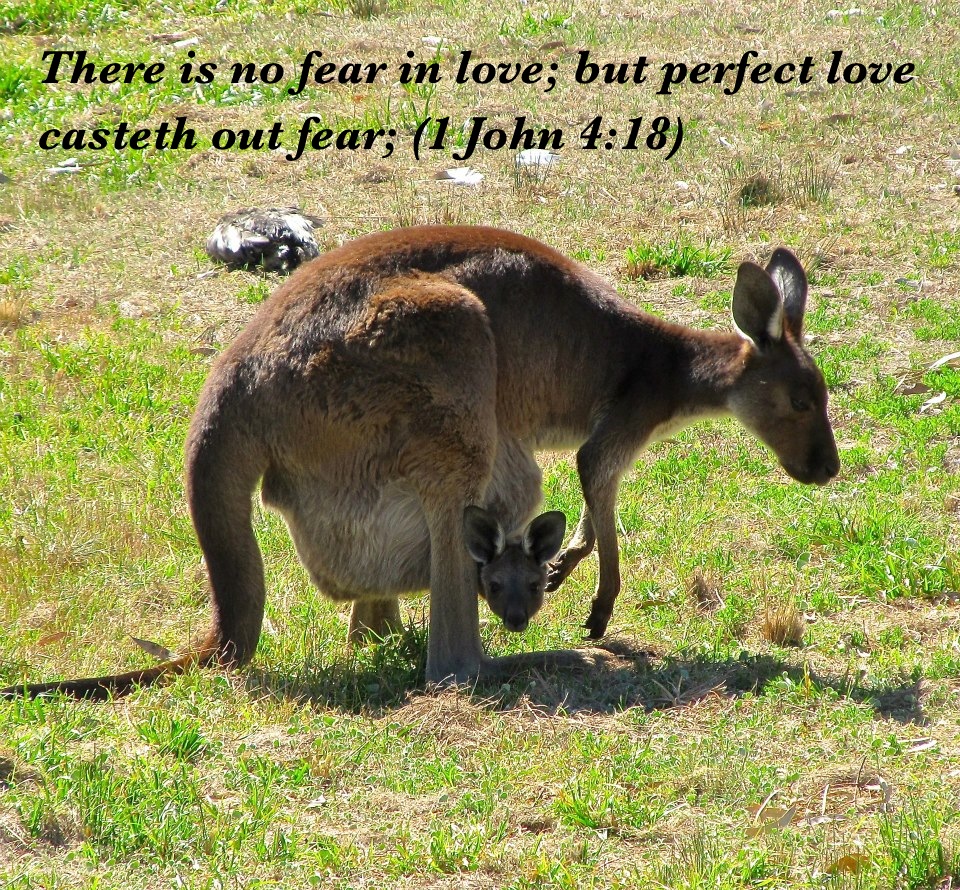
2. Enjoy the love of God.  God’s love was clearly demonstrated upon the cross of Christ.  The fear of death was removed when Jesus died upon the cross for our sins.  His death and resurrection conquered death.  If his love has removed our greatest fear, it can also take away all other fears.  A baby in the arms of its loving mother has no fear.  Likewise, we are in the arms of our loving God.  Why should we be ruled by fear? “There is no fear in love; but perfect love casteth out fear: because fear hath torment. He that feareth is not made perfect in love.” (1 John 4:18) 

3. Develop a fear of God.  The fear of God has been defined as: “Realizing that God is watching and weighing every one of my thoughts, words, actions and attitudes.”  The fear of God places God in His rightful place in our lives.  When our walk with God is right, we can live our life with courage instead of fear. “In the fear of the Lord is strong confidence:and his children shall have a place of refuge.” (Proverbs 14:26)

4. Walk by faith, not by sight.  When walk by faith in our loving, all-wise, and all-powerful God, we can face life with courage.  Fear cannot exist together with faith.  Fear flourishes when we see life from our perspective, instead of trusting our Great God.  When faith rules in our heart, we will have the courage to conquer any mountain that is before us.  “In whom we have boldness and access with confidence by the faith of him (Christ).” (Ephesians 3:12)

5. Study and memorize the Word of God.  Fear often is the result of ignorance.  When we study the Word of God, we see God working in the lives of people such as Moses, Joshua, Ruth, David and Daniel.  These people faced fearful situations; yet they faced them with courage because they knew their God. “But the people that do know their God shall be strong, and do exploits.” (Daniel 11:32)  When we study the Word, we get to know God better.  The more we know Him, the more we will be able to trust Him.  Our fear will turn into courage, not because of who we are, but because of who He is.

6. Become familiar with the “fear nots” in the Bible. God knows our heart.  He knows that we are prone to fear.  We are prone to walk by sight and not by faith.  He encourages us with many of His “fear nots” in the Bible.  Here are just a few.

  • Fear not in your life’s journey. “And the Lord appeared unto him the same night, and said, I am the God of Abraham thy father: fear not, for I am with thee,” Genesis 26:24
  • Fear not concerning your daily needs. “And Elijah said unto her, Fear not; go and do as thou hast said: but make me thereof a little cake first, and bring it unto me, and after make for thee and for thy son. For thus saith the Lord God of Israel, The barrel of meal shall not waste, neither shall the cruse of oil fail, until the day that the Lord sendeth rain upon the earth.” (1 Kings 17:13-14)
  • Fear not when in danger. “And he answered, Fear not: for they that be with us are more than they that be with them. And Elisha prayed, and said, Lord, I pray thee, open his eyes, that he may see. And the Lord opened the eyes of the young man; and he saw: and, behold, the mountain was full of horses and chariots of fire round about Elisha.”  (2 Kings 6:16)
  • Fear not in times of weakness. “Fear thou not; for I am with thee: be not dismayed; for I am thy God: I will strengthen thee;” (Isaiah 41:10)
  • Fear not in times of trials. “Fear not: for I have redeemed thee,I have called thee by thy name; thou art mine. When thou passest through the waters, I will be with thee;and through the rivers, they shall not overflow thee: when thou walkest through the fire, thou shalt not be burned;” (Isaiah 43:1-2)
  • Fear not in times of failure.  Here is what God said after the Israelites’ failure at Ai. “And the Lord said unto Joshua, Fear not, neither be thou dismayed:” (Joshua 8:1)  God did bring the victory after their previous failure.  
  • Fear not in times of sickness or nearing death. “Yea, though I walk through the valley of the shadow of death, I will fear no evil: for thou art with me; thy rod and thy staff they comfort me.” (Psalm 23:4)

“Dear Lord, thank you for assuring me that you are with me throughout this life and for all eternity.  Thank you that you give me the courage to move forward in my life in spite of the obstacles that are before me.  Please, give me the courage to live each day for you. ”

Author’s Note: This is the second article in the series called “Moving Beyond!”