When No One Cares

Canadian Badlands in Alberta, Canada (Photo by: Mark J. Booth)

“In my distress I called upon the LORD, and cried unto my God: he heard my voice out of his temple, and my cry came before him, even into his ears.” (Psalm 18:6)

“Does anyone care?” “If only I could find someone who will listen to me!”  Have you ever caught yourself thinking these thoughts? Yes, throughout life there are times when we feel alone.  We think no one cares. When these times occur, we must not forget that there is One who is always available. He loves us and is ready listen to us. He understands exactly how we feel. Are we ready to confide in our Lord?

When we confide in the Lord, we are saying to Him: “I trust you, and I know that you care about me. I pour out my heart to you, because I know that you understand. I also know that you will show me what I need to do.”

Why did Moses stay faithful in spite of his trials? He confided in the Lord. How did Joshua lead God’s people? He confided in the Lord. How did David receive forgiveness of his sin? He confided in the Lord. How did Paul rejoice in the midst of his persecution and difficulties? He confided in the Lord. How will we stay faithful through life’s tribulations?  We will need to confide in the Lord.

Why do we need to confide in the Lord?

1. We need to confide in the Lord because we have no wisdom or strength within ourselves. When King Jehoshaphat faced the near certain defeat of his armies, he confided in the Lord. He knew that God alone could handle this situation.  “O our God, wilt thou not judge them? for we have no might against this great company that cometh against us; neither know we what to do: but our eyes are upon thee.” (2 Chronicles 20:12) Jehoshaphat demonstrated a spirit of humility before God which enabled him to confide in the Lord. We choose not to confide in God because we don’t want to admit our need of Him.

2. We need to confide in the Lord because we have a deceitful heart that can often lead us astray.  “The heart is deceitful above all things, and desperately wicked: who can know it? ” (Jeremiah 17:9) People often say: “I can’t go wrong if I just follow my heart”. However, God makes it clear that we can not trust our own hearts. We often make decisions based upon our own selfishness, bias or lack of knowledge. We need to confide in the Lord because He will direct us in the right path.

3. We need to confide in the Lord because difficulties come into our lives. We can’t travel the road of life without continually confiding in our Lord. Jesus said: “These things I have spoken unto you, that in me ye might have peace. In the world ye shall have tribulation: but be of good cheer; I have overcome the world.” (John 16:33) When tribulations come, do we forget that the Lord is greater than any trial that may come into our lives.

4. We need to confide in the Lord because of problems with others. People say: “I could be a good Christian, if it wasn’t for other people.” Yes, other people may hurt us, misunderstand us, ignore us and dislike us, but there is a friend who is always there. His name is Jesus! David confided in God when he faced powerful enemies; so can we. “Attend unto me, and hear me: I mourn in my complaint, and make a noise;” (Psalm 55:2)

5. We need to confide in God because of His Greatness. He is worthy of our faith. God is our all-knowing, all-wise, all-powerful Lord. He is our High Priest to whom we can go at any time. He is a refuge in the midst of any storm. “Trust in him at all times; ye people, pour out your heart before him: God is a refuge for us.” (Psalm 62:8)

Elbow Lake in Alberta, Canada (Photo by: Mark J. Booth)

How do we confide in the Lord?

1. We share our requests openly with God. “Deliver me from mine enemies, O my God.” (Psalm 59:1)  The Psalmist understood that he could share any request with God, and that God would hear him. He is ready to listen to all of our requests.

2. We are to show gratefulness unto the Lord as we confide in Him. “Be careful for nothing; but in every thing by prayer and supplication with thanksgiving let your requests be made known unto God.” (Philippians 4:6, 7) God loves to hear and answer our prayer requests, but He also loves to hear us give praise and thanks unto Him.

3. We are to show desperation when we confide in God.  “Hear my prayer, O Lord, and let my cry come unto thee.” (Psalm 102:1) Our desperate cry shows our total dependence upon Him. Our cry also shows that He is our only hope. When desperate times come, God is waiting for us to cry out to Him.

4. We are to confide in God thoughtfully. Confiding in God means that we don’t repeat the same words without thought. God wants us to share our mind, will and emotions with Him.  When Jesus taught about prayer, He said: “But when ye pray, use not vain repetitions, as the heathen do:” (Matthew 6:7)  

We have a choice each day. Will we openly confide in our Lord or ignore the opportunity of pouring out our hearts to our dearest Friend? We should not only confide in the Lord when we have sorrow and trials, but also in our times of blessing and joy. God wants us to confide in Him in every decision that we make. Confiding in God increases our love for Him because we find complete satisfaction in Him.

“Dear Lord, I often live my life without sharing it with you. You have blessed me with your presence and yet I ignore you. Why are you so patient with me? Help me to have the desire to confide in you completely. Thank you that you do care and that I can trust you with my whole heart. With my love, from your child. Amen”

The Distress of My Soul (Psalm 31:7)

A Boca do Inferno (The Mouth of Hell) Cascais, Portugal.  Photo by: Mark J Booth
A Boca do Inferno (The Mouth of Hell) Cascais, Portugal. Photo by: Mark J Booth

I will be glad and rejoice in thy mercy: for thou hast considered my trouble; thou hast known my soul in adversities;” (Psalm 31:7)

Physical pain is a warning sign that something is wrong with our body.  The pain is screaming out for attention as though it is saying: “You have a problem, and you need to do something about it!”

Likewise, when we have pain in our soul (our innermost being), it is a warning sign that something is wrong.  The following problems can cause our soul to cry out in pain.

  • Sin in our life.
  • Lukewarmness towards spiritual matters
  • Resistance to God’s will
  • Selfishness
  • Emptiness within our soul
  • Confusion
  • An angry spirit
  • A great and heavy trial
  • Loneliness, etc.

Like our physical pain, we can tell others about the pain, but they don’t really understand.  The Lord God alone can feel the pain of our soul.  He alone can diagnose the pain of our soul.  Psalm 31:7 says: “Thou hast known my soul in adversities.”  God knows our pain. He knows when our soul is crying out in distress.  God wants us to pour out our heart to Him as we share the pain of our soul.

Not only does God know the pain of our soul, but He diagnoses the source of this pain for us.  How is this accomplished?  Hebrews 4:12 says: “For the word of God is quick, and powerful, and sharper than any twoedged sword, piercing even to the dividing asunder of soul and spirit, and of the joints and marrow, and is a discerner of the thoughts and intents of the heart.”

When we read and study the Word of God, God uses it to penetrate the deepest part of our soul.  An x-ray machine shows what is under our skin.  The Word of God shows what is in our soul.  It shows our sins, fears, doubts, sorrows, pain, hurts, anger, bitterness and many other trials and diseases of our soul.

The Word not only shows us the trials and diseases of our soul, but it also shows us the cure for our soul.  Are we experiencing the following ailments of the soul?  Have we tried God’s remedy for each ailment?

  • Sin? Confess our sin to God. (1 John 1:9)
  • A deep trial? Depend upon His grace (2 Corinthians 12:9)
  • An angry spirit? Yield all of our rights to God. (Matthew 5:5)
  • An overwhelming burden? Cast our care upon Him. (1 Peter 5:7)
  • Loneliness? Remember the presence of God. (Hebrews 13:5)
  • Bitterness? Forgive in our heart the offending party as Christ has forgiven us. (Ephesians 4:32)
  • Fear? Lean upon God’s perfect love because love casts out fear. (1 John 4:18)
  • Lukewarmness? Take time to enjoy deep communion with the Lord.(Revelation 3:20)
  • Confusion? Allow the Lord to direct our way. (Psalm 32:8)
  • Sorrow? Find joy in Jesus. (Psalm 30:5)

The Lord knows us inside and out.  He knows our heart.  When our soul is in distress, we know that he will hear our cry.  He gives us answers for the distress of our soul.  The pain in our soul is God showing us our need for Him in a certain area of our life.  He is ready to apply His cure to our aching soul.

“Dear Lord, my soul often experiences pain.  My words, actions, and attitudes cause much of the pain in my soul.  Other people can also create some pain in my soul.  Regardless of the cause, please show me the source of the pain in my soul and its cure.  I thank you that you are the Great Physician who heals all the diseases and troubles of my soul. Amen”

Jesus is Knocking. Will I Answer? (Enjoying the Presence of God)

Rogue River Trail-Rockford, MI (Photo by: Mark J Booth)

The Christian life encounters many pitfalls. One unsuspecting pitfall is that we lose the joy of being a Christian.  We become lukewarm in our relationship with Christ.   Prayer is routine.  Bible study is a chore.  Our worship has become cold and formal. What has happened to our lives?

There was a church in the New Testament that had these same problems.  Jesus spoke these words to the church at Laodicea: “I know thy works, that thou art neither cold nor hot: I would thou wert cold or hot.  So then because thou art lukewarm, and neither cold nor hot, I will spue thee out of my mouth.”(Revelation 3:15-16)  This church was religious, but they no longer enjoyed Christ’s presence. They had lost a vibrant relationship with their living Lord.

What was Christ’s answer to their problem? “Behold, I stand at the door, and knock: if any man hear my voice, and open the door, I will come in to him, and will sup with him, and he with me.” (Revelation 3:20) Christ was telling the church that they were leaving Him out of their lives.  He politely was knocking on the door of their hearts; so that they would once again enjoy having fellowship with Him.

Chateau-Abbadia (Southwestern France)Photo by: Mark J Booth
Chateau-Abbadia (Southwestern France)
Photo by: Mark J Booth

 A meal in Bible times was a time-consuming event where people enjoyed talking and listening to one another.  Jesus longs for this kind of communion with us.  Have we opened the door?  Christ has prepared a meal for us with His presence and blessings. Have we sat down and taken the time to enjoy His presence?  He is waiting. 

When we take the time to enjoy Christ’s presence, we will view life and our circumstances from a totally different perspective.  We will see life as God sees life.  We will see our problems as God sees our problems.  God has prepared a banquet for us. Here is what He offers to us as take time to enjoy His presence.

1. We have guidance in our life.  “O send out thy light and thy truth: let them lead me;” (Psalm 43:3a) The question is often asked: “How can I know the will of God?”  To understand the will of God means more than following a formula, but we follow the Lord.  As we commune with the Lord, we will discover what pleases Him and what doesn’t please Him.  God’s greatest priority for our lives is that we know Him.  His light and truth will guide us. 

2. We enjoy true worship of God. “let them bring me unto thy holy hill, and to thy tabernacles.” (Psalm 43:3b) The Psalmist in the midst of all that was happening in his life saw the importance of worshiping God. Worship is not to please ourselves, but to please our Lord.  He desires worship because He is worthy of our worship.  Our worship is bringing glory to God in all that we say and do.  When we worship God, we recognize His presence and majesty.  

3. We have joy in spite of the circumstances in our life.  “Then will I go unto the altar of God, unto God my exceeding joy:” (Psalm 43:4a) The Psalmist faced many trials in his life which caused him to become to discouraged and depressed.  He understood that in God’s presence there is great joy.  No matter what is happening in our lives, if we remember that God is with us, we can experience a joy that is not based upon circumstances, but based upon a relationship.

4. We have an attitude of praise.  “yea, upon the harp will I praise thee, O God my God.” (Psalm 43:4b)  We often give praise for the blessings that we receive from God, but what about giving praise to the giver of those blessings.  When we enjoy God’s presence, we will focus upon all that God is.  We will praise HIm for His attributes and titles.  Every day, we should take the time to praise God for all that He is and does.

5. We have a contented spirit.  They shall be abundantly satisfied with the fatness of thy house; and thou shalt make them drink of the river of thy pleasures.” (Psalm 36:8)  A lack of contentment is a warning sign that we are not enjoying God’s presence.  When we are walking with God, we will be totally content. When we are close to the Lord, everything else will fall in place. 

6. We receive comfort from God. I will fear no evil: for thou art with me; thy rod and thy staff they comfort me.” (Psalm 23:4) Comfort is not based on circumstances, but upon our relationship with our Living God.  His rod shows his protection against our enemies.  His staff shows His guidance and help in our lives.  When we have His protection and guidance, we are sure of His comfort and love even in the most trying times. 

Enjoying God’s presence begins with salvation, but it continues for all eternity.  We enjoy His presence as we listen to him, communicate with Him, meditate upon Him and pour out our heart unto Him.  Are enjoying His presence today?

“Dear Lord, my life often becomes filled with the routine.  I have lost the joy of being Christian. I haven’t taken the time or effort to enjoy your presence.  Thank you for knocking on the door of my heart.  Thank you for your desire to fellowship with me.  I now open up the door of my heart to you.  Please come in!  I know that the greatest joy in life comes from being in your presence.  Amen.”

Preparing My Heart for Thanksgiving (Psalm 95)

Near Cascais, Portugal-Photo by: Mark J Booth

The food has been bought.  The guests have been invited.  The television is ready for NFL football.  Preparations are being made for the Black Friday sales.  However, something is missing in our Thanksgiving preparations.  Have we prepared our hearts to give thanks unto our Lord God?

One person has defined gratefulness as: “Making known to God and others in what ways they have benefited my life.”  We prepare our hearts for Thanksgiving by taking the time to reflect upon God’s blessings and then give thanks unto Him for those blessings.  It is also an opportunity to thank others for the ways they have benefited our lives.

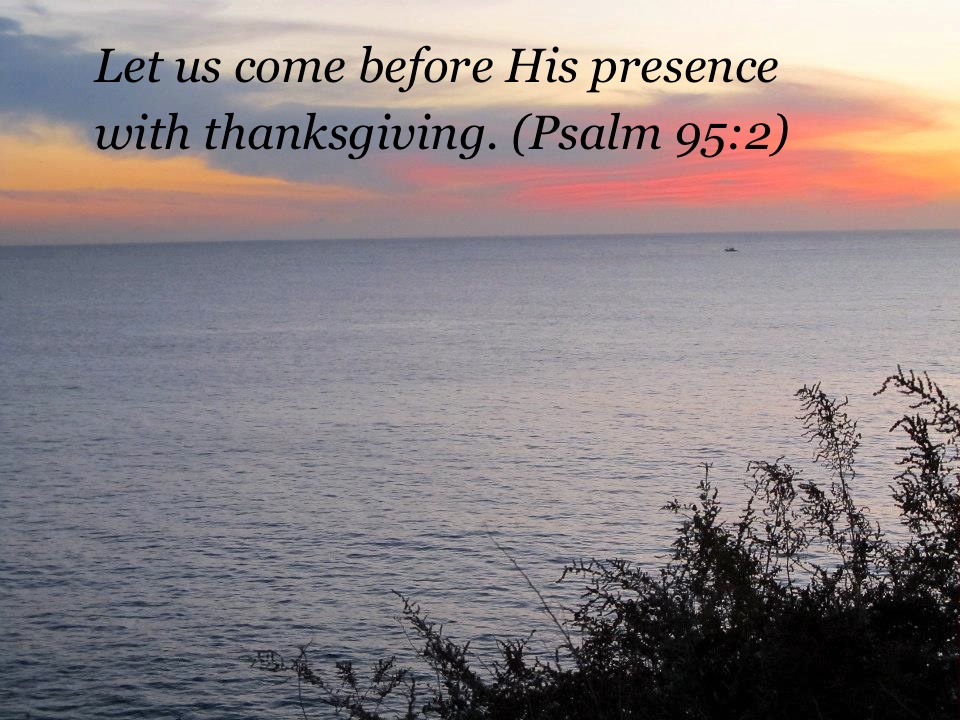
Psalm 95 helps us to prepare our hearts for Thanksgiving.  The focus of this Psalm is upon giving thanks to God.  “Let us come before His presence with Thanksgiving.” (Psalm 95:2)  God desires thankfulness in His people.  Thanksgiving is not a once year reflection upon God’s blessings, but it is a daily giving of thanks to God for his blessings and provision.

We prepare our hearts for Thanksgiving as we reflect upon the reasons we can give thanks to God.  Take a few moments to meditate upon the following verses in Psalm 95. These verses will encourage us to give thanks to God for all that He is and all that He has done.

1. We give thanks to God for His Greatness. “For the Lord is a great God.” (Psalm 95:3a)  God demonstrates His Greatness in all that He is and all that He does.  We find it easy to lose the wonder of God as we grow older.  Our faith becomes routine and ritualistic.  It is time that we meditate upon God’s greatness again, and thank Him for His attributes and all that He has done.

Cabo Da Roca-Portugal; Photo by: Mark J Booth

2. We give thanks God for His Sovereignty. “A great King above all gods.” (Psalm 95:3b) God is in control.  Yes, he sometimes refines us as by fire, but we can thank Him  that nothing passes into our lives apart from His loving will and plan. When we understand that He is in control: then we can commit the trial unto Him and see Him work.  We can thank Him not only for the good times, but also for the difficult times because He is working in our lives.

3. We give thanks to God for His Power.  “The strength of the hills is his also.” (Psalm 95:4) Our God brings spiritual, emotional and physical strength to our lives.  We can give thanks in a difficult situation, because God is there to give us his strength.  Paul understood this as he was in prison when he wrote: “I can do all things through Christ which strengtheneth me.” (Philippians 4:13) 

4. We give thanks to God because He is Personal.  “For He is our God.” (Psalm 95:7a)  God desires to have a personal relationship with us.  He wants to walk with us, talk with us and listen to us.  He loves His children with an everlasting love.  He will never forsake us, in spite of the situation.  We can give thanks that we have a vital relationship with our Living God.  

5. We give thanks to God because He is our Provider. “We are the people of his pasture.” (Psalm 95:7b) We can be confident that the Lord is our loving Shepherd who will provide for our needs, whether they be spiritual, emotional, social or physical.  The Lord Jesus Christ in the Sermon on the Mount reminds us that God will take care of the smallest matter in our lives.  When we focus on how the Lord meets our every need, we are eager to give thanks unto Him. 

6. We give thanks to God because He is our Guide.  “and the sheep of his hand.” (Psalm 95:7c)  Our Good Shepherd not only provides for us, but also leads us.  We can thank the Lord for the times that He gave us direction through His Word in some important decision.  As we look back upon our lives, God’s hand can be seen in His guidance and through the circumstances that He allowed in our lives.  Likewise, as we look forward to the future, we know that He will continue to guide us. 

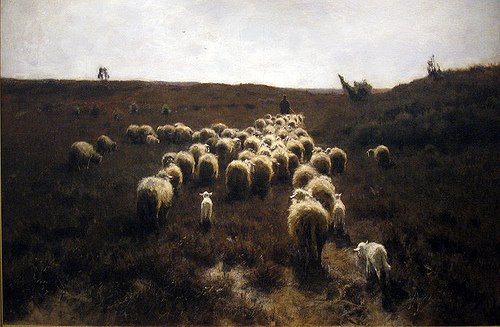
Return of the Flock” by Anton Mauve (19th Century) From the Philadelphia Museum of Art.

The first step to turning away from the Lord is to develop an ungrateful heart.  As we prepare our hearts for this Thanksgiving, let us look upon our Savior, the Lord Jesus Christ and all of His blessings.  Yes, there may food, family, and football for this Thanksgiving, but don’t forget the most important “f” for Thanksgiving, which is focusing upon the Lord and His Blessings.

“Dear Lord, I so often go through my days without thinking about all the blessings that I have as your child.  Thank you for all that you are to me.  Thank you for my great salvation and all the blessings that come with my salvation.  Thank you for your desire to have a personal relationship with me.  Help me not to forget you this Thanksgiving, but to focus upon you and all that you are. Amen.”

Enjoying Life or Enduring Life?

Evening Sky-Photo by: Mark J. Booth

The jail cell was damp and cold.  The quality of the food was dismal.  The Apostle Paul didn’t know if he would soon be executed.  How could he enjoy life in the midst of such dismal circumstances?

The Apostle Paul faced many trying times in his life, but he enjoyed life instead of enduring life.  Many of us no longer enjoy life. We complain about our circumstances. Self-pity controls our thought patterns.  Anxiety keeps us from enjoying God’s presence.  We have the idea that enjoying life is based upon our circumstances.  Paul’s circumstances were dismal in the Roman jail; yet he enjoyed his life.  Let’s look at why Paul enjoyed life even while he was suffering in a Roman jail.

1. Paul enjoyed his life because he had a purpose in life.  “Paul and Timotheus, the servants of Jesus Christ” (Philippians 1:1)

Many people don’t have a life purpose.  They have a vague idea that they should be doing something for themselves, for their family. and for their community; however, they have no real purpose.  Paul enjoyed his life because he had a purpose!  His purpose was to serve His Lord and Savior, Jesus Christ.  Paul enjoyed life because he knew that he belonged to the King of Kings. Paul wasn’t pulled in many different directions.  He received his directions from Christ.  He even understood that his time in prison was for the glory of His Master.  He wrote in another letter.  “Paul, a prisoner of Jesus Christ”.   We will enjoy life when we live each day in light of the fact that “I am a servant of Jesus Christ”.

2. Paul enjoyed his life because he experienced God’s grace and peace.  “Grace be unto you, and peace from God our Father and from the Lord Jesus Christ.” (Philippians 1:2)  

Paul wasn’t alone in his jail cell.  The Lord was with him.  Paul enjoyed his life because he was aware of God’s presence even in the most difficult of times.  God’s grace enabled Paul not only to survive in his trials, but also to thrive.  God’s peace gave him the knowledge that no matter what was happening in his life, God was in control.  We enjoy  life when we experience God’s grace and peace in even the greatest storm of our life.

3. Paul enjoyed his life because he invested his life in others“I thank my God upon every remembrance of you,” (Philippians 1:3)

Even in prison, Paul was ministering to others.  He wrote his letter to the believers at Philippi to encourage them.  He was willing to sacrifice his life for others.  He prayed for others.  He shared the Word of God with others.  He loved others.  Paul didn’t focus upon his problems, but he used his problems as a means of ministering to others.  There is great enjoyment in seeing God use us in the lives of others.  We minister to others through our testimony, our prayers, our words of encouragement, our expressions of love, and our sharing the truths of God’s Word.

4. Paul enjoyed his life, because he understood that his trials brought glory to God.  “But I would ye should understand, brethren, that the things which happened unto me have fallen out rather unto the furtherance of the gospel” (Philippians 1:12)

Paul’s time in jail was part of God’s overall plan.  God used Paul as a witness to the many people with whom he came into contact.  God also used Paul’s imprisonment to encourage other believers to go out and share the gospel.  God doesn’t allow things to enter into our lives for our harm, but for the good of ourselves and others.  We can enjoy life when we surrender to God’s purpose for our trial.

5. Paul enjoyed his life because he knew the future.  “For to me to live is Christ, and to die is gain.” (Philippians 1:21)

Paul showed joy even in facing death, because he knew that death was the door through which he would enter heaven.  We enjoy our life on earth when we live for Christ and keep our focus upon the eternal reward that waits for us in heaven.  When we live our lives for ourselves, our focus is upon this life alone.  Paul saw the big picture, do we?

“Dear Lord, I often feel as though I am enduring life.  I focus on my problems.  I focus on my needs.  I focus on the faults of others. Thank you for Paul’s example to me of a man who enjoyed his life in spite of the dire circumstances he faced.  Please help to enjoy my life in you regardless of the circumstances that I face. Thank you for your great patience and love towards me.  Amen”

Moving Beyond Anger to Meekness

Elbow Lake in Alberta, Canada-Photo by: Mark J. Booth

Anger is a common human emotion that negatively affects us and others.  Anger often leads to emotional, social, spiritual and physical problems in our lives.  We would like to control our anger, but we constantly fall back into the same trap.

Anger is a choice.  We may blame others for our anger, but we can move beyond our anger and live a life of meekness.  Meekness is: “Yielding all of my rights and expectations to God.”  Whenever we become angry, it shows that there is an area in our life that we have yet to yield to God.  Here are three ways that we can move beyond anger and live a life of meekness.

UNDERSTAND GOD’S VIEW OF OUR ANGER

1. God’s commands us to put aside anger. Psalm 37:8 says: “Cease from anger, and forsake wrath: fret not thyself in any wise to do evil.” Anger leads to wrath which leads to evil actions.  Anger destroys our Christian testimony. Our anger shows that we are defending our rights.  Our focus is not upon Christ, but upon ourselves.

2. God tells us that anger causes strife with others.  “A wrathful man stirreth up strife: but he that is slow to anger appeaseth strife.” (Proverbs 15:18) Anger creates strife in marriages, in parent-child relationships, in friendships, in work relationships as well as church relationships.  Our anger is divisive and very self-centered.  This is the very opposite of love.

3. God tells us to avoid friendship with angry people.  “Make no friendship with an angry man; and with a furious man thou shalt not go: Lest thou learn his ways, and get a snare to thy soul.”  An angry person not only causes strife, but he also causes others to take up his angry cause.  Anger is like a contagious disease that goes from one person to another.  For this reason, we are not to develop close friendships with this type of person.

TRANSFORM YOUR ANGER TO MEEKNESS

1. Meekness is one of the fruit of the Holy Spirit.  “But the fruit of the Spirit is love, joy, peace, longsuffering, gentleness, goodness, faith, meekness, temperance: against such there is no law.” (Galatians 5:22-23)  Anger is often the symptom of something seriously wrong in our lives.  When the Holy Spirit controls us, anger will no longer control us.   Meekness must come from the Holy Spirit because it isn’t natural for us to yield up our rights to God.  

2. Meekness learns to pass over a transgression against us.  When somebody wrongs us, we react in anger.  Yes, this is natural, but it is also very destructive to us and to others.   Jesus Christ said: “But I say unto you, Love your enemies, bless them that curse you, do good to them that hate you, and pray for them which despitefully use you, and persecute you;” (Matthew 5:44) This is only possible when we yield the right to our time, possessions, reputation, etc. unto God.   Is this not what Joseph did in response to the treachery of his brothers?

3. Meekness remembers who we are in the eyes of God.   Angry people have an inflated view of their own importance.  We develop meekness when we look at ourselves from God’s perspective.  Paul didn’t become angry throughout his trials with others because he remembered that he was the greatest of all sinners, whom God saved.

4. Meekness is seen in the life of Christ “Let this mind be in you, which was also in Christ Jesus” (Philippians 2:5)  When Christ came to earth, he gave up many of His rights “  He would experience hunger, pain, rejection and eventually death.  Why did he do this?  Christ demonstrated meekness because He saw that His rights were much less important than His mission to die on the cross for our sin.

Our anger says that my rights are more important than ministering to others.  Where would we be if Christ choose not yield his rights?  When Christ prayed to the Father, he laid down his rights.  “Father, if thou be willing, remove this cup from me: nevertheless not my will, but thine, be done.” (Luke 22:42) Can we say the same prayer?

FOCUS ON THE FRUITS OF MEEKNESS

1. We will enjoy God’s presence and teaching: “The meek will he guide in judgment: and the meek will he teach his way.” (Psalm 25:9)

2. We will walk in God’s peace and joy. “But the meek shall inherit the earth; and shall delight themselves in the abundance of peace.” (Psalm 37:11)

3. We will respond eagerly to God’s Word. “Wherefore lay apart all filthiness and superfluity of naughtiness, and receive with meekness the engrafted word, which is able to save your souls.” (James 1:21)

4. We will experience contentment. “The meek shall eat and be satisfied: they shall praise the Lord that seek him:” (Psalm 22:26)

“Lord, I find it easy to become angry with difficult circumstances and difficult people.  My anger keeps me from enjoying your presence, peace and power.  I need to learn to yield all of my rights to you.  Please help me to develop a meek spirit.  Thank you for sending Your Son, the Lord Jesus Christ, who yielded His rights for my salvation. Amen”


Three Truths to Start the Day

Sunrise-Photo by Jonathan Snow (By Permission)

How we start the day often dictates how the rest of our day will go.  When we start our day with anxiety, worry and fear, these emotions likely will continue to affect us during the rest of the day.  David faced many trials and obstacles; yet he could be encouraged by focusing upon His Lord in the morning.  Starting our day with a focus upon God enables us to walk with confidence, peace, and joy.  Our life will not be dictated by the events of the day, but by our faith and confidence in our living God.

David shares his faith and confidence in God by writing Psalm 31:3:  “For thou art my rock and my fortress; therefore for thy name’s sake lead me, and guide me.” (Psalm 31:3) David  didn’t start his day alone.  He was aware of God’s presence throughout the day.   Here are three truths about God that gave David peace, joy, strength and direction each day

1. “My Rock”-David understands that God brings stability to his life.  We don’t know the future.  There are many dangers and pitfalls that we face each day.  We are tempted to worry.  We feel unable to handle what is happening.  We feel like we are drowning; however, we can find stability in the midst of the instabilities of life.  God is our rock!  He is there to steady us. He is there to enable us to withstand any storm.  Like Peter, when you feel like you are drowning allow the Lord to take your hand and place you on the Solid Rock.

2. “My Fortress”-David understands that God brings security to his life.  Worry, fear and anxiety can control our days because of our insecurity.  We feel insecure about our relationships, our finances, our health, our future, and our reputation.  We can say “goodbye” to these insecurities when we flee to our Fortress, the Living God.  He can protect us from whatever “enemies” or destructive thoughts that may be attacking us.

3. “Lead me and guide me”-David understands that God brings direction to his life.  Each day presents its challenges.  Often, we face situations which confuse us.  We don’t know what to do.  God is our Shepherd.  He desires to lead us each day.  As we start each day, God will guide us as we seek Him in His Word and in prayer.  James shared with his readers: “If any of you lack wisdom, let him ask of God, that giveth to all men liberally and upbraideth not; and it shall be given him” (James 1:5)

“Lord, every day has new challenges, problems and unexpected trials.  Thank you for bringing stability, security and direction in my life.  Help me to begin each day focusing upon you as my Rock, my Fortress and my Guide.  Thank you for taking a special interest in me and what happens in my life throughout each day.  Amen”


Delighting in God in Stressful Times


God’s is waiting for us to come to Him. Photo by: Mark J Booth
The cares of this life often seem to build up until we feel overwhelmed. We become discouraged and feel stressed about life. Is there a place of comfort in the midst of the cares of this world? “In the multitude of my thoughts within me (cares of my heart) thy comforts delight my soul.” (Psalm 94:19). The Psalmist is saying: “No matter how stressful life is, God is here not only to bring comfort, but delight to my soul.”
There are many things that can be overwhelming and bring stress upon us:
  • the stress of our own failures, sins, and worries.
  • the stress from our concern for our loved ones.
  • the stress from people who oppose us.
  • the stress of work
  • the stress of growing older
  • the stress of keeping up with others
  • the stress of trials in our lives
  • the stress of loneliness
  • the stress of not knowing the future.
  • the stress of making decisions
Stressful situations fill our lives.  However, In the midst of the stresses of life, we can always flee to the “God of all Comfort”.  We can flee to Him:
  • by prayer and praise unto Him
  • by opening up the Word of God and listening to Him
  • by submitting our lives completely to Him
  • by confessing any known sin unto Him
He is always available to bring comfort, peace and hope to the soul who is coping with stress in their lives. Will we flee to Him in midst of the cares and stresses of life? Yes!
GOD WILL CHANGE OUR STRESS INTO DELIGHT IN HIM!


A Sunny Way to Start the Day(Psalm 19)

The early morning sky over Sydney, Australia: Photo by: Mark J. Booth

How we begin each day not only affects us, but also affects those around us.  How can we start the day in the right way?  In Psalm 19, God shares the example of one of His greatest creations, the sun.  The sun as it begins each day teaches us many lessons.

Once, Sharon and I had the joy of staying a couple of days in a bed and breakfast on the shores of Lake Huron.  One morning, we enjoyed a beautiful sunrise over the lake.  The sunrise brought the hope of a new day. It brought a renewed sense of the glory of God, and caused us to reflect anew upon the beauty of God’s creation.

A sunrise is one of God’s masterpieces.  Psalm 19:4-6 says: “In them hath he set a tabernacle for the sun,  Which is as a bridegroom coming out of his chamber, and rejoiceth as a strong man to run a race. His going forth is from the end of the heaven, and his circuit unto the ends of it:and there is nothing hid from the heat thereof.”

The sun begins the day with great joy and purpose.  It fulfills God’s plan every day. Also, it brings warmth to all of us who live upon the earth.  The sun glorifies God in all that it does.
“The heavens declare the glory of God, the firmament showeth his handiwork.” (Ps. 19:1)
What about us?  How can we live each day like the sun? How can we bring glory to God?

The heavens declaring God’s Glory from the sky: Photo by: Mark J. Booth

1. The sun rejoices as it begins each new day.  (“Rejoiceth as a strong man”)
How do we begin our day?  Do we begin the day with dread?  Do we begin the day with anger?  Do we begin the day with a complaining spirit?  Have we tried rejoicing as a way to start the day?  Our joy is not based upon circumstances, but upon our relationship with Jesus Christ.  A joyful start to the day will help us through the difficulties of the day, will bring glory to God, and will brighten the lives of other people.

2. The sun fulfills God’s purpose for each day.  (“His circuit unto the ends of it”)
The sun willingly performs the task that God has given unto it.  The sun doesn’t complain.  It doesn’t get praise.  It doesn’t doubt God’s plan.  How about God’s purpose for our lives?  Are we seeking to fulfill God’s plan for our lives?  God has a great plan for each of us.  It began with our salvation in Jesus Christ and will continue for all eternity.  Daily, we have a choice: “Will I fulfill God’s plan for my life, or will I fulfill my plan for my life?”

3. The sun ministers unto others. (“There is nothing hid from the heat thereof”)
The sun brings warmth, light and a sense of beauty to all of us.  Every day, we have an opportunity to bring warmth into the lives of those around us.  We can encourage others with our words and actions.  We can share God’s love with those that God brings into our lives.  Every day is an opportunity to brighten the lives of those around us.

Each new day is a gift from God.  We have the opportunity to rejoice in the Lord, to follow God’s plan and to brighten the lives of others.  Don’t let the clouds of fear, doubt, anger and self-pity keep you from shining brightly before God and others.  Whose life will you brighten today?