“For unto you is born this day in the city of David a Savior, who is Christ the Lord.” (Luke 2:11)
Dear Lord, Help me to see beyond the lights of Christmas and see you, the Light of the World. Help me to see beyond the gifts of Christmas and see you, the Gift from God the Father. Help me to see beyond the food of Christmas and see you, the Bread of Life. Help me to see beyond the activity of Christmas and see you, the Rest for my Soul. Amen
“He is not afraid of bad news; his heart is firm, trusting the Lord” (Psalm 112:7)
“We Wish You a Merry Christmas and a Happy New Year” is a Christmas Carol that people have sung since the 16th century in England. It is a song of joy as expressed in the words: “Good tidings we bring to you and your kin. We wish you a Merry Christmas and a Happy New Year.” However, not everybody receives good news during this time of year. We still face trials, sorrow, and pain. We may feel a great sense of loneliness. Yes, difficulties don’t stop during this time of year; however, there is good news from God.
In the Bible, many people triumphed over the hardships in their lives. Joseph overcame many hardships, including betrayal, slavery, and prison, to become Egypt’s prime minister. Ruth overcame the bad news of the death of her husband and living in poverty. She would soon marry Boaz and become the great-grandmother of King David.
God gives us his Word to encourage us as we face the evil tidings of life that may come our way. Every day, “bad news” can surprise us. We don’t ask for it, but it is a package delivered to the doorway of our lives. How can we triumph even amid heartbreaking news? Psalm 112:7 gives us an answer to this question.
Typically, our first response to bad news is to be afraid or fearful. Fear paralyzes us. It causes us to focus on the bad news instead of our Great God. God tells us that we do not have to fear the “hardships” that enter our lives. God knows that fear will keep us from seeing Him. Fear causes us to doubt the goodness and the power of God. For this reason, God gives us many verses that command us to “fear not.”
“But now thus saith the Lord that created thee, O Jacob,and he that formed thee, O Israel, FEAR NOT: for I have redeemed thee, I have called thee by thy name; thou art mine.” (Isaiah 43:1)
” FEAR THOU NOT; for I am with thee: be not dismayed; for I am thy God:I will strengthen thee; yea, I will help thee; yea, I will uphold thee with the right hand of my righteousness.” (Isaiah 41:10)
“Peace I leave with you, my peace I give unto you: not as the world giveth, give I unto you. Let not your heart be troubled, NEITHER LET IT BE AFRAID.” (John 14:27)
When fear departs amid the bad news, we can take the next step in facing our difficulties. We now can “fix our heart” upon the Lord. Our bad news is an opportunity to focus on God. We can focus on all of His attributes and promises. When we fix our hearts upon the Lord, it may not change our circumstances, but it will change how we face our situations. We will understand with the Apostle Paul that God’s grace is sufficient for the “bad news” that may come in our lives.
Once fear has departed and we have fixed our hearts upon the Lord, then we can have faith in Him. Faith is responding to all that we know about God. The more we know the Lord, the more we can trust Him. True faith knows that God will never leave or forsake us regardless of the “bad news” that may come our way. His love is unchanging. He loves us with an “everlasting love.”. Faith in our Lord will dispel any fear in our lives. It will enable us to bear whatever “bad news” that comes our way.
In summary, when we receive bad news, Psalm 112: 7 tells us three ways to respond to the “bad news.”
Do not allow fear to dominate our thoughts and actions.
Fix our hearts upon the Lord. Let our thoughts focus on the Lord.
Place our faith in the Lord. He will carry us as we face the “bad news.”
When “evil tidings” enter, God has a way of turning those evil tidings into an opportunity to see Him work in our lives. God will turn those “evil tidings” into “good tidings” that will draw us closer to Him and bring glory to His name.
A PRAYER WHEN BAD NEWS COMES: Dear Lord, the news I receive is not always positive. I see people who are suffering. I hear of those who have marital problems. I talk with those who have a loved one who is dying. I see people who have turned away from you. I also face difficulties from time to time in my life. I tend to meet the bad news with fear. Help me to turn my eyes off the “bad news” and fix my heart upon you. Please, increase my faith. Help me believe that you will take this “bad news” and make it a blessing. Thank you for your excellent plan for my life. Amen”
The valley is a place of the unknown. The future is unknown. The next step to take has yet to be discovered. The reason for being in the valley is unknown. The unknown causes us to develop fear and anxiety. Faith seems to disappear in our lives. We know that God is with us. We know the promises of God. We want to trust God. We need to trust God! Yet, we only see the dark road ahead of us. Why is faith so difficult when we need it the most?
I have tried to understand the answer to the above question. Why can’t I trust my loving God? Why can’t I trust my all-wise God? Perhaps the answer lies in the verse where Jesus tells us that we are to become as little children. “And (Jesus)said, Verily I say unto you, Except ye be converted, and become as little children, ye shall not enter into the kingdom of heaven.” (Matthew 18:3). A little child has great faith and trust, which is essential for us in our walk with God.
As a very young child, I trusted my parents in everything. I didn’t doubt anything they said. When they told me Santa Claus was coming, I believed them. When they took me to the doctor for a painful shot, I believed them when they said it was for my own good. They were my parents, so I trusted them.
As I grew older, I started to doubt what my parents said. I doubted their rules. I doubted what they thought was best for me. I doubted the way they raised me. I still loved them, but I thought I knew better. I lost my child-like trust in them. I weighed everything they did from my very narrow teenage viewpoint.
In my relationship with God, I find it easy to lose my child-like faith. I see my life from my viewpoint. I try to understand what God is doing instead of trusting what He is doing. Instead of submitting to his way of working in a particular situation, I try to interfere in what He is doing.
As a child, my parents would take me to various places in our car. I never doubted that I would arrive there safely. I never doubted that they had my best interest at heart. I never complained about the journey. I would sit in the back seat, look around at the scenery, and accept that my parents wanted this.
Why is it that when God is taking us through a valley experience, we don’t trust Him? Does He not know what is best for us? Does He not use the valley experience for our benefit and for the benefit of those to whom I minister? I need to have a child-like faith and believe that God knows what is best. Romans 8:28 is still true: “And we know that all things work together for good to them that love God, to them who are the called according to his purpose.”
The struggle of faith exists because we act too much like adults. We need to see before believing. We need to understand before we believe. We need to know the results before we believe. We need to feel like there is something that we can do to resolve the trial. The more we think like an adult, the more our faith diminishes.
How can we grow in faith in the midst of the valley? The valley challenges our faith. It batters our faith. We need faith desperately. The first step of faith is to return to a child-like view of God. We don’t have to understand what God is doing. We don’t have to understand what will happen in the future. We don’t have to know why all of this is happening. We can look unto our Heavenly Father and know that He controls everything. His path is always the best way to go, even if it takes us through a dark valley.
“Dear Father, I thank you for your patience with me. I approach you quite often with the attitude that I need to understand everything. I need you to explain everything to me. This has hindered my faith. Please help me to trust you with the heart of a little child. I know that you will resolve my struggle of faith when I surrender my perspective, my ideas, and my dreams unto you. Thank you for being my loving Father in whom I can place all of my trust. Amen”
I will fear no evil in the shadow of death because God is with me.
Have you recently entered into a valley in your life? You didn’t choose this valley, but God has chosen it for you. God knows exactly what He is doing in your life. The process of becoming more like Christ is not always pleasant. The valley is a place where we meet fire, pressure, and the unknown. The great thing about the valley is that we are not traveling this valley alone. David, who faced many valleys, wrote: “Yea, though I walk through the valley of the shadow of death, I will fear no evil: FOR THOU ART WITH ME; thy rod and thy staff they comfort me.” (Psalm 23:4)
As you reflect upon your time in the valley, there are several lessons to learn. As James wrote: “My brethren, COUNT IT ALL JOY when ye fall into divers temptations; Knowing this, that the trying of your faith worketh patience. But let patience have her perfect work, that ye may be perfect and entire, wanting nothing.” (James 1:2-4) There is joy amid the valley because the Lord is still working in our lives.
Regardless of age, we are learning new lessons and reviewing old ones. We are slow learners, but God is a very patient teacher. He knows what to bring into our lives to make Christlikeness a reality. Every valley is different, and there are new lessons to learn. Here are some lessons the Lord teaches us as we travel through this valley.
1. We learn that every valley is God’s special plan for our lives. Joseph didn’t choose to become a slave, but it was God’s special plan. He understood this very clearly when he told his brothers. “But as for you, ye thought evil against me; but God meant it unto good, to bring to pass, as it is this day, to save much people alive.” (Genesis 50:20). Joseph’s brothers did evil when they sold him into slavery, yet God took that evil deed and used it for good.
As we plod through this valley, we become thankful that God is still working in our lives. Paul understood this when he wrote: “Being confident of this very thing, that he which hath begun a good work in you will perform it until the day of Jesus Christ.” (Philippians 1:6). God is working His loving plan in our lives. He knows the right instrument to use to make us more like Jesus!
2. We learn that the valley is a place of thirsting for Christ. Communion with Christ can elude us in the good times; however, in the valley, it is essential. The valley shouts to us: “Go to Christ! Go to Christ!” Our need for Christ increases our desire for him. David wrote: “O God, thou art my God; early will I seek thee: my soul thirsteth for thee, my flesh longeth for thee in a dry and thirsty land, where no water is.” (Psalm 63:1). When we thirst for Christ, He is there to satisfy our thirst. When we run from the valley of His choosing, we lose those intimate times of fellowship with Him.
3. We learn that we can show our vulnerabilities before others. The valley has a way of causing us to be broken and humble before God and others. As a result, people see that we are vulnerable. Those who love us will see this vulnerability and try to bring comfort, healing, and encouragement into our lives. Naomi showed her vulnerability before Ruth. As a result, Ruth left everything and became her dearest friend.
Sometimes, we try to show our strength while traveling in the valley. If we had only expressed our needs, people would have been eager to help us. There is nothing wrong with letting people know that you are traveling through a valley. Jonathan had a great ministry of encouragement to David because David showed his vulnerability to Jonathan.
4. We learn that we need intercessory prayer. We don’t ask people to pray for us when things are going well. However, when we enter the valley, Paul’s words, “Brethren, pray for us,” easily fall from our lips. We may not understand how prayer works, but it does! There are many pitfalls in this valley, and yet the prayers of others will take us through each pitfall.
5. We learn that tears are perfectly appropriate. We may rarely cry, but when something or someone you love is hurting, tears flow naturally. Jesus said: “Blessed are they that mourn for they shall be comforted.” (Matthew 5:4) Comfortcomes from the Savior who shed His tears for the people of Jerusalem. He sorrows for the same things which cause us to have sorrow. The tears show that we love those things that Jesus loves. When we weep in our valley, we follow the example of Jesus Christ.
6. We learn that great comfort comes from the Word of God. The valley causes us to have a greater desire to read the Word, but it also gives us a greater ability to allow the truths of God’s Word to speak to our hearts. When things are going well, we may read the Bible, but the Bible becomes our life-preserver when we are in the valley. We hold unto its truths as though our lives depend upon it. “It is good for me that I have been afflicted; that I might learn thy statutes.” (Psalm 119:71)
As you continue traveling this valley, be thankful that you don’t have to travel alone. Jesus is walking with you and places people in your life who will walk with you in the valley. There will be more lessons to learn and relearn; however, you have the greatest teacher who ever walked the earth. His name is Jesus!
Ruins tell the story of decay, neglect, and destruction, which can picture our spiritual lives. Despair and hopelessness settle into our lives. The Prophet Jeremiah faced a time in his life when he was in the midst of the ruins of Jerusalem. Babylon had destroyed the city, and all hope was gone. How did Jeremiah handle this hopeless condition? How can we manage our hopeless situation?
Jeremiah, amid the ruins of Jerusalem, looks up to God. He says in Lamentations 3:21: “This I recall to my mind, therefore have I hope.” He knows in himself there are no answers: ” My strength and my hope is perished from the LORD:” (Lam 3:18). However, he knows that his hope is in God alone.
When we are facing hopelessness in our lives, our only hope is in the Lord alone. We must take our eyes off the ruins around us and in us and focus on the Lord. Jeremiah focuses on five attributes of God that bring great hope in his life despite the ruins around Him.
1. God is Merciful– “It is of the LORD’S mercies that we are not consumed, ” (Lamentations 3:22). We find hope in His forgiveness as we come to Him with a repentant heart.
2. God is Compassionate. “because his compassions fail not.” (Lam. 3:22b)
We find hope in his compassion. He does love us even amid our hopeless situation.
3. God is Faithful– “They are new every morning: great is thy faithfulness.” (Lamentations 3:23) We find hope in His faithfulness to keep all of His promises.
4. God is Omnipresent. (He is with me) ” The LORD is my portion, saith my soul; therefore will I hope in him.” Lamentations 3:24 We find hope in His presence. He walks with us amid the ruins and the rebuilding thereof.
5. God is Good. “The LORD is good unto them that wait for him, to the soul that seeketh him.” Lamentations 3:25 We find hope in the will of God, which is always for our good.
What will we do amid our hopelessness? Will we stay defeated and discouraged, or will we look up to our great and mighty God? Jeremiah discovered great hope in a hopeless situation, and so can we!!
Dear Heavenly Father, I am sorry that I couldn’t find a card for you for Father’s Day; there are none available here on earth. But, as you know, my earthly father is no longer here, so I thought it would be proper to write you a love letter of appreciation on this Father’s Day.
First of all, I would like to thank you for adopting me into your family. I know that it was at a great cost for you because your Son, the Lord Jesus Christ, died in my place. However, the amazing thing about this adoption is that nothing in me made me desirable to you. After all these years, I still can’t believe that I have the privilege to call you Abba, Father!
As my Heavenly Father, you have blessed my life in so many ways that it is impossible to express all that you have done in one letter. You have been so very patient with me throughout the years. Yes, I have failed you many times, and yet you continue to show me love and mercy through your forgiveness. Not only do you forgive me, but you also choose to forget every sin that I have done against you.
One of the greatest gifts you have given to me is your Word to teach me more about yourself. I have enjoyed learning all about you. Your Word has revealed your beauty demonstrated in your love, faithfulness, mercy, holiness, and grace. Your Word has revealed your great power, wisdom, and majesty. In the Word, you have taught me the way that I should go. Even when I depart from that way, you redirect me and place me back on the right path.
Dear Father, thank you for being with me at all times. You have always fulfilled your promise that you will never leave me nor forsake me. In the good times, you are with me. In the difficult times, you are with me. Your presence has given me the strength to continue despite times when I felt like quitting. I find no greater joy than taking a walk and being aware of the fact that you are walking with me.
There are many times when I need to cry out to you, and you always listen to me. You listen to my cries of desperation, but you also listen when I just want to thank you for the many blessings you have given to me. I am grateful that your ears are always open, and you recognize my voice.
Father, when no one else understands, you do! You know everything about me. You know my thoughts, my actions, my desires, and my attitudes. You know when I get up in the morning, and you know when I go to bed. As the Psalmist writes, “Such knowledge is too wonderful for me”!
For this Father’s Day, I don’t have anything to give to you, except I want to say once again, “I love you!” Yes, it is an imperfect love, but it is all that I have to give. So, again, thank you for being my Father, who loves me with everlasting love! I don’t know where I would be in this life without you. From Your Loving Child, Mark
How we start our day often dictates how we view the rest of the day. There are many days when I feel confused or even anxious. I feel like I am running on empty. What is the problem? Perhaps, I have forgotten the pleasure of starting my day with the most important person in my life, my Heavenly Father. The Psalmist, David, understood the importance of starting the day with a time of prayer with the Lord. “My voice shalt thou hear in the morning, O LORD; in the morning will I direct my prayer unto thee, and will look up.” (Psalm 5:3)
1. Morning prayer is a pleasure because it reminds us of our need of God. David lived his life with one trial after another. These trials were a constant reminder to him that he needed his Heavenly Father daily. When we start our day with prayer, we are saying to God: ” I need you throughout this day. I need your wisdom. I need your strength. I need your protection.” Morning prayer enables us to come to God with all humility
2. Morning prayer is a pleasure because it reminds us of the greatness of God. David recognizes the greatness of God when he writes: “Hearken unto the voice of my cry, my King, and my God.” (Psalm 5:2) David constantly writes about the attributes of God. Morning prayer enables us to start the day focusing upon God. We remember that our God is faithful, merciful, loving, holy, just, all-powerful, omnipresent, all-knowing, and wise. We also remember that He is our Father, who wants to take care of us throughout the coming day.
3. Morning prayer is a pleasure because it enables us to sort out our priorities. David says: “I direct my prayer unto thee, and will look up.” (Psalm 5:3) David was a man after God’s own heart because he had the proper priorities in his life. David started his day by seeking direction from God. His relationship with the Lord was the top priority of His life. When we start the day with the Lord, we are saying to him: “My relationship with you is the most important priority in my life.” Wrong priorities create confusion and very anxious days. When our relationship with the Lord is right, everything else will fall into its proper place.
4. Morning prayer is a pleasure because we can share our burdens with the Lord. David writes: “Lead me, O LORD, in thy righteousness because of mine enemies: make thy way straight before my face.” (Psalm 5:8) David faced many enemies. These enemies were a great burden upon David. We begin our day with many burdens. We have burdens in our family. We have burdens at work. We have financial burdens. We have health burdens. We have many other burdens. Our morning prayer time is a great opportunity to cast these burdens upon the strong arms of our Heavenly Father. “Cast thy burden upon the LORD and he shall sustain thee: he shall never suffer the righteous to be moved.” (Psalm 55:22).
Every day begins with a great opportunity to talk to our loving Heavenly Father. When you love someone deeply, it is a pleasure to start the day with them. Prayer is not a chore, but a pleasure. God is always available to listen to us, but are we ready to speak to Him?
“Dear Heavenly Father, there are many mornings that I forget to take the time to talk with you. I have forgotten the pleasure I derive from spending this time with you. You are patiently waiting for me every morning. You are always ready to listen. Help me to come to you each morning with an open heart, remembering that you also take pleasure in hearing from me. Amen”
Pandemic, virus, quarantine, shortages, sickness, and death, all of these words have created great fear in the lives of many people today. In the last month, our lives have changed dramatically with the coming of the Coronavirus. Our response has been fear, panic, and confusion. We feel helpless, and our leaders seem to be as confused as we are.
Will our faith overcome our fears? Or will our fears overcome our faith? Faith and fear can not abide in our lives at the same time. It is not by accident that the Word of God exhorts us continually with the words: “Fear not.” God knows that when fear controls our lives, we cannot trust, love, and obey Him as we ought.
God gives us four reasons that fear should not control our lives. When we remember these truths, it will help us to overcome the fear that is surrounding us today.
God is our Heavenly Father. “For you did not receive the spirit of bondage again to fear, but you received the spirit of adoption by whom we cry out, “Abba, Father.” (Romans 8:15) Fear brings bondage to our lives. In the fog of our fear, we don’t see our Father. We forget the importance of our position as God’s children. Our Father will not abandon us. He promises never to leave us nor forsake us. How can we fear when God, Our Father is near?
Our Heavenly Father loves His Children. “There is no fear in love; but perfect love casts out fear, because fear involves torment.” (1 John 4:18) Fear not only brings bondage but also torments us. This torment keeps us from enjoying God’s peace. Because of this torment, we become blinded to God’s love and the needs of others. God’s love is His remedy for our fears. Why should we allow our fears to torment us when we can lean on the breast of our loving Shepherd? Even in the valley of the shadow of death, He is with us. (See Psalm 23)
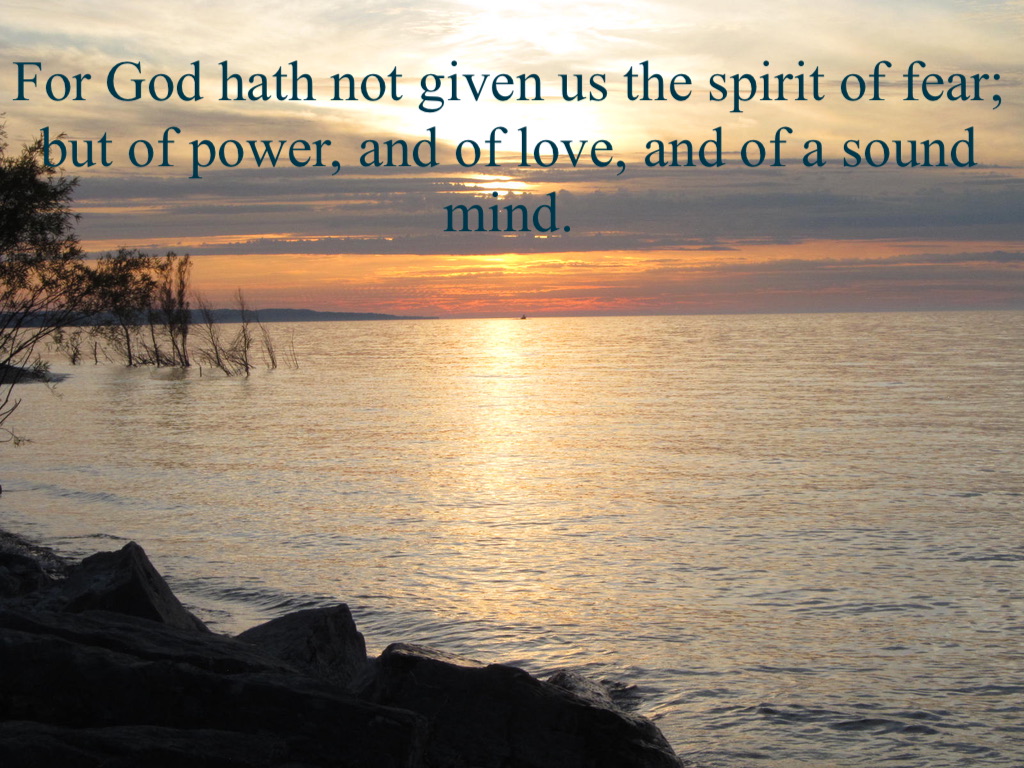
Our Heavenly Father’s purpose for our life excludes fear. “For God has not given us a spirit of fear, but of power and of love and of a sound mind.” (2 Timothy 1:7) Fear keeps us weak in faith. Fear creates a self-centered attitude that keeps us from loving God and others. Fear brings confusion into our lives. We are unable to see life from God’s perspective. A fearful Christian cannot fulfill God’s great purpose in their life. God’s plan involves depending upon His strength, sharing His love with others, and growing in His wisdom day by day.
God promises peace during fearful times. “Peace I leave with you, my peace I give to you; not as the world gives do I give to you. Let not your heart be troubled, neither let it be afraid.” (John 14:27) God’s promise of peace is real. His peace overcomes the fear that enters into our lives. Why do we embrace fear instead of embracing Christ’s peace?
God’s children will experience fearful times, but we don’t have to live in fear during those times. God’s Word makes it clear that our Heavenly Father has given us every reason to banish fear in our lives.
“Dear Heavenly Father, thank you for adopting us as your children. Thank you for your love and peace that you give to us. We live in fearful times. All around us, people are afraid. We need to look up to you instead of being dominated by our fears. Please help us to find courage, faith, and love during these fearful times. Amen”
Do you ever have the feeling that you are sinking deeper and deeper into the sea of sin, doubt, despair, and discouragement? Do you feel that you are in the midst of a storm, and there is no end in sight? The Apostle Peter understood the storms of life. He also experienced sinking deeper and deeper into the sea. Let’s join Peter and see how he handled his sinking deeper and deeper into the sea.
The disciples are in a boat in the midst of a storm. Jesus comes to them, walking upon the water. He tells them: “Be of good cheer, it is I; be not afraid. (Matthew 14:27) Jesus always desires to calm our fears. He comes to us out of love and compassion. Jesus arrives in the powerful storm that caused such panic in the disciples.
Peter was taking an opportunity to demonstrate faith asked if he also could walk on water. Jesus answers with one word: “Come.” Jesus wants us to join him in the adventure of faith. However, Peter’s faith disappears in light of waves coming upon him. He must cry out immediately, “Lord, save me.”
We can describe Peter’s cry in three ways:
1. It was a desperate cry. Peter knows that death is near. He has only one hope. Likewise, God is waiting for our call of desperation to Him. The Psalmist wrote: “This poor man CRIED and the Lord heard him and saved him out of all his troubles.” (Psalm 34:6)
2. It was a cry of faith. Peter calls out to the Lord in faith. He knows that the Lord alone can save him from sinking to the depths of the sea. Faith believes that the Lord hears our cries and that he will respond. “I sought the Lord, and he heard me.” (Psalm 34:4)
3. It was a cry based on his knowledge of Christ. Peter knows that the Lord can save him. He knows that the Lord is all-powerful, all-knowing, and all-loving. As we know the Lord intimately, we can cry out to him with greater confidence and freedom.
The Deliverance by the Loving Lord
Jesus hears Peter’s desperate cry, and he immediately responds: “And immediately Jesus stretched forth his hand, and caught him, and said unto him, O thou of little faith, wherefore didst thou doubt? And when they entered into the ship, the wind ceased.” (Matthew 14:31-32)
Yes, there will be times when we seem to be sinking deeper and deeper. All hope seems lost, but Our Lord is waiting for us to cry out to Him. His hand is always ready to pull us out of the storm.
“Dear Lord, there are many times that we seem to sink deeper and deeper into sin, despair, or discouragement. Our circumstances seem too difficult to bear. Please help us to learn to cry out to you in the times when We are sinking. Thank you for always being ready and willing to pull me up from whatever is causing me to sink. Amen.”
Fear comes in many forms, but it still has the same effect. Our fears can dominate us spiritually, emotionally, mentally, and even physically. As our fears increase, our faith in God decreases. We lose confidence in His promises, presence, and power. Fear keeps us from enjoying our daily walk with God and others.
Isaiah 41:10 gives us four great promises from God that enable us to conquer whatever fear is crippling our lives. “Fear thou not; for 1) I am with thee: be not dismayed; for I am thy God:2) I will strengthen thee; yea, 3) I will help thee; yea,4) I will uphold thee with the right hand of my righteousness.”
1. When I am lonely, God promises his presence. He will never leave me. How can I be afraid if I know that my loving Father is with me? He is with me to bring comfort, wisdom, strength, and grace. What we cannot handle alone, can is there with us.
2. When I am weak and feel like quitting, God will strengthen me. How can I be fearful when I remember that: “I can do all things through Christ which strengtheneth me.” (Philippians 4:13)? He will give me His strength to bear whatever comes into my life.
3. When I need spiritual, emotional, or physical help, God will help
How can I be afraid when God’s ability overcomes my inability? The Lord is right there with me. He is my help, no matter how fearful and difficult the future is.
4. When I stumble or fall, God will pick me up.
How can I be fearful when I know that God will pick me up when I fall or stumble? When Peter sinned, stumbled, and fell, Jesus picked him up and restored him. Our fear of failure often keeps us from moving forward in our spiritual lives. This promise assures us that when we stumble, God is right there to keep us going.
“Lord, help me to believe your promises. May I know that you are greater than any fear that is dominating my life. Thank you for your presence and power that conquer my fears. Amen”
Note: A special thanks to Karla Da Silva for the photo. The photo is of Waterfall Gully in South Australia.









 Bible Treasures for Today