God’s Waiting Room

782711_entrance_waiting_room-1

A doctor’s waiting room is not a pleasant place. Yes, there are comfortable chairs, a TV, and magazines. However, somebody is sitting in the office waiting for test results that will bring bad news.  Another person is waiting for a procedure that may or may not work. Another person is fidgeting because they are growing very impatient. Another person is anxious because they don’t know how they will pay their large medical bills. Another person looks completely bored as they continually look at the clock.

God’s waiting room is much like a doctor’s waiting room.  As we wait upon God, fear and anxiety can creep into our lives.  We don’t know what plans God has for us. For this reason, we worry about our future.  We are filled with pain, whether it be physical, emotional or spiritual. We wonder how long must I continue with this pain. We can become upset with God because He is keeping us in His waiting room longer than we would like.

God’s waiting room is one of the most difficult places for a believer. We want God to come and relieve us of our fear and anxiety quickly. We want God to change our lives now and make us a super Christian.  We get tired of the daily drudgery of our lives. The pain is constant and no relief is in sight. We feel like we are drowning and coming up for air one last time, and God’s hand is not there to pull us out.

David had some of these feelings throughout his life. He faced a lengthy time of persecution by King Saul. He struggled with his own guilt over his sin with Bathsheba.  He faced many other fearful, anxious and painful situations. How did David respond to being in God’s waiting room?  Psalm 40 helps us to join David in God’s waiting room.

“I waited patiently for the Lord; and he inclined unto me, and heard my cry. He brought me up also out of an horrible pit, out of the miry clay, and set my feet upon a rock, and established my goings.  And he hath put a new song in my mouth,even praise unto our God: many shall see it, and fear, and shall trust in the Lord. (Psalm 40:1-3)

David understood that there are times in life in which we must spend time in God’s waiting room.  In David’s case, it was a deep pit from which he couldn’t escape. God often makes us wait so that He can teach us some very important lessons about ourselves and His person. He makes us wait because it is part of His perfect plan for our lives. God’s waiting room is also a place to teach us faith and patience.

God in His timing will take us out of His waiting room and respond to our cries. God heard David’s cry and took him out of the pit and placed him upon the solid rock. God gave David the grace to continue serving Him and ministering to others. Likewise, our waiting room experience will enable us to have a greater capacity to serve the Lord and minister to others. We will have learned the art of dependence upon God in the waiting room.

The greatest blessing of being in God’s waiting room is to share our experience with others. David’s experience caused him to give praise unto God. When people saw David’s response to God’s working in his life, they learned the lesson of trust for their own lives. They understood that if God was with David in the waiting room, He will also be with me.

John Bunyan spent several years in the Bedford jail. His crime was that he preached the gospel of Jesus Christ. While in jail, Bunyan produced one of the greatest Christian books ever written, called “The Pilgrim’s Progress.”  Even today, many people have been blessed by John Bunyan’s waiting room experience.

Like Bunyan, God will give us a message to share with others while we are in His waiting room.  It may not be a book, but it will be a message about God’s faithfulness, love and deliverance.  Faith means that no matter what happens in my life, God is in control and He will ultimately use it for His glory and the benefit of others.

Today, if you feel as though you would like to escape God’s waiting room, don’t!  God is right there with you in the waiting room though you may not see Him working or understand what He is doing. The waiting room is a place of patience and faith. God’s timing is not always our timing, but it is the best timing.

“Dear Lord, I am in pit that is dark, deep and hopeless. I know that you tell me to wait, but I can’t stay in your waiting room much longer. Please give me the faith to see that this waiting room is your will for my life. I know that you hear my cry. Help me to believe that one day, you will set me on the solid rock. Thank you for being with me in this waiting room.  Thank you for the opportunity to give praise to your name and have a ministry to others. Even in this waiting room, I love you, Lord. Amen.”

Does Jesus Care? (1 Peter 5:7)

Guincho Beach in Portugal (Photo by Mark J. Booth)

Does Jesus care about what is happening in my life? Does He care about me personally? Many believers to whom Peter wrote had these same questions, because they were facing a period of great persecution for their faith. Their safety and well-being were in peril.  Peter understood persecution.  He had endured imprisonment, and misunderstanding. Jesus had clearly prophesied that one day Peter would die a violent for His sake.

Peter encouraged these beleaguered believers with a letter of a great hope in Jesus Christ. Peter reminded the believers that Jesus does know and care about what is happening in their lives.  The words: “Casting all your care upon him; for he careth for you.” (1 Peter 5:7) brought great comfort to the readers of Peter’s letter. Today, these same words bring comfort, encouragement and hope to each one of us.

What does it mean “to cast our care upon Jesus”. First of all the word “care” has the idea of a burden, worry, or an anxious thought. There are many causes of “care” in our lives.

  1. We have the “care” for things that are outside of ourselves.  These include natural catastrophes, rejection by others, and political conflict in our nation.  Our news media has a great knack of creating anxiety upon those who are watching or listening to what they have to say. We feel helpless in the midst of a world that seems to be spinning out of control.
  2. We have the “care” for our loved ones. Many a parent lives a life filled with worry because of their children. We worry about their safety, their future, and their health. Perhaps, we have loved ones who have turned aside from the Lord. This also creates anxiety.
  3. We have the “care” concerning our own lives. We have anxiety over our future, our finances, our failures, our sins, and our health.  As we grow older we become anxious about death and leaving our loved ones behind. If a person doesn’t have the assurance of their salvation, there is the worry about life after death.

Peter admits that we have “cares” but he also tells us what to do with these cares.  Our cares are to be “cast” upon Jesus. The word “cast” has the idea of throwing a weight and placing it upon an object that can bear the weight. Perhaps, the idea can be seen by throwing a bale of hay on a wagon. Why carry the bale of hay when the wagon can do the work?

Why do we carry our “cares” with us when Jesus can carry any load that we place upon Him. He wants us to “cast our all of our cares” upon Him because He cares about what happens in our life. He died for us when we were his enemies. Will He not take care of us, now that we belong to Him?

What keeps us from casting all of our cares upon Jesus?  Could it be pride?  Could it be stubbornness? Could it be a lack of faith? Jesus’ arms are open. He is saying: “Give me that “care” that has you feeling exhausted, overwhelmed and discouraged. I can handle anything you give me. Will you not trust me today?”

Render Unto God the Things that are God’s

Coins

This week, I  read the account of the Jewish leaders trying to entrap Jesus with their questions. One question has to do with paying taxes to Caesar. Jesus responds by asking for a coin. He than asks whose inscription is on the coin. His questioners answer Caesar’s. Jesus than surprises them all with His answer: “Render therefore unto Caesar the things which are Caesar’s; and unto God the things that are God’s.” (Matthew 22:21)

When I read this account, God convicted me about my life. I had always read these words with the understanding that we are to pay our taxes, but I never paid much attention to the second part of Jesus’ statement. God wants me to give all things unto Him because I belong to Him.

One question that comes to my mind: “Have I rendered unto God the things that belong to Him?” I realize that my answer is “no”.  I still am dealing with selfishness in several areas of my life. I often don’t recognize in my heart that belonging to God means I surrender every area of my life to Him. Surrender is the true essence of defining what it means to be a servant (bond-slave) of Jesus Christ.

“What are the things that I need to render unto God?” First of all, I need to render my life unto God. I often grab hold of my life and try to take it back from God. I can do this as I make decisions concerning my future, or the use of my time. I also have the tendency to allow my worries and anxieties to remain in my heart instead of giving them over to the Lord as He desires: “Casting all your care upon him; for he careth for you.” (1 Peter 5:7)

My reputation is an area in my life that I need to give unto God. It is difficult not to defend oneself when others may not agree with you or even worse when they oppose you or try to tear you down. Jesus Christ is the great example of one who surrendered His reputation to His Heavenly Father. God’s reputation is more important than my reputation.

A second area of my life that I need to render to God is my family. Marriage can easily bring out my selfish bent.  Instead of looking at my wife in the same way as Christ loved the church. I seek to please myself. A marriage surrendered to God demonstrates a selfless love that seeks the best for one’s spouse.

Also, I am grateful for the three children that God has given to us. Our two sons are serving the Lord in Portugal and our daughter and her husband are making plans to minister in England. When we give our children unto God, it is difficult when the Lord takes them to distant place to live. This is a great reminder that our children ultimately belong to God.  They are his gift to us to raise them to honor and glorify Him.

A third area of my life that I need to render to God is the church.  As a pastor of a church, I need to remind myself that Christ is the Head of the church. I am His servant, who needs to minister to those that God brings into our local church. Patience is a necessity in dealing with people.  The Bible reminds me: “that it is God who worketh in you both to will and do of His good pleasure.”  In myself I can’t make anyone grow spiritually.  I can’t  make anyone confess and forsake their sin. I need to constantly “turn my eyes upon Jesus.”

Almost every day, the Lord reminds me of some area of my life that I need to surrender to Him. He is my Lord and Master. He knows what is best for me. What keeps me from surrendering every area to my Loving Lord?

“Dear Lord, thank you for using your Word to show me my need to give every area of my life to you. I know that I attempt to grab from you some part of my life that belongs to you. Help me to see those areas of my life, my family and the church that I have yet delivered unto you.  Sometimes transferring the ownership of some area of my life is difficult, but I know that your peace, guidance and wisdom come when I render everything to you.  Thank you that I belong to you because your Son took my place on the cross, Amen.”

Why Me? (A Good Friday Meditation)

cross 2I have always had the habit of saying: “Why me?” when things go wrong.  For some reason, deep in my heart, I feel that nothing bad should come my way. Why should I get sick? Why should my plane be delayed? Why should I have an expensive car repair?

Why is it that I don’t ever say: “Why me?” when I think of all the undeserved blessings that I have received. On this Good Friday, I need to say: “Why me?” in regard to Christ’s death on the cross. I don’t deserve the love of God. I don’t deserve my Lord Jesus Christ dying on the cross to take away my sin. Why does He love me? Why did He die for me?

A couple of years ago, I was able to spend twenty-four hours in Jerusalem. It was a whirlwind trip, but one of the things that stood out was my visit to the possible place where Jesus died. There is a road that passes outside the old city and the rock formation above the road forms into the shape of a skull. This sight was a serious reminder of all that Christ suffered on the cross for a world of lost sinners, of which I am a part.

The Place of the Skull (Golgotha or Calvary).

Reflecting upon Christ’s death causes me to cry out: “Why me?” Christ suffered physically upon the cross, but more importantly He suffered spiritually. He took all of our sin upon Himself. For this reason, He cried out to God, the Father. “My God, My God, why hast thou forsaken me?” (Matthew 27:46) Christ felt the full force of the Father’s wrath on the cross because He became sin for us; so that we could have His righteousness upon ourselves. The perfect Son of God took my place! “Why me?”

There are many other people in history who could say:”Why me?” They knew their sin before God. They knew that they deserved God’s wrath; yet they could say: “Why me?”

  • Matthew, the crooked tax collector, could have said: “Why me?”
  • The repentant thief on the cross could have said: “Why me?”
  • Saul (Paul), the persecutor of the church, could have said: “Why me?”
  • The Ethiopian Eunuch could have said: “Why me?”
  • Countless Christian slaves in the Roman Empire could have said: “Why me?”
  • Those who have died for their faith could have said: “Why me?”
  • Countless millions of believers through the centuries could say: “Why me?”

“Dear Heavenly Father, I still don’t understand: “Why me?” You sent Jesus Christ to die on the cross for me. You gave me your Word which showed me all that Christ did on the cross for me. You sent your Holy Spirit to convict me of my sin. Father, you adopted me into your family. You have promised me a place in heaven. “Why me?!!” Though I may never know the answer to this question, I thank you for your great, undeserved love towards me. Help me never to forget the question: “Why me?”

WHY SHOULD HE LOVE ME SO? By Robert Harkness (1925)
Love sent my Savior to die in my stead;
Why should He love me so?
Meekly to Calvary’s cross He was led;
Why should He love me so?

Nails pierced His hands and His feet for my sin;
Why should He love me so?
He suffered sore my salvation to win;
Why should He love me so?

O how He agonized there in my place;
Why should He love me so?
Nothing withholding my sin to efface;
Why should He love me so?

CHORUS
Why should He love me so?
Why should my Savior to Calvary go?
Why should He love me so?


Am I a Spiritual Demolition Expert?

346-hudsonPano

On October 24, 1998, there occurred a very sad event in the history of Detroit.  On this day, the J.L. Hudson’s department store demolished. This landmark of downtown Detroit was, at one time, the second largest department store building in the nation.

The Hudson’s building was prepared for demolition by experts who knew what they were doing. In a matter of seconds, the building came tumbling down. The demolition experts had done their work.

In the spiritual realm, there are also demolition experts. These people have a talent to harm other believers and churches. They may do their work with a spiritual veneer, like the Pharisees did in the time of Jesus.  They may have a goal of “doing what is good”. They may be sincere or “mean well”.  Whether intentional or not, these demolition experts cause broken lives and churches.

We may not think that we are a demolition expert, but there is a demolition expert in all of us.  We have all caused harm to an individual or to a church fellowship. What are some of the qualifications of being a spiritual demolition expert?

One of the first qualifications of a demolition expert is pride. Pride causes us to feel superior to others. Because we are better than others, we have every right to condemn them and put them in their place.  Pride means that we are never open to correction, but we are always open to correct others. It also causes us to love self instead of loving others. We see this in the life of Saul when he became jealous of the acclaim that David received.  Saul’s pride caused his death, the downfall of his family, harm to the Kingdom of Israel, and great grief to the life of David.

Another qualification of a spiritual demolition expert is an uncontrolled tongue.  This person’s tongue can destroy a person or a church in various ways. They can speak words of slander about others. They also can create divisions among people through gossip. Angry words have also destroyed people and churches. These people are experts at welding their tongue to bring harm to many with whom they come into contact. James warned us of the danger of the tongue when he wrote: “And the tongue is a fire, a world of iniquity: so is the tongue among our members, that it defileth the whole body, and setteth on fire the course of nature; and it is set on fire of hell.” (James 3:6)

A third qualification of a spiritual demolition expert is the “Holy Spirit Syndrome”.  This individual feels like they have the answer for everybody’s situation. They know what others need to do and how they should do it. This doesn’t seem to bring harm to others. However, the person with this syndrome keeps others from developing their own personal walk with the Lord. Instead of looking to the Word of God or to the Holy Spirit for guidance and direction, many people look to the person who has become “their holy spirit”.

A fourth qualification of a spiritual demolition expert is a person who lives their lives to please themselves. This person hurts others because they don’t see the importance of their example. They may say: “I don’t care what other people think. It is my life.!” This person leads others down the path of sin, rebellion and destruction. They have forgotten what Paul said: “For ye are bought with a price: therefore glorify God in your body, and in your spirit, which are God’s.” (1 Corinthians 6:20)

God has not called us to be demolition experts. He has called us to be builders. “Wherefore comfort yourselves together, and edify one another, even as also ye do.” (Ephesians 4:11) A builder shows care, concern and sacrifice in producing a building.  We need to have this same concern and love for individuals as well as for the Body of Christ.

Let’s take a quick look at a few qualifications of spiritual builders.

  • They have a love for the Lord and others.
  • They have a humble spirit.
  • They use their tongue to build up others.
  • They encourage others to develop their own walk with the Lord.
  • They are sensitive to the needs of others.

“Dear Lord, I know that I have hurt others in my life, and that I need to forsake the qualifications of a spiritual demolition expert.  Help me, to have a ministry of building up others through my love, words and actions. Thank you for the people you have used in my life to build me up spiritually. Truly, you have blessed me with many spiritual builders. Amen”

Remembering the Love of God (The Parable of the Prodigal Son)

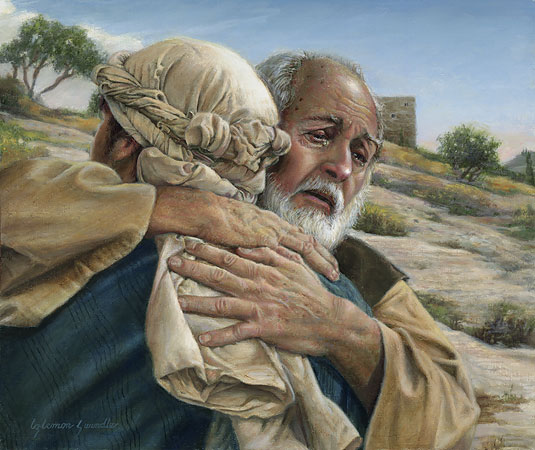
The Return of the Prodigal Son by: Liz Lemon Swindle (Used with Permission) If you are interested in her paintings her webpage is: www.lizlemonswindle.org
The Hope of Every Parent. Painting by Liz Lemon Swindle (Used with Permission) If you are interested in her paintings, her webpage is: http://www.lizlemonswindle.org

“When he was yet a great way off, his father saw him, and had compassion, and ran, and fell on his neck, and kissed him.” (Luke 15:20)

One of the most beautiful stories in the Word of God is the Parable of the Prodigal Son.  We enjoy reading this parable because it is a great reminder of God’s unfailing love. We may say in our hearts: “I would never do what this son did with his life.” However, on further investigation, we may see a bit of ourselves in the Prodigal Son.

In the beginning of this parable, we see the younger son asking his father for his inheritance. This seems like a very strange request because the father is still alive. However, it shows that the son is insensitive to the feelings of his father.  He is basically saying; “I don’t want to have anything to do with you. I wish you were dead.”

In our lives there are times, when we also act as though we don’t want to have anything to with God. We make plans without consulting God. We seek to please ourselves above all else. We are happy to have a place in heaven, but we are reluctant to allow the Lord to rule our hearts.

After the son receives his money, he leaves his father and family and goes his own way.  He spends his money on all sorts of sinful activities. He has no interest in the things of heaven. His focus is purely on sinful pleasure. He has no thoughts of his father.

Like the Prodigal Son, we find it easy to have an earthly focus in this life. The world becomes all important to us. The getting of money becomes more important than seeking the true riches of God’s Word. Seeking our comfort becomes more important than seeking the glory of God. Paul tells the believers at Colossae. “Set your affections on things above, not on things of the earth.” (Colossians 3:2)

After the Prodigal Son loses all of his money, he makes another drastic error. This is the time that he should immediately return to his father; however, he tries to get out of his mess by his own effort.  He soon takes the lowest of all jobs. He tends to the pigs. His humiliation is complete. He finds that the his downward spiral has hit the end.

When we find ourselves at the end of our rope. How do we respond? Do we try to resolve the situation with our own effort? Do we just quit on life and become filled with despair? Yes, we have sinned.  Yes, we have failed God, but must we go to the very bottom? Do we know that our loving Heavenly Father is waiting for us to return?

The parable takes a sudden turn when Jesus says: “And when he came to himself, he said, How many hired servants of my father’s have bread enough and to spare, and I perish with hunger!  I will arise and go to my father, and will say unto him, Father, I have sinned against heaven, and before thee, And am no more worthy to be called thy son: make me as one of thy hired servants.” (Luke 15:17-19)

The Prodigal Son has finally seen the reality of his situation. He sees that his only hope is to return to his father and confess his sin. His past flashes through his eyes. His regrets are real; yet he moves from despair to hope as travels the long distance back to his father.

Have we travelled a great distance from our Father? Have we turned our back on God’s love, mercy, peace and grace. Is our present situation filled with despair? Like the Prodigal Son, we can return to our Father. We know He loves us in spite of our sins and failures. He is waiting for us to repent of our sin.

As the son approaches his father, we see one of the most touching scenes in the Word of God. Jesus says: “And he arose, and came to his father. But when he was yet a great way off, his father saw him, and had compassion, and ran, and fell on his neck, and kissed him.” (Luke 15:20) The father pours out his love upon his son. The father’s love is greater than his son’s sin. He instantly forgives his son. The relationship is restored.

Our Heavenly Father also waits for us to return to Him. His arms are open. His heart is ready to receive us again. Yes, we don’t deserve this love, but God’s love, like all of His attributes, is infinite. Will we, like the Prodigal Son, “come to ourself” and return to our Father?

“Dear Father, like the Prodigal Son, I often neglect you and do things that don’t please. When I try to deal with my problems, I fail. I have the tendency to have an earthly focus and I don’t concentrate on my relationship with you. I do want to return to you. Please break my pride; so that I will flee back into you loving arms.”

Lord, I Believe, Help My Unbelief

Cabo da Roca, Portugal (Photo by Mark J. Booth)

Why do I find it difficult to believe in the person and promises of God?  Yes, I believe in my head, but my heart has a lack of complete trust in Him. Recently, God brought this to my attention while reading the account of the man whose child had an unclean spirit.

“And he said, Of a child.And ofttimes it hath cast him into the fire, and into the waters, to destroy him: but if thou canst do any thing, have compassion on us, and help us. Jesus said unto him, If thou canst believe, all things are possible to him that believeth. And straightway the father of the child cried out, and said with tears, Lord, I believe; help thou mine unbelief.” (Mark 9:22-24)

The father is in a desperate situation. He has no hope for his son; however, he pleads with Jesus that if He can help, please do something for his child. Jesus catches the doubt in this man’s heart as he said: “If thou canst do anything.” This man was speaking to God in the flesh; and yet doubted His ability to heal his child.

I have fallen into this same trap. I believe in who the Lord is, but deep down, I don’t think, He is able to do what seems impossible to me. I can’t see how he can save a loved one. I don’t see how He can change a person’s life. I don’t see how He can help me in a very difficult situation.

After the man speaks, Jesus encourages him to have faith: “If thou canst believe, all things are possible to him that believeth.” Jesus is saying that there is nothing too hard for Him. How often, I have looked at circumstances, at others or at myself, and felt overwhelmed. My heart says: “Can God handle this?” Doubt brings torment. Yes, I know in my head that God is All-Powerful, but doubt fills my heart. James says that “A doubleminded man is unstable in all his ways.” (James 1:8)

In this story, God speaks to my doubting heart. He is saying: “Don’t look at the difficulty in front of you, but look to me. I am God. I am All-Powerful. I know what I am doing. I do have compassion upon you. Your mind says you can trust me, let your heart trust me as well.”

The man responds in tears with words that resonate in my heart: “Lord, I believe; help thou mine unbelief.” These words could come right from mine own mouth.  At times, my head says: “I believe.” However, my heart says: “I can’t believe”. God wants me to be open about my doubts; so that He can change my heart into a heart that believes in all that He is and all that He says.

I am not the only person who is double minded when it comes to trusting the Lord. The disciples once came to Jesus and made this important request: “Increase our faith”. They saw their need in light of their doubts that were overwhelming their hearts. Likewise, I need to constantly pray with the disciples: “Lord, increase my faith.”

In the end, Christ honors the man’s wavering faith and heals his son. This man’s struggle with doubt brought him to a greater faith in Christ. His struggle also helps me to see that Christ understands my struggle with trusting Him with my heart. There is great peace, comfort, and strength when I trust Him with both my mind and my heart.

“Dear Lord, I believe in all that you are in my mind. I know in my mind that you are All-Powerful, All-Knowing, All-Wise, and All-Loving. I believe your Word from Genesis to Revelation. I believe in the miracles that you have done. However, when times get tough, when people don’t seem to respond to you, I begin to doubt in my heart. Please forgive me for my unbelief.  Bring me to a belief not only in my head, but also in my heart. Thank you for your patience in all that you are doing in my life. Amen.”

The Preciousness of Christ

Sunset over Lake Michigan (Photo by Mark J Booth)

“Unto you therefore which believe he is precious: but unto them which be disobedient, the stone which the builders disallowed, the same is made the head of the corner.”
(1 Peter 2:7)

The word “precious” means of great value or of high price. It also means to be dear or beloved in the eyes of the beholder. Peter makes it clear that believers in Jesus Christ should naturally have a great passion for Christ. He should be pursued with all of our hearts, because there is nothing more precious than he.

Is Jesus Christ precious in our eyes today? Perhaps, the world no longer sees Christ as being important, because believers have slowly lost sight of the preciousness of Jesus Christ. When Peter wrote the words: “Unto you therefore which believe he is precious.”
(1 Peter 2:7), he was writing to believers who were facing great persecution. These believers had a great passion for Christ, in spite of the great persecution they faced. They understood there was nothing of greater value in this life than having Jesus Christ as their Lord and Savior.

The Bible clearly shows us the preciousness of Christ in many ways.

1. Jesus Christ is precious because He is God in the flesh.  The Book of John  shows Christ’s deity in his works, his words, and his holiness. John wrote:
And the Word was made flesh, and dwelt among us, (and we beheld his glory, the glory as of the only begotten of the Father,) full of grace and truth.” (John 1:14) His Deity means that He has all the attributes of God the Father.  Our worship, our words, our attitudes and actions should reflect our love and submission to Christ, who is God in the flesh.

2. Jesus Christ is precious because He is the only way of salvation. Mankind is under God’s condemnation. We are all born in sin and in rebellion to the Holy, Righteous God. However, God the Son came to earth to satisfy the Father’s justice. He took our sins upon Himself when He died upon the cross. “Jesus saith unto him, I am the way, the truth, and the life: no man cometh unto the Father, but by me.” (John 14:6) Jesus is the object of our love because He took the punishment of our sin upon Himself.

3. Jesus Christ is precious because His love never ends. As Jesus was preparing to leave the earth, his disciples felt lonely. Despair had overcome them; yet Christ encourages them with words concerning His eternal love. Christ’s love for us isn’t based upon our performance, it is a love that never ends. “Who shall separate us from the love of Christ? shall tribulation, or distress, or persecution, or famine, or nakedness, or peril, or sword?” (Romans 8:35)

4. Jesus Christ is precious because He is the Good Shepherd. Life presents many challenges. We face important decisions, immovable obstacles, sicknesses, and loneliness. Do people really care? Jesus says: “I am the good shepherd, and know my sheep, and am known of mine.” (John 10:14) Jesus knows our hearts. He leads us in the way we should go. He carries us with tenderness when the path seems impossible. He takes away our fears. He walks with us even in the valley of the shadow of death. “He shall feed his flock like a shepherd: he shall gather the lambs with his arm, and carry them in his bosom, and shall gently lead those that are with young.” (Isaiah 40:11)

5. Jesus Christ is precious because of His great promises. Christ not only gives us promises to encourage and exhort us, but He also keeps all of His promises. “Whereby are given unto us exceeding great and precious promises: that by these ye might be partakers of the divine nature, having escaped the corruption that is in the world through lust.” (2 Peter 1:4) Reflect upon His promises and know that Christ is more precious than anything else in this life. Here are just a few samples of His promises.

  • “He shall call upon me, and I will answer him: I will be with him in trouble; I will deliver him, and honour him.” (Psalm 91:15)
  • “But seek ye first the kingdom of God, and his righteousness; and all these things shall be added unto you.” (Matthew 6:33)
  • “And we know that all things work together for good to them that love God, to them who are the called according to his purpose.” (Romans 8:28)
  • “And even to your old age I am he; and even to hoar hairs will I carry you: I have made, and I will bear; even I will carry, and will deliver you.” (Isaiah 46:4)
  • “Thou wilt keep him in perfect peace, whose mind is stayed on thee: because he trusteth in thee.” (Isaiah 26:3)

With our finite minds, it is impossible to completely comprehend the preciousness of Christ.  He is precious in all of His attributes, words and deeds. The more we know Him, the more precious He will become to us. When others see how precious Christ is to us, perhaps, they will start to take the claims of Christ seriously in their own lives.

“Dear Lord, I often take you for granted. I know that you are my Lord and Savior; yet, I don’t treasure my relationship with you. You are precious beyond all of my understanding. Help me to gaze upon you and see how precious you are to me. Amen.”


God’s Still, Small Voice in a Busy World

Bennett Park, Charlotte, MI (Photo by: Mark J. Booth)

Are you too busy? Are you a victim of our hurried lifestyle? Does God seem distant in the midst of all of our activities? A busy lifestyle can take its toll upon our spiritual, emotional and physical life.

Elijah is a prophet, who is busy serving God. He successfully challenges the prophets of Baal concerning the reality of the True God. His prayer for fire to come down upon the sacrifice is answered. He then prays for rain, and rain falls upon the drought-stricken nation of Israel. He then runs a great distance(17 miles) to Jezreel, Ahab’s winter residence. Elijah is a tired man. In addition to his tiredness, Queen Jezebel threatens his life. Elijah falls into the midst of great despair, and flees from Israel in great fear.

However, God takes care of His prophet, just as He takes care of us. God provides Elijah with food and rest. Often, we can became depressed because of too much activity and not enough rest. God provides the rest we need. Jesus said: “Come unto me, all ye that labour and are heavy laden, and I will give you rest.” (Matthew 11:28)

Elijah speaks to God and asks to die. He says that he is all alone. No one cares for him. Have you ever been there? God doesn’t speak to Elijah in the earthquake or fire. He speaks to him with a “still, small voice.” (1 Kings 19:12) God had to get Elijah to the point where he would listen.

God may have to take us to the depths of despair before we will listen to His still, small voice. Our busyness and self-centredness can keep us from hearing God’s voice.

When God speaks to Elijah with His still, small voice, He asks Elijah a question: “What doest thou here, Elijah?” This question is to encourage Elijah to take his eyes off of himself and his circumstances and look unto God. Unfortunately, Elijah continues with his complaint unto God. He still wants to die, because no one cares and he is alone.

God may ask us this same question: “What are you doing here?” Will we respond with a complaining spirit like Elijah? God’s purpose for this question is not to hear our complaints, but to get us to see the distance between God and ourselves. This question can be rephrased in the following ways:

  • What are you doing here living in sin?
  • What are you doing here living in despondency?
  • What are you doing here living outside of my will?
  • What are you doing here living by sight and not by faith?
  • What are you doing here living in fear?
  • What are you doing here living in selfishness?
  • What are you doing here living in bitterness?

God’s still, small voice is waiting for us to listen to Him. Life overwhelms us because we don’t take the time to hear His still, small voice. Let’s join Elijah and find rest for our souls and listen to the voice of our Lord. He will bring us deliverance from our sin, despair, and exhaustion in this life.

“Dear Lord, I get so busy. Noise is all around me. Amidst my busyness, I can’t seem to discern your voice. My life seems to spin out of control. I easily become discouraged. Help me to slow down, and find a quiet place to listen to your still, small voice. Bring me back to the place of usefulness and close fellowship with you. Amen”

Under the Shadow of His Wings

Free Photo provided by: www.sxc.hu
Free Photo provided by: http://www.sxc.hu

“How excellent is thy lovingkindness, O God! therefore the children of men put their trust under the shadow of thy wings.” (Psalm 36:7)

Often, as a pastor, I minister to people facing tough times. We have all experienced the death of a loved one, a serious sickness, issues within the family, financial setbacks, sin problems, and many other forms of pain and trials. Many times, these problems are unsolvable from a human perspective: however, there is a place of security, love, comfort and peace. The Bible calls this place, “under the shadow of His wings.”

David often faced great difficulties in his life. In Psalm 36, David writes about those who would bring harm to his life. He realizes that he is helpless in face of these schemes; so he chooses to find refuge under the wings of his Lord God.

The words, “under His wings”, refer to how a young bird finds protection from danger within the shadow of his mother’s wings.  Whatever danger that comes to the young bird must first pass through the ever vigilant mother. God is like that mother bird. He gives us a place of refuge under the shadow of His wings. Nothing will enter our lives until it first passes through His ever vigilant eyes and protection.

Here are some examples of times when we need to seek the security that God provides for His children.

  •  Fear. (Even groundless fear is still painful.)
  •  Danger. (Self, sin, Satan, and foes)
  •  Inability to defend or overcome without help
  •  Foresight that sees the storm coming and looks for safety.
  •  Prudence to hide before the storm.
  •  Times of fatigue, discouragement, or temptation.

David fled to the safety of the shadow of the Lord”s wings because He knew God personally; thus, he could trust Him. How well do we know God? In Psalm 36, David focuses upon five attributes of God that will help us to know Him better.

1. God is merciful. We don’t deserve His forgiveness, compassion and protection; and yet  He shows mercy unto us.  “Thy mercy, O Lord, is in the heavens;” (Psalm 36:5a)

2. God is faithful. People may come and go in our lives. People may not want to help us. Sometimes, others may get tired of helping us, but God demonstrates His faithfulness by His presence in our lives. He never leaves us, nor does He forsake us.
“Thy faithfulness reacheth unto the clouds.” (Psalm 36:5b)

3. God is righteous. We can trust God because He can do no wrong. When God makes a promise to us, He keeps His word. There is great comfort and strength when we flee to God’s Word to claim one of His promises. God will never fail us, nor wrong us. “Thy righteousness is like the great mountains.” (Psalm 36:6a)

4. God is just. Everywhere we look we see injustices occurring. We wonder, “where is the justice?”  When we flee to God, we will receive justice. God’s justice is perfect and impartial. “Thy judgments are a great deep:” (Psalm 36:6b)

5. God is love. God knows our weakness. He knows our need of Him, more than we do. His love says to us: “Come unto me, I will take care of you” “How excellent is thy lovingkindness, O God!” (Psalm 36:7)

When we find refuge under the shadow of His wings, we will find abundant peace, protection and guidance from our Heavenly Father. David testifies of God’s provision in the life of those who live under the shadow of His wings. “They shall be abundantly satisfied with the fatness of thy house; and thou shalt make them drink of the river of thy pleasures. For with thee is the fountain of life: in thy light shall we see light.” (Psalm 36:8-9)

“Dear Father, instead of finding refuge under your wings, I try to solve my problems on my own. I know that I should come to you. I know that you love me; yet, I seek to go my way. Help me to trust you when hard times come. Place me under your loving wings; so that I will know the warmth of your love, peace and protection. Amen”