Verses for the Valley

Cape Verde-Photo by: Mark J Booth

“It was the best of times, it was the worst of times, it was the age of wisdom, it was the age of foolishness, it was the epoch of belief, it was the epoch of incredulity, it was the season of Light, it was the season of Darkness, it was the spring of hope, it was the winter of despair, we had everything before us, we had nothing before us.” (A Tale of Two Cities: By Charles Dickens)

These words by Dickens can typify the valleys that we face in our lives. We can say with Dickens that the valley is the worst of times, but it is also the best of times. It is an anxious time. It is a comforting time. It is a time of sorrow. It is a time of joy. It is a time of discouragement. It is a time of encouragement. It is time of confusion. It is a time of direction. It is a time of silence from God. It is a time of closeness with God.

The valley is a place of contradictions. If our lives were without valleys, there would be very little spiritual growth. The valleys expose our need for God. The valleys expose the many things that need to be changed in our lives. The valleys teach us faith.  Though the valley may not pleasant, there are many verses that bring refreshment to us as we go through the valley. These verses have refreshed me as I have traveled through a valley.

1. GOD IS WITH ME  “Yea, though I walk through the valley of the shadow of death, I will fear no evil: for thou art with me; thy rod and thy staff they comfort me.” (Psalm 23:4)

In life we often face very dark valleys. How can we keep going as we travel through a valley filled with the unknown, with dangers, and with pain of heart?  The loneliness of the valley can become suffocating. There is no one who understands. There is no one to help us get through this rough patch. However, David understood that the Lord’s presence is with us even in the darkest valley of all, death. God never forsakes His children. Though we don’t see Him, we know that he is with us every step of the way as walk through the dark valley.

A Prayer  “Dear Lord, as I walk through a very dark valley. I don’t know how long I will be here in this valley, but I know that you are with me. You are teaching me. You are guiding me. You are comforting me. You are walking alongside me enabling me to enjoy your presence. Please enable me to honor you while I am walking through this valley. I love you, My Shepherd. Thank you for loving me. Amen”

2. GOD DOESN’T CHANGE.  For I am the Lord, I change not.” (Malachi 3:6)

Changes are reality in life. We change. People change. Our surroundings change; Our circumstances change. Our life can often feel like a boat adrift in the ocean; yet amidst the uncertainties of life, God doesn’t change! His Salvation, His Word, His love, His mercy, His comfort, His faithfulness, His holiness never change. These unchangeable truths give us hope as we trod through the valley. Yes, our world may be changing before our eyes, but God never changes.

3. GOD STRENGTHENS ME. “Have not I commanded thee? Be strong and of a good courage; be not afraid, neither be thou dismayed:for the Lord thy God is with thee whithersoever thou goest.” (Joshua 1:9)

We need strength and courage for what lies ahead. The path before us looks impossible to tread. We feel tired. We lack sleep. We are emotionally and spiritually exhausted. We want to quit.  We think we can’t go one step further. Where can we find the strength and courage to continue moving forward?  The same strength and courage that Joshua found from God before crossing the Jordan River and confronting Jericho is available to us.

A Prayer “Dear Lord, the path before me seems filled with difficulties and dangers. I feel tired. I don’t know how much further I can go. I have lost the will to continue in the struggle; however, I thank you for your presence. I thank you for giving me the strength and courage to go forward. Amen

4. GOD IS MY FOCUS.  “Looking unto Jesus the author and finisher of our faith.” (Hebrews 12:3) “

Have you ever found yourself so engrossed in a situation that all you can do is think about it? There is little sleep.There is little peace. There is little joy. What are we to do?  When we take our eyes off of the situation and place them upon Jesus, our perspective becomes totally different. When we focus upon the people who may have placed us in this valley, we start to become like them. When we place our eyes upon Jesus, we become more like Him.

A Prayer:
There is no wisdom in myself, but in you.
There is no compassion in myself, but in you.
There is no courage in myself, but in you.
There is no peace in myself, but in you.
There is no joy in myself, but in you.
Thank you, Lord, for always being with me, so that when I look to you, you are always there. Amen.

5. GOD IS MY BELOVED (Deuteronomy 33:27) “The eternal God is thy refuge, and underneath are the everlasting arms.”

The valley can be a place of opposition. You may feel unloved. You may feel alone. This is a time to remember God’s everlasting arms are waiting to embrace and draw you unto Himself. Like a child runs into the arms of a loving parent, We also can run into the arms of our loving Father. The valley produces great needs in our life.  As a result of our needs our love increases for the Lord.

A Prayer: “Dear Lord, I come to you whose arms are wide open. I need you to embrace me and hold me tight because:
I need your love.
I need your comfort.
I need your understanding.
I need your peace.
I need your wisdom.
I need your forgiveness.
Thank you for always being ready to embrace me when I come to you with a broken and contrite heart. Amen”

6. GOD IS MY DELIGHT. “Delight thyself also in the Lord; and he shall give thee the desires of thine heart.” (Psalm 37:4)

In spite of situations that are not delightful, we can still delight in the Lord. When we delight in the Lord, He will change our desires to match HIs desires. Delighting in the Lord will enable us to find peace and joy in the midst of the valley.

God’s Word has always brought comfort to His people. These verses have brought comfort to me in the midst of my valley. May you find comfort in them as you travel through your valley.

 

Marriage and the Supreme Court Decision (One Pastor’s Thoughts)

Marriage handsRecently, the Supreme Court weighed in on the subject of Gay Marriage.  Their decision was no surprise to me, nor should it be to any person who claims to be a Christian.  This decision reflects our culture and where we are as a nation.  Yes, we would like the laws of our country to follow our beliefs, but many of them do not.  Our nation is not a Christian nation, though in past times it followed Christian principles.

What should be our response to this decision by the Supreme Court?  First of all, we as Christians should forsake once and for all the idea that we can see people change through government action.  Should we expect people to live and believe like a Christian when they are not Christians?  The early church didn’t demand laws to show their beliefs. The early church understood the sinfulness of man.  The way the early church changed the culture was to proclaim the Gospel of Jesus Christ.  The Gospel changes the heart of a man.  Unlike Jesus Christ, no government can give a man a new heart.

Secondly, we need to remember that Jesus made it clear how we are to relate to the culture around us.  In the Sermon on the Mount, He said; “Ye are the salt of the earth: but if the salt have lost his savour, wherewith shall it be salted? it is thenceforth good for nothing, but to be cast out, and to be trodden under foot of men.  Ye are the light of the world.  A city that is set on an hill cannot be hid.  Neither do men light a candle, and put it under a bushel, but on a candlestick; and it giveth light unto all that are in the house.” (Matthew 5:13-15)

Our lives should shine forth as a testimony of our love for the Lord Jesus Christ.  A light shines brighter as the darkness increases.  There are two extremes in dealing with the sin that is so clearly accepted in our society.  One extreme is to compromise our beliefs so that we become more acceptable to our society.  The other extreme is to totally withdraw from our society.  A light needs to be in the darkness to shine, but it doesn’t allow the darkness to overcome its light.

Thirdly, we need to think about our own personal lives and our walk with God.  Yes, our culture has embraced sin and rebellion against God.  In the midst of our concern, have we forgotten our own walk with God?  When we get caught up with confronting our culture, it is easy to forget our own sin before God.  The early church at Ephesus did a great job of separating themselves from the evil of their culture.  Christ says of them: “Thou canst not bear them which are evil.” (Revelation 2:2) This church hated the evil that was a reality in the Roman Empire, but they had forgotten something in the process.

Jesus continued to speak to this church with some very convicting words: “Nevertheless, I have somewhat against, because thou hast left thy first love.” (Revelation 3:4) Have we left our first love?  Have we forgotten our daily walk with God?  If we are walking close to the Lord, we will have a greater impact upon the lives of those around us.

Fourthly, the Supreme Court ruling has no bearing upon our own marriages.  Why is it that professed Christians have a divorce rate that is equal to those who don’t claim to be Christians?  Yes, we have no control over the Supreme Court decisions concerning its view of marriage, but we can make our marriage one that honors God and His Word.

When God gave His instructions about marriage in Ephesians 5, He did so in the midst of a culture that allowed all sorts of immoral activities.  God’s focus is upon our own marriage.  We need to seek to love each other within our marriage and seek to fulfill Psalm 34:3 as a married couple. “O magnify the LORD with me, and let us exalt his name together.” 

Fifthly, Jesus Christ made it clear that we shouldn’t be surprised if we face persecution from the society around us.  Before His death, He said: “If the world hate you, ye know that it hated me before it hated you.”(John 15:18)  Our culture has no interest in the Biblical Jesus.  Yes, it wants a Jesus who loves everybody, but they have rejected the true Jesus of the Bible.  The Biblical Jesus loves, but He also is holy and He hates sin so much that He died on the cross for our sins.

Persecution can become very real as our society departs from any kind of Christian worldview.  The early Christians were persecuted because they were different from those around them.  God’s Word proclaims truths that our culture rejects and mocks.  Will not our culture eventually reject anybody who believes on God’s Word and chooses to live their lives according to His Word?

One last response to this decision is that we can say with the Apostle Paul: “For to me to live is Christ, and to die is gain.” (Philippians 1:21) We realize that death will be our entrance into the presence of Jesus Christ.  It will be a time of joy and worship.  We will no longer be exposed to the wickedness of this present world.

We can also say with the Apostle John at the end of Revelation: “He which testifieth these things saith, Surely I come quickly. Amen. Even so, come, Lord Jesus.”  One day there will be a government which will exalt righteousness, holiness and truth.  Jesus will one day return to reign as the King of Kings.

“Dear Lord, I see your Word being trampled underneath the feet of our culture.  I know that this is only natural because of the fact that we are born into sin.  Thank you for sending your Son, the Lord Jesus Christ to be the Savior of the World.  Please work through your people so that we can be an effective witness to those around us.  Thank for your love that is patiently waiting for people to turn to you.  Amen.”

Remembering Mom: June Solomon Booth (1923-2003)

Mom and I shortly after my birth.

June 9, 1923 was a very special day for me. This was the day that Annie Solomon gave birth to the last of the many children that she and Charles brought into the world. They would call this last child June Leona Solomon. June spent the first eighteen years of her life in the small coal-mining town of Patton, Pennsylvania. However, there weren’t many opportunities in Patton; so June followed her married sister, Frances, to Detroit.

Mom as a young child in Patton, PA.  She is the one in the middle.
Mom as a young child in Patton, PA. She is the one in the middle.

The big city was a contrast to the small laid back life back in Patton. She often spoke about working in the Guardian Building and living on Grand Blvd. In time, June would meet Arthur Booth and in 1950 they would become husband and wife. I would be the last child born to my parents in August of 1955.

Dad and Mom before I came on the scene.

In life, we can choose whom we marry, we can choose our friends, but we can’t choose our mothers. I am very grateful for the mother that God gave to me. She wasn’t a perfect person, but she was the perfect mother for me.

My mother was able to stay home with the three of us because my Dad sacrificed by working two jobs. Mom took her role as mother quite seriously. She took care of all of our basic needs. She always fixed our meals without complaints. She packed my sack lunch with loving care  She took care of our clothes. I still remember her ironing in the dining room as she would spray water on the clothes before she would pass the iron over them.  She also took us to all the places that we needed to go.

Mom did much more than take care of our basic needs. She loved us. She showed her love in how she sacrificed her time for us. She made it a point to give each of us special attention. Often, we would gather around the table with Mom and play Scrabble, Password or Jeopardy. The highlight of my day was bedtime, because Mom would tuck me into my bed and then read a story to me. She started with stories from Uncle Remus or Dr. Seuss.  When I was older she would read biographies and historical novels. She taught me to have a love for reading and history.

My Mom also enjoyed being involved in different community organizations.  She was involved in the Midland Elementary School PTA. She also was a den mother for the Cub Scouts for a couple of years. I still remember her working on the craft projects that her pack would do that day. Mom also taught Sunday School for a couple of years at the Highland Park Congregational Church. I was proud to be in her Junior High class.

Holidays and birthdays were always special to Mom. She would decorate our house special on each holiday. She enjoyed hiding the Easter baskets for Easter. She also was right there cleaning out the pumpkin for Halloween. Thanksgiving dinner was always a special treat. To this day, I can still taste her stuffing that would come right out of the turkey.

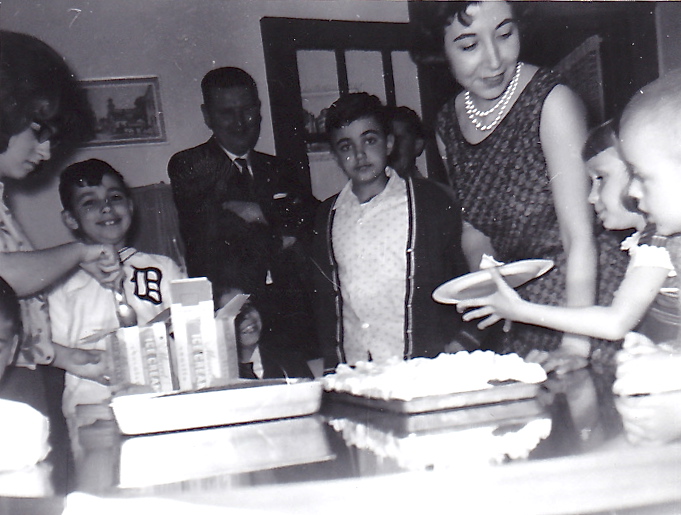
As for birthdays, she always prepared a big party. One year when Batman was popular on TV, she gave me a Batman party with Batman hats, plates, and cups.  She always invited our rather large extended family to the party as well as my friends.  She made each birthday like one gigantic celebration.

Mom enjoying hosting one of my birthday parties.

Mom also had a real gift of hospitality. She always seemed to have some family member at our house. She always welcomed my friends into the house. I never heard her complain about the noise that we made while we were playing.  She never said, “I wish you and your friends would go somewhere else.”

Mom was not always comfortable driving. She didn’t mind Woodward Avenue or Oakland Avenue, but the Davison and the Lodge expressways were off-limits in her mind. One day, Mom made a wrong turn and somehow she was driving on the Davison Expressway entering the Lodge. I was standing in my usual position in the back seat (Remember no seat belts or car seats in those days). I felt the panic of Mom as she asked me what to do?  As a seven-year old, I sure didn’t have the answer. Somehow, we made it off the Lodge Expressway. I never again remember Mom driving on one of the expressways. If she did, I am glad that I wasn’t with her.

The greatest contribution that Mom made in my life was that she taught me about God.  She didn’t read the Bible to me, but she did take me to church and gave me a prayer to repeat when I went to bed. She always told me not to put anything on top of the Bible because it was God’s Word. Because of Mom’s influence, when I was in high school, I started to read my Bible in search of God and how I could be right with Him. By the time, I was a student in college, I had placed my faith in Jesus Christ as my Savior.

After accepting Christ, I took Mom to Coltman Memorial Baptist Church which was a small Baptist church on Hamilton near Puritan. The people in the church really loved Mom and she loved them. She would soon accept the Lord as her Savior and she was also baptized.  Being younger than most of the people in the church, Mom would have a ministry of helps to many of the older women in the church. She would learn much from the Word of God as result of the good teaching she would receive.

Mom with the ladies of Coltman Memorial Baptist Church

When we left to minister in South Africa in 1983, Mom found it difficult to adjust. She would miss us, especially as her grandchildren would grow up in another land. Mom would send us cassette tapes of her thoughts and memories, as well as having Dad read a story to our children. This helped the children to relate to family back in the States. We would visit every couple of years. This would be a special time for our children to bond with their grandparents.

In 1996, we would return to the States. Mom was finding it difficult to get out, but she still found a certain joy when we would come and visit her. She loved our three children. With sadness, we would say goodbye to Mom in July of 2003. It has been ten years since I have been able to kiss Mom and say: “I love you.” I probably didn’t do this enough in this life.  However, I thank God that I could call June Booth, “Mom”.

Does Jesus Care? (1 Peter 5:7)

Guincho Beach in Portugal (Photo by Mark J. Booth)

Does Jesus care about what is happening in my life? Does He care about me personally? Many believers to whom Peter wrote had these same questions, because they were facing a period of great persecution for their faith. Their safety and well-being were in peril.  Peter understood persecution.  He had endured imprisonment, and misunderstanding. Jesus had clearly prophesied that one day Peter would die a violent for His sake.

Peter encouraged these beleaguered believers with a letter of a great hope in Jesus Christ. Peter reminded the believers that Jesus does know and care about what is happening in their lives.  The words: “Casting all your care upon him; for he careth for you.” (1 Peter 5:7) brought great comfort to the readers of Peter’s letter. Today, these same words bring comfort, encouragement and hope to each one of us.

What does it mean “to cast our care upon Jesus”. First of all the word “care” has the idea of a burden, worry, or an anxious thought. There are many causes of “care” in our lives.

  1. We have the “care” for things that are outside of ourselves.  These include natural catastrophes, rejection by others, and political conflict in our nation.  Our news media has a great knack of creating anxiety upon those who are watching or listening to what they have to say. We feel helpless in the midst of a world that seems to be spinning out of control.
  2. We have the “care” for our loved ones. Many a parent lives a life filled with worry because of their children. We worry about their safety, their future, and their health. Perhaps, we have loved ones who have turned aside from the Lord. This also creates anxiety.
  3. We have the “care” concerning our own lives. We have anxiety over our future, our finances, our failures, our sins, and our health.  As we grow older we become anxious about death and leaving our loved ones behind. If a person doesn’t have the assurance of their salvation, there is the worry about life after death.

Peter admits that we have “cares” but he also tells us what to do with these cares.  Our cares are to be “cast” upon Jesus. The word “cast” has the idea of throwing a weight and placing it upon an object that can bear the weight. Perhaps, the idea can be seen by throwing a bale of hay on a wagon. Why carry the bale of hay when the wagon can do the work?

Why do we carry our “cares” with us when Jesus can carry any load that we place upon Him. He wants us to “cast our all of our cares” upon Him because He cares about what happens in our life. He died for us when we were his enemies. Will He not take care of us, now that we belong to Him?

What keeps us from casting all of our cares upon Jesus?  Could it be pride?  Could it be stubbornness? Could it be a lack of faith? Jesus’ arms are open. He is saying: “Give me that “care” that has you feeling exhausted, overwhelmed and discouraged. I can handle anything you give me. Will you not trust me today?”

Render Unto God the Things that are God’s

Coins

This week, I  read the account of the Jewish leaders trying to entrap Jesus with their questions. One question has to do with paying taxes to Caesar. Jesus responds by asking for a coin. He than asks whose inscription is on the coin. His questioners answer Caesar’s. Jesus than surprises them all with His answer: “Render therefore unto Caesar the things which are Caesar’s; and unto God the things that are God’s.” (Matthew 22:21)

When I read this account, God convicted me about my life. I had always read these words with the understanding that we are to pay our taxes, but I never paid much attention to the second part of Jesus’ statement. God wants me to give all things unto Him because I belong to Him.

One question that comes to my mind: “Have I rendered unto God the things that belong to Him?” I realize that my answer is “no”.  I still am dealing with selfishness in several areas of my life. I often don’t recognize in my heart that belonging to God means I surrender every area of my life to Him. Surrender is the true essence of defining what it means to be a servant (bond-slave) of Jesus Christ.

“What are the things that I need to render unto God?” First of all, I need to render my life unto God. I often grab hold of my life and try to take it back from God. I can do this as I make decisions concerning my future, or the use of my time. I also have the tendency to allow my worries and anxieties to remain in my heart instead of giving them over to the Lord as He desires: “Casting all your care upon him; for he careth for you.” (1 Peter 5:7)

My reputation is an area in my life that I need to give unto God. It is difficult not to defend oneself when others may not agree with you or even worse when they oppose you or try to tear you down. Jesus Christ is the great example of one who surrendered His reputation to His Heavenly Father. God’s reputation is more important than my reputation.

A second area of my life that I need to render to God is my family. Marriage can easily bring out my selfish bent.  Instead of looking at my wife in the same way as Christ loved the church. I seek to please myself. A marriage surrendered to God demonstrates a selfless love that seeks the best for one’s spouse.

Also, I am grateful for the three children that God has given to us. Our two sons are serving the Lord in Portugal and our daughter and her husband are making plans to minister in England. When we give our children unto God, it is difficult when the Lord takes them to distant place to live. This is a great reminder that our children ultimately belong to God.  They are his gift to us to raise them to honor and glorify Him.

A third area of my life that I need to render to God is the church.  As a pastor of a church, I need to remind myself that Christ is the Head of the church. I am His servant, who needs to minister to those that God brings into our local church. Patience is a necessity in dealing with people.  The Bible reminds me: “that it is God who worketh in you both to will and do of His good pleasure.”  In myself I can’t make anyone grow spiritually.  I can’t  make anyone confess and forsake their sin. I need to constantly “turn my eyes upon Jesus.”

Almost every day, the Lord reminds me of some area of my life that I need to surrender to Him. He is my Lord and Master. He knows what is best for me. What keeps me from surrendering every area to my Loving Lord?

“Dear Lord, thank you for using your Word to show me my need to give every area of my life to you. I know that I attempt to grab from you some part of my life that belongs to you. Help me to see those areas of my life, my family and the church that I have yet delivered unto you.  Sometimes transferring the ownership of some area of my life is difficult, but I know that your peace, guidance and wisdom come when I render everything to you.  Thank you that I belong to you because your Son took my place on the cross, Amen.”

Why Me? (A Good Friday Meditation)

cross 2I have always had the habit of saying: “Why me?” when things go wrong.  For some reason, deep in my heart, I feel that nothing bad should come my way. Why should I get sick? Why should my plane be delayed? Why should I have an expensive car repair?

Why is it that I don’t ever say: “Why me?” when I think of all the undeserved blessings that I have received. On this Good Friday, I need to say: “Why me?” in regard to Christ’s death on the cross. I don’t deserve the love of God. I don’t deserve my Lord Jesus Christ dying on the cross to take away my sin. Why does He love me? Why did He die for me?

A couple of years ago, I was able to spend twenty-four hours in Jerusalem. It was a whirlwind trip, but one of the things that stood out was my visit to the possible place where Jesus died. There is a road that passes outside the old city and the rock formation above the road forms into the shape of a skull. This sight was a serious reminder of all that Christ suffered on the cross for a world of lost sinners, of which I am a part.

The Place of the Skull (Golgotha or Calvary).

Reflecting upon Christ’s death causes me to cry out: “Why me?” Christ suffered physically upon the cross, but more importantly He suffered spiritually. He took all of our sin upon Himself. For this reason, He cried out to God, the Father. “My God, My God, why hast thou forsaken me?” (Matthew 27:46) Christ felt the full force of the Father’s wrath on the cross because He became sin for us; so that we could have His righteousness upon ourselves. The perfect Son of God took my place! “Why me?”

There are many other people in history who could say:”Why me?” They knew their sin before God. They knew that they deserved God’s wrath; yet they could say: “Why me?”

  • Matthew, the crooked tax collector, could have said: “Why me?”
  • The repentant thief on the cross could have said: “Why me?”
  • Saul (Paul), the persecutor of the church, could have said: “Why me?”
  • The Ethiopian Eunuch could have said: “Why me?”
  • Countless Christian slaves in the Roman Empire could have said: “Why me?”
  • Those who have died for their faith could have said: “Why me?”
  • Countless millions of believers through the centuries could say: “Why me?”

“Dear Heavenly Father, I still don’t understand: “Why me?” You sent Jesus Christ to die on the cross for me. You gave me your Word which showed me all that Christ did on the cross for me. You sent your Holy Spirit to convict me of my sin. Father, you adopted me into your family. You have promised me a place in heaven. “Why me?!!” Though I may never know the answer to this question, I thank you for your great, undeserved love towards me. Help me never to forget the question: “Why me?”

WHY SHOULD HE LOVE ME SO? By Robert Harkness (1925)
Love sent my Savior to die in my stead;
Why should He love me so?
Meekly to Calvary’s cross He was led;
Why should He love me so?

Nails pierced His hands and His feet for my sin;
Why should He love me so?
He suffered sore my salvation to win;
Why should He love me so?

O how He agonized there in my place;
Why should He love me so?
Nothing withholding my sin to efface;
Why should He love me so?

CHORUS
Why should He love me so?
Why should my Savior to Calvary go?
Why should He love me so?


Moving Beyond Covetousness to Contentment

Woldumar Nature Center (Lansing, Michigan USA) Photo by: Mark J. Booth

Discontentment is found everywhere, including our own hearts.  People are discontent with their marriages, with their jobs, with their health, with their relationships, as well as their possessions.  The root of discontentment is covetousness.  Covetousness is defined as the inordinate desire to have something.  It is also defined as the desire to have something that belongs to another.

Covetousness is a sin that creates a warped view of God.  We feel that God has cheated us out of something.  Satan used this approach with Eve when he told her that God was wrong to withhold the fruit of the tree of the knowledge of good and evil.  Eve coveted the fruit and ate it.  The tenth commandment says: “Thou shalt not covet thy neighbour’s house, thou shalt not covet thy neighbour’s wife, nor his manservant, nor his maidservant, nor his ox, nor his ass, nor any thing that is thy neighbour’s.” (Exodus 20:17)

God’s gives this commandment for two reasons.  First of all, God hates covetousness because it places the coveted object above Him, which is a form of idolatry.  It also causes us to have the wrong view of His person and blessings. “For the wicked boasteth of his heart’s desire,and blesseth the covetous, whom the Lord abhorreth.” (Psalm 10:3)

Secondly, covetousness brings harm to us and to those around us.  The Bible teaches us that covetousness leads to:

  • injustice: “And they covet fields, and take them by violence;and houses, and take them away: so they oppress a man and his house, even a man and his heritage.” (Micah 5:2)
  • harm to ourselves: “But they that will be rich fall into temptation and a snare, and into many foolish and hurtful lusts, which drown men in destruction and perdition.
    (1 Timothy 6:9)
  • departure from the faith: “For the love of money is the root of all evil: which while some coveted after, they have erred from the faith, and pierced themselves through with many sorrows.” (1 Timothy 6:10)
  • many sorrows-See the above verse
  • family problems: “He that is greedy of gain troubleth his own house;”
    (Proverbs 15:27)

Covetousness is clearly a problem many of us face.  The solution to this problem is having a spirit of contentment.  The secret of a growing, joyful Christian life is being content in our relationship with God in spite of the circumstances.  One person defined contentment as: “Realizing that God has provided everything I need for my present happiness.”  How do we go from a spirit of covetousness to a spirit of contentment?

We move beyond covetousness to contentment when:

1. We know that our Heavenly Father will take care of us.  Covetousness says: “I want something beyond what God gives me.”  Contentment says: “My Heavenly Father loves me and He takes care of all of my needs.” “Therefore take no thought, saying, What shall we eat? or, What shall we drink? or, Wherewithal shall we be clothed? 32 (For after all these things do the Gentiles seek:) for your heavenly Father knoweth that ye have need of all these things.” (Matthew 6: 31-32)

2. We know that God is with us even in the most difficult situations we face.  Covetousness looks at others and thinks that they have a better situation than we have.  Contentment doesn’t look at others, but looks to God.  God is with us.  What more do we need?  “Let your conversation be without covetousness; and be content with such things as ye have: for he hath said, I will never leave thee, nor forsake thee.”
(Hebrews 13:5)

3. We focus on our spiritual lives above all else.  A covetous person focuses upon the physical realm.  He doesn’t make his spiritual life a priority.  Jesus reminded His hearers; “But seek ye first the kingdom of God, and his righteousness; and all these things shall be added unto you.” (Matthew 6:33)  A contented person understands that in this life we will have difficulties, but he knows that life is more than this material world.  His desires are focused upon his soul and his relationship with God.

4. We give God all of our burdens.  A covetous person attempts to find security through their own efforts.  They always feel that there is something missing in their life to have total security.  A contented person gives all of their cares and burdens to the Lord.  He is their security. “Casting all your care upon him; for he careth for you.” (1 Peter 5:7)

Our Heavenly Father has blessed us beyond what we will ever know or understand.
“Dear Father, thank you for your many blessings.  Help me to see you in every circumstance in my life.  Help me to trust you to meet all of my needs.  May your presence, love, and provision be the focus of my daily life.  Thank you for adopting me into your family.  Amen.”

Moving Beyond Doubt to Faith

Morning sky over Sydney, Australia-Photo by: Mark J Booth

Faith in God can often be elusive in our lives.  We know that we should have faith in God; yet everything around us is crying out saying: “Can you really trust God?”.  “Why is God taking so long.?” “Where is God in all of this?”  How can we move beyond these doubts and live in faith towards God?

How do we doubt God in our daily lives?

  1.  We doubt the protection of God.  We feel vulnerable when events bring hurt into our lives.  Like the Israelites, we feel that God has left us on our own.
  2. We doubt the promises of God.  God’s Word is full of promises, but we don’t accept them for our own lives.  We feel undeserving.  We may be ignorant of his promises.  We think these promises don’t apply to our circumstances.  Thus, we lose out on the blessings that these promises provide.
  3. We doubt the presence of God. God says that “He will never leave us nor forsake us.”  We look for God, but we can’t seem to find Him.  We may think that he doesn’t care.
  4. We doubt the power of God.  Paul says: “I can do all things through Christ which sterngtheneth me.” (Philippians 4:13)  However, we fail to experience this power when we are expecting God “to come through for us.”
  5. We doubt the provision of God.  God says that He will take care of us; yet we fret and worry about our money and possessions.
  6. We doubt the plan of God.  God is not working in our lives in the way we would like.  We decide to go our own way. Joseph could have doubted God’s plan because the path was dark and difficult to which God had called him.

What causes us to doubt God?

  1. We doubt God because of our own human nature.  One of the conflicts we have in our Christian life is that we choose to walk by sight and not by faith.  We allow our circumstances to cloud our view of God.  Sin blinds us to the reality of God’s Word and His Promises.
  2. We doubt God because of the influence of others.  When those around us doubt God and His Word, they can infect us with this same thinking.  The ten spies influenced one another to doubt God.  Caleb and Joshua had enough faith to withstand the pressure from the other spies.
  3. We doubt God because of the many obstacles that happen in our lives.  Job had some difficulties with his faith because his whole world had collapsed.  Likewise, we tend to doubt God in the tough times.
  4. We doubt God because of his “divine delays”.  God doesn’t work His plans in our time.  Because of this, we become impatient and we begin to doubt God.  We say: “Why hasn’t God done something!”

How do we move beyond doubt into faith? 

We know that we should walk by faith and not by sight.  We know that living by faith pleases God, but we still struggle with our doubts.  What can we do to cultivate our faith.

  1. We cultivate our faith through reading and studying the Word of God.  Romans 10:17 says:  “So then faith cometh by hearing, and hearing by the word of God.”  The reading of the Word enables us to learn more about God, His promises, and His working in our lives.  The more we know God; the more we will trust Him.  The heroes of the faith in Hebrews knew their God.  This resulted in their unwavering faith.  How well do we know our God?
  2. We cultivate our faith by learning to cry out to God.  Once Jesus met a man whose son was demon possessed.  This father understood his need to cry out to God:  “And straightway the father of the child cried out, and said with tears, Lord, I believe; help thou mine unbelief.” (Mark 9:24)  Crying out to God is saying: “I can’t do it.”  “I can’t continue without you.” God will respond when we cry out to Him.
  3. We cultivate faith by choosing faith when doubt is crying out to us.  When we choose faith, we are siding with God and His Word.  We put aside our viewpoints and opinions and accept the ways of God.  2 Corinthians 5:7 says: “(For we walk by faith, not by sight:)”  Paul made a choice to choose faith in spite of all the obstacles.  Our problems should be stepping stones to our faith and not stumbling blocks to our faith.

God is totally worthy of our faith.  He doesn’t need to prove Himself to us.  When we choose to move beyond doubt unto faith, we will live a life that is pleasing to God.  “But without faith it is impossible to please him: for he that cometh to God must believe that he is, and that he is a rewarder of them that diligently seek him.” (Hebrews 11:6)  Faith in God brings pleasure to God because it shows that we know Him, we love Him,  and we need Him.

Faith is a choice in the midst of obstacles.  Let’s move beyond our doubts and place our faith in Him.  Doubt will make cowards of us all.  Faith will enable us to face life with courage.  Doubt will keep us from moving forward in our Christian life.  Faith will keep us walking close to God.

“Father, I doubt you quite often.  I choose to walk by sight instead of by faith.  Like the man who cried out to you to help his unbelief, I cry out to you: “Increase my faith.”

Delighting in God in Stressful Times


God’s is waiting for us to come to Him. Photo by: Mark J Booth
The cares of this life often seem to build up until we feel overwhelmed. We become discouraged and feel stressed about life. Is there a place of comfort in the midst of the cares of this world? “In the multitude of my thoughts within me (cares of my heart) thy comforts delight my soul.” (Psalm 94:19). The Psalmist is saying: “No matter how stressful life is, God is here not only to bring comfort, but delight to my soul.”
There are many things that can be overwhelming and bring stress upon us:
  • the stress of our own failures, sins, and worries.
  • the stress from our concern for our loved ones.
  • the stress from people who oppose us.
  • the stress of work
  • the stress of growing older
  • the stress of keeping up with others
  • the stress of trials in our lives
  • the stress of loneliness
  • the stress of not knowing the future.
  • the stress of making decisions
Stressful situations fill our lives.  However, In the midst of the stresses of life, we can always flee to the “God of all Comfort”.  We can flee to Him:
  • by prayer and praise unto Him
  • by opening up the Word of God and listening to Him
  • by submitting our lives completely to Him
  • by confessing any known sin unto Him
He is always available to bring comfort, peace and hope to the soul who is coping with stress in their lives. Will we flee to Him in midst of the cares and stresses of life? Yes!
GOD WILL CHANGE OUR STRESS INTO DELIGHT IN HIM!


Where Can I Go?(Psalm 18:2)


Photo of the Alps by Mark J. Booth

I am drowning in the midst of a storm.  I feel alone.  I don’t know where to go?  What does the Word of God say: “The Lord is MY ROCK, and MY FORTRESS, and MY DELIVERER; MY GOD, MY STRENGTH, in whom I will trust; MY BUCKLER (shield), and the HORN OF MY SALVATION, and MY HIGH TOWER.” (Psalm 18:2)

Jesus reminded the disciples that in this life they would experience tribulation.  We have all experienced tribulation.  We try to resolve the situation.  We try to cope.  We try to ignore the storm; yet we feel like we are sinking deeper and deeper into the raging waters.  David experienced many storms in his life.  Where did he go for deliverance and relief?  He went to “his God”.  Likewise, we can go to our God regardless of how strong the storm.

1. We can go to Our God because He is our Rock.  When a person is sinking into the water, they are looking for something solid on which to find their footing.  We often stumble and fall because we don’t stand firmly upon our solid rock, the Lord God.  Do you feel like you are wavering in every direction, then go to the Rock.  

2. We can go to Our God because He is Our Fortress.  A fortress is a place of refuge from the enemies we may have in this life.  Many people talk about being hurt by others.  Yes, others may try to hurt us, but we have a fortress to whom we can run.  We don’t have to be hurt by others, we can go to the Lord God, Our Fortress.

3. We can go to Our God because He is Our Deliverer.  The disciples were fearful in the midst of a terrible storm.   They were without hope until they cried out to the Lord.  The Lord stopped the storm.  No matter how awful the storm, the Lord is ready and able to deliver us.  No matter how strong the temptation the Lord will deliver us.

4. We can go to Our God because He is Our God.  David knows that he has a personal relationship with the Lord God.  He can go to His God at any time.  When we know God, we can trust Him.  We know that He loves us with an everlasting love.  We know that He will never leave us nor forsake us.

5. We can go to Our God because He is Our Strength.  David couldn’t handle his enemies in his own strength, but he knew the All-Powerful God.  We can do nothing apart from God.  As Paul stated: “I can do all things through Christ which strengtheneth me.” (Philippians 4:13).  We may get tired and want to quit, but God’s strength enables us to carry on.

6. We Can Go to Our God because He is our Shield.  Satan throws his fiery darts of doubt, denial, guilt, temptation, discouragement, and rebellion against God.  In ourselves, we have no defense against these darts; however God is Our Shield.  He comes between us and the fiery darts of Satan.  There is no safer place than behind God, Our Shield.

7. We can Go to Our God because He is Our Savior.  Our salvation solves the greatest problem in life, which is how can a sinful person approach a Holy God.  Jesus took our place upon the cross and paid for our sin.  Through Him, we have eternal life.  If God has taken care of our greatest problem in this life, why can’t we trust Him with the storms that pass through our lives?

8. We can Go to Our God because He is Our High Tower.  We often see a bird flee into the sky as we approach it.  The bird knows that there is safety in the heights.  Likewise, our Lord places us in the heights to keep us away from the traps and snares of this life.  The storms have little effect upon us when we are safe and secure in the Lord.

As a result of all that God is, David says: “In whom I will trust.”  David knows the Greatness of God.  He trusts God because he knows Him.  Do we know our Great God.  Yes, the storm may be strong, but we do have One to whom we can go.  Will we?