God’s Waiting Room

782711_entrance_waiting_room-1

A doctor’s waiting room is not a pleasant place. Yes, there are comfortable chairs, a TV, and magazines. However, somebody is sitting in the office waiting for test results that will bring bad news.  Another person is waiting for a procedure that may or may not work. Another person is fidgeting because they are growing very impatient. Another person is anxious because they don’t know how they will pay their large medical bills. Another person looks completely bored as they continually look at the clock.

God’s waiting room is much like a doctor’s waiting room.  As we wait upon God, fear and anxiety can creep into our lives.  We don’t know what plans God has for us. For this reason, we worry about our future.  We are filled with pain, whether it be physical, emotional or spiritual. We wonder how long must I continue with this pain. We can become upset with God because He is keeping us in His waiting room longer than we would like.

God’s waiting room is one of the most difficult places for a believer. We want God to come and relieve us of our fear and anxiety quickly. We want God to change our lives now and make us a super Christian.  We get tired of the daily drudgery of our lives. The pain is constant and no relief is in sight. We feel like we are drowning and coming up for air one last time, and God’s hand is not there to pull us out.

David had some of these feelings throughout his life. He faced a lengthy time of persecution by King Saul. He struggled with his own guilt over his sin with Bathsheba.  He faced many other fearful, anxious and painful situations. How did David respond to being in God’s waiting room?  Psalm 40 helps us to join David in God’s waiting room.

“I waited patiently for the Lord; and he inclined unto me, and heard my cry. He brought me up also out of an horrible pit, out of the miry clay, and set my feet upon a rock, and established my goings.  And he hath put a new song in my mouth,even praise unto our God: many shall see it, and fear, and shall trust in the Lord. (Psalm 40:1-3)

David understood that there are times in life in which we must spend time in God’s waiting room.  In David’s case, it was a deep pit from which he couldn’t escape. God often makes us wait so that He can teach us some very important lessons about ourselves and His person. He makes us wait because it is part of His perfect plan for our lives. God’s waiting room is also a place to teach us faith and patience.

God in His timing will take us out of His waiting room and respond to our cries. God heard David’s cry and took him out of the pit and placed him upon the solid rock. God gave David the grace to continue serving Him and ministering to others. Likewise, our waiting room experience will enable us to have a greater capacity to serve the Lord and minister to others. We will have learned the art of dependence upon God in the waiting room.

The greatest blessing of being in God’s waiting room is to share our experience with others. David’s experience caused him to give praise unto God. When people saw David’s response to God’s working in his life, they learned the lesson of trust for their own lives. They understood that if God was with David in the waiting room, He will also be with me.

John Bunyan spent several years in the Bedford jail. His crime was that he preached the gospel of Jesus Christ. While in jail, Bunyan produced one of the greatest Christian books ever written, called “The Pilgrim’s Progress.”  Even today, many people have been blessed by John Bunyan’s waiting room experience.

Like Bunyan, God will give us a message to share with others while we are in His waiting room.  It may not be a book, but it will be a message about God’s faithfulness, love and deliverance.  Faith means that no matter what happens in my life, God is in control and He will ultimately use it for His glory and the benefit of others.

Today, if you feel as though you would like to escape God’s waiting room, don’t!  God is right there with you in the waiting room though you may not see Him working or understand what He is doing. The waiting room is a place of patience and faith. God’s timing is not always our timing, but it is the best timing.

“Dear Lord, I am in pit that is dark, deep and hopeless. I know that you tell me to wait, but I can’t stay in your waiting room much longer. Please give me the faith to see that this waiting room is your will for my life. I know that you hear my cry. Help me to believe that one day, you will set me on the solid rock. Thank you for being with me in this waiting room.  Thank you for the opportunity to give praise to your name and have a ministry to others. Even in this waiting room, I love you, Lord. Amen.”

Does Jesus Care? (1 Peter 5:7)

Guincho Beach in Portugal (Photo by Mark J. Booth)

Does Jesus care about what is happening in my life? Does He care about me personally? Many believers to whom Peter wrote had these same questions, because they were facing a period of great persecution for their faith. Their safety and well-being were in peril.  Peter understood persecution.  He had endured imprisonment, and misunderstanding. Jesus had clearly prophesied that one day Peter would die a violent for His sake.

Peter encouraged these beleaguered believers with a letter of a great hope in Jesus Christ. Peter reminded the believers that Jesus does know and care about what is happening in their lives.  The words: “Casting all your care upon him; for he careth for you.” (1 Peter 5:7) brought great comfort to the readers of Peter’s letter. Today, these same words bring comfort, encouragement and hope to each one of us.

What does it mean “to cast our care upon Jesus”. First of all the word “care” has the idea of a burden, worry, or an anxious thought. There are many causes of “care” in our lives.

  1. We have the “care” for things that are outside of ourselves.  These include natural catastrophes, rejection by others, and political conflict in our nation.  Our news media has a great knack of creating anxiety upon those who are watching or listening to what they have to say. We feel helpless in the midst of a world that seems to be spinning out of control.
  2. We have the “care” for our loved ones. Many a parent lives a life filled with worry because of their children. We worry about their safety, their future, and their health. Perhaps, we have loved ones who have turned aside from the Lord. This also creates anxiety.
  3. We have the “care” concerning our own lives. We have anxiety over our future, our finances, our failures, our sins, and our health.  As we grow older we become anxious about death and leaving our loved ones behind. If a person doesn’t have the assurance of their salvation, there is the worry about life after death.

Peter admits that we have “cares” but he also tells us what to do with these cares.  Our cares are to be “cast” upon Jesus. The word “cast” has the idea of throwing a weight and placing it upon an object that can bear the weight. Perhaps, the idea can be seen by throwing a bale of hay on a wagon. Why carry the bale of hay when the wagon can do the work?

Why do we carry our “cares” with us when Jesus can carry any load that we place upon Him. He wants us to “cast our all of our cares” upon Him because He cares about what happens in our life. He died for us when we were his enemies. Will He not take care of us, now that we belong to Him?

What keeps us from casting all of our cares upon Jesus?  Could it be pride?  Could it be stubbornness? Could it be a lack of faith? Jesus’ arms are open. He is saying: “Give me that “care” that has you feeling exhausted, overwhelmed and discouraged. I can handle anything you give me. Will you not trust me today?”

Render Unto God the Things that are God’s

Coins

This week, I  read the account of the Jewish leaders trying to entrap Jesus with their questions. One question has to do with paying taxes to Caesar. Jesus responds by asking for a coin. He than asks whose inscription is on the coin. His questioners answer Caesar’s. Jesus than surprises them all with His answer: “Render therefore unto Caesar the things which are Caesar’s; and unto God the things that are God’s.” (Matthew 22:21)

When I read this account, God convicted me about my life. I had always read these words with the understanding that we are to pay our taxes, but I never paid much attention to the second part of Jesus’ statement. God wants me to give all things unto Him because I belong to Him.

One question that comes to my mind: “Have I rendered unto God the things that belong to Him?” I realize that my answer is “no”.  I still am dealing with selfishness in several areas of my life. I often don’t recognize in my heart that belonging to God means I surrender every area of my life to Him. Surrender is the true essence of defining what it means to be a servant (bond-slave) of Jesus Christ.

“What are the things that I need to render unto God?” First of all, I need to render my life unto God. I often grab hold of my life and try to take it back from God. I can do this as I make decisions concerning my future, or the use of my time. I also have the tendency to allow my worries and anxieties to remain in my heart instead of giving them over to the Lord as He desires: “Casting all your care upon him; for he careth for you.” (1 Peter 5:7)

My reputation is an area in my life that I need to give unto God. It is difficult not to defend oneself when others may not agree with you or even worse when they oppose you or try to tear you down. Jesus Christ is the great example of one who surrendered His reputation to His Heavenly Father. God’s reputation is more important than my reputation.

A second area of my life that I need to render to God is my family. Marriage can easily bring out my selfish bent.  Instead of looking at my wife in the same way as Christ loved the church. I seek to please myself. A marriage surrendered to God demonstrates a selfless love that seeks the best for one’s spouse.

Also, I am grateful for the three children that God has given to us. Our two sons are serving the Lord in Portugal and our daughter and her husband are making plans to minister in England. When we give our children unto God, it is difficult when the Lord takes them to distant place to live. This is a great reminder that our children ultimately belong to God.  They are his gift to us to raise them to honor and glorify Him.

A third area of my life that I need to render to God is the church.  As a pastor of a church, I need to remind myself that Christ is the Head of the church. I am His servant, who needs to minister to those that God brings into our local church. Patience is a necessity in dealing with people.  The Bible reminds me: “that it is God who worketh in you both to will and do of His good pleasure.”  In myself I can’t make anyone grow spiritually.  I can’t  make anyone confess and forsake their sin. I need to constantly “turn my eyes upon Jesus.”

Almost every day, the Lord reminds me of some area of my life that I need to surrender to Him. He is my Lord and Master. He knows what is best for me. What keeps me from surrendering every area to my Loving Lord?

“Dear Lord, thank you for using your Word to show me my need to give every area of my life to you. I know that I attempt to grab from you some part of my life that belongs to you. Help me to see those areas of my life, my family and the church that I have yet delivered unto you.  Sometimes transferring the ownership of some area of my life is difficult, but I know that your peace, guidance and wisdom come when I render everything to you.  Thank you that I belong to you because your Son took my place on the cross, Amen.”

Going Home-Maria Teresa Standridge’s Testimony

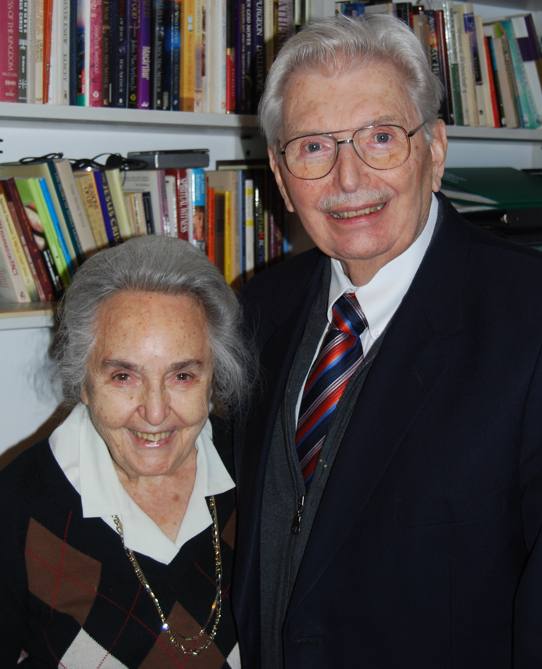
Maria Teresa Standridge-A woman who loves God and others.

What does it feel like to hear from the doctor that you have only a few months to live?  Maria Teresa Standridge recently received this news from her doctors in Italy.  Maria Teresa has served the Lord with her husband, Bill, for nearly sixty years in Rome, Italy. Though she is eighty-eight years old, she is still serving the Lord. They have been an inspiration to me because of their faithful service unto the Lord even into their eighties.

I have been given permission to share Maria Teresa’s thoughts about her impending death.  Please take time to read this beautiful testimony of God’s peace in the midst of facing death.

I’M GOING HOME! BY MARIA TERESA STANDRIDGE (ROME, ITALY)

“Mr. Standridge, bring  your wife to the emergency room immediately for a blood transfusion. The levels in her blood are very low. We have already informed your doctor. ”

I had just finished blood tests in a medical center and things seemed really serious. I did not expect anything like this, even though, for a few weeks, I had been feeling pretty weak and with little energy. We went straight to the emergency room of a large hospital in Rome, close to home, and soon I was lying on a bed with a needle stuck in my arm and a nice bag of blood, which was followed by two more, transferring its liquid, drop by drop, into my veins.

Since then I have been on a rollercoaster of news and surprises, hospitalization, other blood tests, and also samples of bone marrow, that led to a diagnosis of acute myeloid leukemia, to which doctors have added the unpromising  adjective “terminal” .

So today, without any particular pain and, apparently, still in good health and with a good measure of strength, I find myself thinking in a very practical and realistic way, of my “going home with the Lord” when He wills. Perhaps very soon.

How have I reacted to a story like this?  Honestly, surprised and almost in disbelief.  But, even so, with HIS peace.

A few years ago, when I was invited to do Bible studies in a Conference for women, I said with a laugh that, given my age of more than 85, (soon I’m going to be 89), the organizers would do well to also get a “spare  tire” in case I had to decline the invitation. But honestly, given my health that I thought was disease-proof,  I said it jokingly as if I were actually immortal.

Today, the jokes are over and the reality is different. It is a reality of a certain sadness (I’d be lying if I said otherwise), but also very calm.

Sadness because leukemia is a reality that speaks of separation from Bill, the only love of my life, with whom I have spent more than 56 years, and have had the joy of serving the Lord, in a kind of spiritual and also intellectual symbiosis.   I shared a passion for the Word of God, the commitment of raising four children, and the responsibility of helping many to learn and grow in biblical faith.

Bill and Maria Teresa Standridge-Married and serving the Lord together for over 56 years!
Bill and Maria Teresa Standridge- Serving the Lord together for over 56 years in Italy!

I know that after my departure Bill will feel a bit as though he was “mutilated”, but I know that his love for the Lord, His Word, and the Italians, will support him and help him serve as long as he has the strength.

Of course I do not like, either, the idea of ​​leaving our four children, three daughters-in-law and also a son-in-law, who love me and twelve grandchildren (one married) and two great-grandchildren, each one more lovely than the other. But the moment of separation will come.

But my joy is that all have trusted the Lord as their Savior and are therefore in his hands.

But now, let’s talk about the reasons for my peace of mind.

I came to know Jesus as Savior and Lord when I was 20 years old. Since then, the grace of God has surrounded me and the unmerited favor of the Lord has wrapped and protected me.

I know I’m saved, and my faith is based on the promises of God’s Word.  One that comforts me in particular is the letter of the Apostle Paul to Titus: “He saved us, not because of works done by us in righteousness, but according to his own mercy, by the washing of regeneration and renewal of the Holy Spirit, whom he poured out on us richly through Jesus Christ our Savior, so that being justified by his grace we might become heirs according to the hope of eternal life.” (Titus 3:5-7) What more than that could you want or hope for?

Then I had the honor to receive from the Lord a clear call to serve full-time, I went to Bible school, I had teachers of great value, I have experienced the extraordinary time of evangelistic fervor and spiritual growth in Italy after the end of World War II. I was a part of  the beginning of the new period of political freedom in Italy that gave us permission to start youth camps, summer schools, conferences and all kinds of activities that the Lord has blessed. I threw myself headlong into every new evangelistic project.

My university studies prepared me to have a ministry of writing and my heart led me to make available to the Lord every capacity that He had given me.

Over the years I learned to study and nourish myself in the Word of God, I understood the importance of furthering knowledge in His truth, and rooted my faith in obedience to what it says. Without a good supply of this type of knowledge, the Christian life can become very severe and be very flat.

I confess also that I have made many mistakes for which I had to ask forgiveness from the Lord, from my loved ones, brothers and sisters, and I realized that forgiveness is the key to the Christian life.  It is essential in both the human family and that of God.

He who does not forgive others has understood little of the love of God, but those who practice the confession of their sins to God and asking for the pardon of all they have offended, know that the blood of Christ purifies them and allows them to walk in the light (1 John 1:8-10).

After so many years of walking with the Lord, I realized that “in me, in my flesh, Maria Teresa, dwelleth no good thing” (Romans 7:18), but whatever I did that is good is what he has done for me and in me (Isaiah 26:12).

During a conference in Isola del Gran Sasso, Daniel, one of our sons, in a meditation stressed the fact that after the resurrection, Jesus bore in his body the marks of his suffering and death for us. The disciples have seen his scars and know that, with his resurrected human body, Jesus ascended to heaven.

In the vision of Revelation,  John later saw Him as a “lamb, standing, which seemed to have been sacrificed” (5:6) and I, with myriads of believers (and hopefully with you) will behold for all eternity those signs of the price paid by Jesus for our salvation.   Those signs will inspire us to worship Him in perfection.

This wonderful thought humbles me, but also fills me with great gratitude.
With love, Maria Teresa  Rome, March 2013

Do you want to have the same my certainties?
Write to:Association of Evangelical Truth
Via Pozzuoli, 9 – 00182 Rome – Italy
http://www.istitutobiblicobereano.org | assverev@tin.it

Clinging to God

Kangaroos in Australia (Photo by: Mark j. Booth)

Do you remember as a child when you would cling to your dad or mom when you felt danger approaching? “My soul followeth hard after thee: thy right hand upholdeth me.” (Psalm 63:8) The words “followeth hard” have the idea of clinging unto the Lord. When danger, temptations and sorrows approach, the best response is to cling to Our Heavenly Father. He alone can carry us through the tough times.

The world is a dangerous place for every child of God. We face a variety of dangers, including temptations from Satan, the lusts of our own flesh, and pressures from the world to conform. Because of these dangers, we need to cling to our Lord each step of the way. When we let go of the Lord, we not only find ourselves being exposed to dangers from without, but also the dangers from within our hearts.

The first aspect of clinging unto the Lord is total dependence upon Him.  We know that within ourselves there is no hope to face the dangers and pitfalls of this life. When crossing a very busy street, I would cling to my Dad’s hand. I was completely incapable of crossing the many lanes of traffic alone. The cars were large and moving fast. I completely depended upon my Dad to navigate me to the other side of the street.

All through the Word of God, we see people who forsook their own ability and completely depended upon God. David when he battled Goliath totally depended upon the Lord. Like David, no matter how big the danger before us, we can cling unto our Heavenly Father.  He will never push us away.

Joseph continually faced pressure from Potiphar’s wife to commit adultery. The pressure was great to yield to this temptation, but Joseph continually depended upon God. Daniel could have compromised his faith several times while in Babylon; yet he depended totally upon God. Ruth could have lived a life of great despair, but she depended upon God in the midst of all the trials she faced. We have the same Heavenly Father that each of these had. We can and need to depend upon Him.

A second aspect of clinging unto the Lord is our complete love for Him. Peter’s denial of the Lord occurred when he placed his love for himself above his love for the Lord Jesus Christ. After the resurrection, Jesus emphasized this truth to Peter when He asked him three times: “Do you love me?” Jesus wanted Peter to know that there was great safety in clinging to Him in love.  Peter would face innumerable trials, but he clung to the Lord in love.

How close are we to God? Have we left our first love like the church at Ephesus did? When our love grows cold God seems distant. We don’t speak to Him with words of affection. We don’t open His Word with enthusiasm. We live our lives as though God is not there. This lack of love creates greater opportunities to fall into temptations, to doubt God’s love and provision, and to live a selfish life before others.

Loving God means that we need to stay as close to Him as possible.  We want to listen to His Word. We enjoy our times of communion with Him. We are not ashamed of Him, but we are proud to call God, Our Heavenly Father.

A third aspect of clinging to God is to recognize the dangers of this life. Last year, while in Australia, I came across a joey with its mother kangaroo. The joey was lying close to its mother; however when I came closer to the joey, the joey recognized danger.  He immediately leaped to its feet and jumped into his mother’s pouch. The joey found complete safety in his mother’s pouch.

Do we recognize the dangers in our life? Jesus constantly warns His followers of the ways of this world. He knows that we can easily become apathetic and careless in our spiritual lives. We don’t see the need of clinging to the Lord because we have become insensitive to the dangers around us and within us.

God is always there to uphold us, as long as we are always ready to cling unto Him. He holds His arms out as though saying: “Come unto me, I will protect you. I will love you. I will guide you through this situation.” We mustn’t let pride, self-will, ignorance, and busyness keep us from clinging to our Heavenly Father.

“Dear Heavenly Father, I have crossed many dangerous roads in my life. Sometimes, I have chosen to cross those roads without you. This has created difficulties for me and others. Thank you for the many times, that I have clung to you and you took me through those dangerous roads. I know that in the future I can depend upon you regardless of what happens. Thank you for first loving me; so that I can love you in return. Amen”

Am I a Spiritual Demolition Expert?

346-hudsonPano

On October 24, 1998, there occurred a very sad event in the history of Detroit.  On this day, the J.L. Hudson’s department store demolished. This landmark of downtown Detroit was, at one time, the second largest department store building in the nation.

The Hudson’s building was prepared for demolition by experts who knew what they were doing. In a matter of seconds, the building came tumbling down. The demolition experts had done their work.

In the spiritual realm, there are also demolition experts. These people have a talent to harm other believers and churches. They may do their work with a spiritual veneer, like the Pharisees did in the time of Jesus.  They may have a goal of “doing what is good”. They may be sincere or “mean well”.  Whether intentional or not, these demolition experts cause broken lives and churches.

We may not think that we are a demolition expert, but there is a demolition expert in all of us.  We have all caused harm to an individual or to a church fellowship. What are some of the qualifications of being a spiritual demolition expert?

One of the first qualifications of a demolition expert is pride. Pride causes us to feel superior to others. Because we are better than others, we have every right to condemn them and put them in their place.  Pride means that we are never open to correction, but we are always open to correct others. It also causes us to love self instead of loving others. We see this in the life of Saul when he became jealous of the acclaim that David received.  Saul’s pride caused his death, the downfall of his family, harm to the Kingdom of Israel, and great grief to the life of David.

Another qualification of a spiritual demolition expert is an uncontrolled tongue.  This person’s tongue can destroy a person or a church in various ways. They can speak words of slander about others. They also can create divisions among people through gossip. Angry words have also destroyed people and churches. These people are experts at welding their tongue to bring harm to many with whom they come into contact. James warned us of the danger of the tongue when he wrote: “And the tongue is a fire, a world of iniquity: so is the tongue among our members, that it defileth the whole body, and setteth on fire the course of nature; and it is set on fire of hell.” (James 3:6)

A third qualification of a spiritual demolition expert is the “Holy Spirit Syndrome”.  This individual feels like they have the answer for everybody’s situation. They know what others need to do and how they should do it. This doesn’t seem to bring harm to others. However, the person with this syndrome keeps others from developing their own personal walk with the Lord. Instead of looking to the Word of God or to the Holy Spirit for guidance and direction, many people look to the person who has become “their holy spirit”.

A fourth qualification of a spiritual demolition expert is a person who lives their lives to please themselves. This person hurts others because they don’t see the importance of their example. They may say: “I don’t care what other people think. It is my life.!” This person leads others down the path of sin, rebellion and destruction. They have forgotten what Paul said: “For ye are bought with a price: therefore glorify God in your body, and in your spirit, which are God’s.” (1 Corinthians 6:20)

God has not called us to be demolition experts. He has called us to be builders. “Wherefore comfort yourselves together, and edify one another, even as also ye do.” (Ephesians 4:11) A builder shows care, concern and sacrifice in producing a building.  We need to have this same concern and love for individuals as well as for the Body of Christ.

Let’s take a quick look at a few qualifications of spiritual builders.

  • They have a love for the Lord and others.
  • They have a humble spirit.
  • They use their tongue to build up others.
  • They encourage others to develop their own walk with the Lord.
  • They are sensitive to the needs of others.

“Dear Lord, I know that I have hurt others in my life, and that I need to forsake the qualifications of a spiritual demolition expert.  Help me, to have a ministry of building up others through my love, words and actions. Thank you for the people you have used in my life to build me up spiritually. Truly, you have blessed me with many spiritual builders. Amen”

Lord, I Believe, Help My Unbelief

Cabo da Roca, Portugal (Photo by Mark J. Booth)

Why do I find it difficult to believe in the person and promises of God?  Yes, I believe in my head, but my heart has a lack of complete trust in Him. Recently, God brought this to my attention while reading the account of the man whose child had an unclean spirit.

“And he said, Of a child.And ofttimes it hath cast him into the fire, and into the waters, to destroy him: but if thou canst do any thing, have compassion on us, and help us. Jesus said unto him, If thou canst believe, all things are possible to him that believeth. And straightway the father of the child cried out, and said with tears, Lord, I believe; help thou mine unbelief.” (Mark 9:22-24)

The father is in a desperate situation. He has no hope for his son; however, he pleads with Jesus that if He can help, please do something for his child. Jesus catches the doubt in this man’s heart as he said: “If thou canst do anything.” This man was speaking to God in the flesh; and yet doubted His ability to heal his child.

I have fallen into this same trap. I believe in who the Lord is, but deep down, I don’t think, He is able to do what seems impossible to me. I can’t see how he can save a loved one. I don’t see how He can change a person’s life. I don’t see how He can help me in a very difficult situation.

After the man speaks, Jesus encourages him to have faith: “If thou canst believe, all things are possible to him that believeth.” Jesus is saying that there is nothing too hard for Him. How often, I have looked at circumstances, at others or at myself, and felt overwhelmed. My heart says: “Can God handle this?” Doubt brings torment. Yes, I know in my head that God is All-Powerful, but doubt fills my heart. James says that “A doubleminded man is unstable in all his ways.” (James 1:8)

In this story, God speaks to my doubting heart. He is saying: “Don’t look at the difficulty in front of you, but look to me. I am God. I am All-Powerful. I know what I am doing. I do have compassion upon you. Your mind says you can trust me, let your heart trust me as well.”

The man responds in tears with words that resonate in my heart: “Lord, I believe; help thou mine unbelief.” These words could come right from mine own mouth.  At times, my head says: “I believe.” However, my heart says: “I can’t believe”. God wants me to be open about my doubts; so that He can change my heart into a heart that believes in all that He is and all that He says.

I am not the only person who is double minded when it comes to trusting the Lord. The disciples once came to Jesus and made this important request: “Increase our faith”. They saw their need in light of their doubts that were overwhelming their hearts. Likewise, I need to constantly pray with the disciples: “Lord, increase my faith.”

In the end, Christ honors the man’s wavering faith and heals his son. This man’s struggle with doubt brought him to a greater faith in Christ. His struggle also helps me to see that Christ understands my struggle with trusting Him with my heart. There is great peace, comfort, and strength when I trust Him with both my mind and my heart.

“Dear Lord, I believe in all that you are in my mind. I know in my mind that you are All-Powerful, All-Knowing, All-Wise, and All-Loving. I believe your Word from Genesis to Revelation. I believe in the miracles that you have done. However, when times get tough, when people don’t seem to respond to you, I begin to doubt in my heart. Please forgive me for my unbelief.  Bring me to a belief not only in my head, but also in my heart. Thank you for your patience in all that you are doing in my life. Amen.”

When No One Cares

Canadian Badlands in Alberta, Canada (Photo by: Mark J. Booth)

“In my distress I called upon the LORD, and cried unto my God: he heard my voice out of his temple, and my cry came before him, even into his ears.” (Psalm 18:6)

“Does anyone care?” “If only I could find someone who will listen to me!”  Have you ever caught yourself thinking these thoughts? Yes, throughout life there are times when we feel alone.  We think no one cares. When these times occur, we must not forget that there is One who is always available. He loves us and is ready listen to us. He understands exactly how we feel. Are we ready to confide in our Lord?

When we confide in the Lord, we are saying to Him: “I trust you, and I know that you care about me. I pour out my heart to you, because I know that you understand. I also know that you will show me what I need to do.”

Why did Moses stay faithful in spite of his trials? He confided in the Lord. How did Joshua lead God’s people? He confided in the Lord. How did David receive forgiveness of his sin? He confided in the Lord. How did Paul rejoice in the midst of his persecution and difficulties? He confided in the Lord. How will we stay faithful through life’s tribulations?  We will need to confide in the Lord.

Why do we need to confide in the Lord?

1. We need to confide in the Lord because we have no wisdom or strength within ourselves. When King Jehoshaphat faced the near certain defeat of his armies, he confided in the Lord. He knew that God alone could handle this situation.  “O our God, wilt thou not judge them? for we have no might against this great company that cometh against us; neither know we what to do: but our eyes are upon thee.” (2 Chronicles 20:12) Jehoshaphat demonstrated a spirit of humility before God which enabled him to confide in the Lord. We choose not to confide in God because we don’t want to admit our need of Him.

2. We need to confide in the Lord because we have a deceitful heart that can often lead us astray.  “The heart is deceitful above all things, and desperately wicked: who can know it? ” (Jeremiah 17:9) People often say: “I can’t go wrong if I just follow my heart”. However, God makes it clear that we can not trust our own hearts. We often make decisions based upon our own selfishness, bias or lack of knowledge. We need to confide in the Lord because He will direct us in the right path.

3. We need to confide in the Lord because difficulties come into our lives. We can’t travel the road of life without continually confiding in our Lord. Jesus said: “These things I have spoken unto you, that in me ye might have peace. In the world ye shall have tribulation: but be of good cheer; I have overcome the world.” (John 16:33) When tribulations come, do we forget that the Lord is greater than any trial that may come into our lives.

4. We need to confide in the Lord because of problems with others. People say: “I could be a good Christian, if it wasn’t for other people.” Yes, other people may hurt us, misunderstand us, ignore us and dislike us, but there is a friend who is always there. His name is Jesus! David confided in God when he faced powerful enemies; so can we. “Attend unto me, and hear me: I mourn in my complaint, and make a noise;” (Psalm 55:2)

5. We need to confide in God because of His Greatness. He is worthy of our faith. God is our all-knowing, all-wise, all-powerful Lord. He is our High Priest to whom we can go at any time. He is a refuge in the midst of any storm. “Trust in him at all times; ye people, pour out your heart before him: God is a refuge for us.” (Psalm 62:8)

Elbow Lake in Alberta, Canada (Photo by: Mark J. Booth)

How do we confide in the Lord?

1. We share our requests openly with God. “Deliver me from mine enemies, O my God.” (Psalm 59:1)  The Psalmist understood that he could share any request with God, and that God would hear him. He is ready to listen to all of our requests.

2. We are to show gratefulness unto the Lord as we confide in Him. “Be careful for nothing; but in every thing by prayer and supplication with thanksgiving let your requests be made known unto God.” (Philippians 4:6, 7) God loves to hear and answer our prayer requests, but He also loves to hear us give praise and thanks unto Him.

3. We are to show desperation when we confide in God.  “Hear my prayer, O Lord, and let my cry come unto thee.” (Psalm 102:1) Our desperate cry shows our total dependence upon Him. Our cry also shows that He is our only hope. When desperate times come, God is waiting for us to cry out to Him.

4. We are to confide in God thoughtfully. Confiding in God means that we don’t repeat the same words without thought. God wants us to share our mind, will and emotions with Him.  When Jesus taught about prayer, He said: “But when ye pray, use not vain repetitions, as the heathen do:” (Matthew 6:7)  

We have a choice each day. Will we openly confide in our Lord or ignore the opportunity of pouring out our hearts to our dearest Friend? We should not only confide in the Lord when we have sorrow and trials, but also in our times of blessing and joy. God wants us to confide in Him in every decision that we make. Confiding in God increases our love for Him because we find complete satisfaction in Him.

“Dear Lord, I often live my life without sharing it with you. You have blessed me with your presence and yet I ignore you. Why are you so patient with me? Help me to have the desire to confide in you completely. Thank you that you do care and that I can trust you with my whole heart. With my love, from your child. Amen”

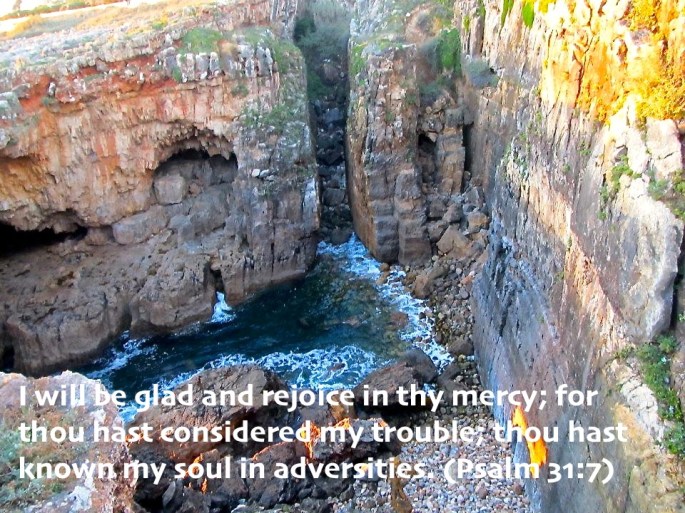
The Distress of My Soul (Psalm 31:7)

A Boca do Inferno (The Mouth of Hell) Cascais, Portugal.  Photo by: Mark J Booth
A Boca do Inferno (The Mouth of Hell) Cascais, Portugal. Photo by: Mark J Booth

I will be glad and rejoice in thy mercy: for thou hast considered my trouble; thou hast known my soul in adversities;” (Psalm 31:7)

Physical pain is a warning sign that something is wrong with our body.  The pain is screaming out for attention as though it is saying: “You have a problem, and you need to do something about it!”

Likewise, when we have pain in our soul (our innermost being), it is a warning sign that something is wrong.  The following problems can cause our soul to cry out in pain.

  • Sin in our life.
  • Lukewarmness towards spiritual matters
  • Resistance to God’s will
  • Selfishness
  • Emptiness within our soul
  • Confusion
  • An angry spirit
  • A great and heavy trial
  • Loneliness, etc.

Like our physical pain, we can tell others about the pain, but they don’t really understand.  The Lord God alone can feel the pain of our soul.  He alone can diagnose the pain of our soul.  Psalm 31:7 says: “Thou hast known my soul in adversities.”  God knows our pain. He knows when our soul is crying out in distress.  God wants us to pour out our heart to Him as we share the pain of our soul.

Not only does God know the pain of our soul, but He diagnoses the source of this pain for us.  How is this accomplished?  Hebrews 4:12 says: “For the word of God is quick, and powerful, and sharper than any twoedged sword, piercing even to the dividing asunder of soul and spirit, and of the joints and marrow, and is a discerner of the thoughts and intents of the heart.”

When we read and study the Word of God, God uses it to penetrate the deepest part of our soul.  An x-ray machine shows what is under our skin.  The Word of God shows what is in our soul.  It shows our sins, fears, doubts, sorrows, pain, hurts, anger, bitterness and many other trials and diseases of our soul.

The Word not only shows us the trials and diseases of our soul, but it also shows us the cure for our soul.  Are we experiencing the following ailments of the soul?  Have we tried God’s remedy for each ailment?

  • Sin? Confess our sin to God. (1 John 1:9)
  • A deep trial? Depend upon His grace (2 Corinthians 12:9)
  • An angry spirit? Yield all of our rights to God. (Matthew 5:5)
  • An overwhelming burden? Cast our care upon Him. (1 Peter 5:7)
  • Loneliness? Remember the presence of God. (Hebrews 13:5)
  • Bitterness? Forgive in our heart the offending party as Christ has forgiven us. (Ephesians 4:32)
  • Fear? Lean upon God’s perfect love because love casts out fear. (1 John 4:18)
  • Lukewarmness? Take time to enjoy deep communion with the Lord.(Revelation 3:20)
  • Confusion? Allow the Lord to direct our way. (Psalm 32:8)
  • Sorrow? Find joy in Jesus. (Psalm 30:5)

The Lord knows us inside and out.  He knows our heart.  When our soul is in distress, we know that he will hear our cry.  He gives us answers for the distress of our soul.  The pain in our soul is God showing us our need for Him in a certain area of our life.  He is ready to apply His cure to our aching soul.

“Dear Lord, my soul often experiences pain.  My words, actions, and attitudes cause much of the pain in my soul.  Other people can also create some pain in my soul.  Regardless of the cause, please show me the source of the pain in my soul and its cure.  I thank you that you are the Great Physician who heals all the diseases and troubles of my soul. Amen”

What about Bad Tidings in the Season of Good Tidings? (Psalm 112:7)

Storm brewing over Downriver Area of Metro Detroit.
Storm brewing over Downriver Area of Metro Detroit (2011)

“He shall not be afraid of evil tidings: his heart is fixed, trusting in the Lord.” (Psalm 112:7)

“We Wish You a Merry Christmas and a Happy New Year” is a Christmas Carol that people sang since the 16th century in England.  If is a song of joy as expressed in the words: “Good tidings we bring to you and your kin. We wish you a Merry Christmas and a Happy New Year.”  However, not everybody receives good tidings during this time of year.  We still face trials, sorrow, and pain.  Many people even feel a deeper sense of loneliness during this time of year than at any other time of the year.  Yes, evil tidings don’t stop during this time of year: however there is good news from God in the midst of evil tidings that may come our way.

In the Bible, we see many people who triumphed over the evil tidings in their lives.  Joseph overcame many evil tidings, including betrayal, slavery, and prison, to become the prime minister of Egypt.  Ruth overcame the evil tidings of the death of her husband and living in poverty.  She would soon marry Boaz and become the great-grandmother of King David.

God gives us his Word to encourage us as we face the evil tidings of life that may come our way.  Every day, “bad news” can surprise us. We don’t ask for it, but it is a package delivered to the doorway of our lives.   How can we triumph even in the midst of bad news?  How can we see good news come out of the bad news?  Psalm 112:7 gives us some answers to these questions.

Normally, our first response to bad news is to be afraid or fearful.  Fear paralyzes us.  It causes us to focus upon the bad news instead of our Great God.  God tells us that we do not have to be afraid of the “evil tidings” that enter into our life.  God knows that fear will keep us from seeing Him clearly.  Fear causes us to doubt the goodness and the power of God.  For this reason God gives us many verses that command us to “fear not”.

  • But now thus saith the Lord that created thee, O Jacob,and he that formed thee, O Israel, FEAR NOT: for I have redeemed thee, I have called thee by thy name; thou art mine.” (Isaiah 43:1)
  • ” FEAR THOU NOT; for I am with thee: be not dismayed; for I am thy God:I will strengthen thee; yea, I will help thee; yea, I will uphold thee with the right hand of my righteousness.” (Isaiah 41:10)
  • “Peace I leave with you, my peace I give unto you: not as the world giveth, give I unto you. Let not your heart be troubled, NEITHER LET IT BE AFRAID.” (John 14:27)

When fear departs in the midst of the bad news, then we are able to do the next step in facing our bad news.  We now can “fix our heart” upon the Lord.  Our bad news is an opportunity to focus upon God.  We can focus upon all of His attributes and promises.  When we fix our heart upon the Lord, it may not change our circumstances, but it will change how we face our circumstances.  We will understand with the Apostle Paul that
God’s grace is sufficient for the “evil tidings” that may come in our life.

Once fear has departed and we have fixed our heart upon the Lord, then we can have faith in Him.  Faith is responding to all that we know about God.  The more we know the Lord, the more we will be able to trust Him.  True faith knows that God will never leave us, nor forsake us regardless of the “bad news” that may come our way.  His love is an unchanging love.  He loves us with an “everlasting love.”.  Faith in our Lord will dispel any fear in our life.  It will enable us to bear whatever “bad news” that comes our way.

In summary, when we receive bad news, Psalm 112: 7 tells us three ways to respond to the “evil tidings”

  1. Do not allow fear to dominate our thoughts and actions.
  2. Fix our heart upon the Lord.  Let our thoughts focus on the Lord.
  3. Place our faith in the Lord.  He will carry us as we face the “bad news’ in our life.

When the “evil tidings” enter into our live, God has a way of turning those evil tidings into an opportunity to see Him work in our life and in the lives of those around us.  God will turn those “evil tidings” into “good tidings” that will draw us closer to Him, and bring glory to His name.

“Dear Lord, the news that I receive is not always good.  I see people who are suffering.  I visit those who have marital problems.  I talk with those who have a loved one who is dying.  I see people who have turned away from you.  I also face difficulties from time to time in my life.  My tendency is to face the bad news with fear.  Help me, to turn my eyes off the “bad news” and fix my heart upon you.  Please, increase my faith.  Help me to believe that you will take this “bad news” and make it into something good. Thank you for your great plan for my life. Amen”