A Prison of Mine Own Making: Am I a People-Pleaser?

old-prison-2-1093527-mA prison is a place of confinement, a place without freedom, a place of loneliness. Nobody would voluntarily enter a prison. However, many people have entered into a prison of their own making.  This prison is the prison of being a people-pleaser.  A people-pleaser is one who desires to please others before pleasing God. By trying to please others, they face the great problem of trying to please competing interests.  A people-pleaser doesn’t make decisions in light of what God says, but what others expect.

We are susceptible to become a people-pleaser. It is natural for us to want others to like and accept us. Being a people-pleasure is difficult because there are many competing interests that are coming from various directions. What one person thinks is the right decision; another person takes the opposite view. As a people-pleaser, we live our lives by the opinions and demands of others, instead of seeking to please our Lord God.

One Christian who found freedom from the prison of being a people-pleaser was the Apostle Paul. In his ministry, Paul constantly received criticism from others. Paul could find acceptance with various people by surrendering his ministry to the opinions of others. However, Paul chose not to enter the prison of being a people-pleaser. He found freedom by desiring to please only one person, God, His Father. “Even so we speak; not as pleasing men, but God, which trieth our hearts.” (1 Thessalonians 2:4)

The Lighthouse at Port  Sanilac, Michigan.  Photo by Mark J. Booth
The Lighthouse at Port
Sanilac, Michigan. Photo by Mark J. Booth

How can we find the freedom that Paul found?  First of all, Paul understood the danger of being a pleaser of men. He knew that it would be impossible to please God, if he was always seeking to please people with their ever-changing opinions, desires and goals. He also understood that men, being sinners, could not always see life from God’s perspective. Paul knew that when he kept his eyes upon what men thought, he would soon forget to keep his eyes focused upon God.

Secondly, Paul understood that God was his Master. We don’t serve ten masters or twenty masters. No, we serve one Master. Our goal is to please the very One who loves us and knows what is best for us. We submit to Him as Lord. Yes, in living for our Master, we may serve others, but our eyes are always upon pleasing Him. When we become a people-pleaser, we no longer are submitting to the Lord as our Master. Many people have ruined their lives because they sought to please others at the cost of pleasing the Lord God

Thirdly, people are very quick to wrongly judge our motives; God knows our motives because he knows our every thought and attitude. Paul understood that God is the One who will ultimately test our hearts. God knows not only what we do, but why we do it. A people-pleaser can’t please everybody thus they feel frustration and guilty. People are often quite harsh in their judgment of our actions. God sees our hearts. If our hearts are clear before God then we will be free from being a people-pleaser.

Fourthly, people tend to be selfish. They want to control or even bully others to follow their desires, opinions and goals. Their desire is self-focused instead of God-focused. God’s will is not only for His own Glory, but for our benefit. Others can’t see the big picture, God sees it. He loves us and wants what is best for us. When we focus on God’s wisdom and plan, we will be free from the limited understanding of those around us.

Being a Christian doesn’t mean that we ignore the people we love and serve, but it does mean that their opinions should not imprison us. God can use the thoughts of others to give us direction, but we must not take our focus from the One whom we are truly serving. Yes, we can try to make those around us happy, but it must never be at the cost of displeasing our Master. When we become imprisoned by the desires of others, we will never be free to serve our True Master.

“Dear Lord, I find myself tempted to be a people-pleaser. I don’t enjoy the criticism that comes my way when I make decisions. I want you to use me in the lives of others. However, I realize that when I become imprisoned by the desires of others, I can no longer be useful to you or to others. Please help me to keep my focus upon you. Help me to discern the difference between my will and your will. I know in my heart, that in pleasing you that I will reach my full potential of being a blessing to others.

 

Maria Teresa Standridge (Her Testimony) 1924-2013

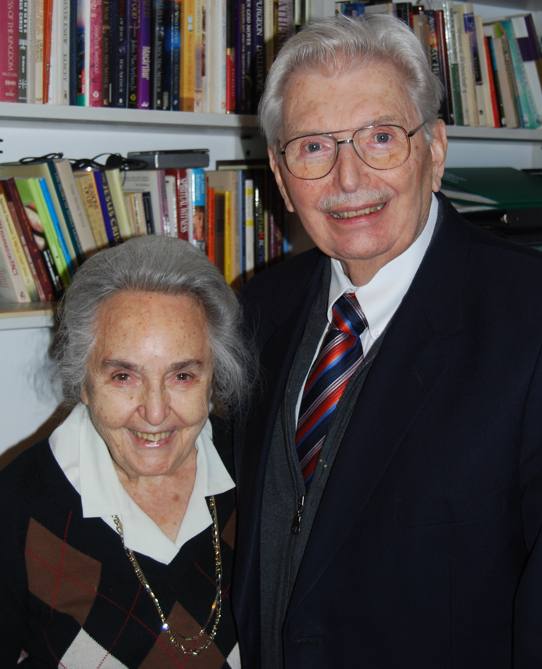
Maria Teresa Standridge-A woman who loves God and others.

Yesterday, Maria Teresa Standridge went to be with the Lord. Maria Teresa served the Lord with her husband, Bill, for nearly sixty years in Rome, Italy. Though she was eighty-nine years old when she died. She served the faithfully until her death. Maria Teresa not only impacted the lives of many people in Italy, but also in the United States and around the world.

I have been given permission to share Maria Teresa’s thoughts as she approached the last few months of her life. Please take the time to read this beautiful testimony written by Maria Teresa of God’s peace in the midst of facing death.  Please feel free to write any comments that would be an encouragement to Bill and the rest of the family

I’M GOING HOME! BY MARIA TERESA STANDRIDGE (ROME, ITALY)

“Mr. Standridge, bring  your wife to the emergency room immediately for a blood transfusion. The levels in her blood are very low. We have already informed your doctor. ”

I had just finished blood tests in a medical center and things seemed really serious. I did not expect anything like this, even though, for a few weeks, I had been feeling pretty weak and with little energy. We went straight to the emergency room of a large hospital in Rome, close to home, and soon I was lying on a bed with a needle stuck in my arm and a nice bag of blood, which was followed by two more, transferring its liquid, drop by drop, into my veins.

Since then I have been on a rollercoaster of news and surprises, hospitalization, other blood tests, and also samples of bone marrow, that led to a diagnosis of acute myeloid leukemia, to which doctors have added the unpromising  adjective “terminal” .

So today, without any particular pain and, apparently, still in good health and with a good measure of strength, I find myself thinking in a very practical and realistic way, of my “going home with the Lord” when He wills. Perhaps very soon.

How have I reacted to a story like this?  Honestly, surprised and almost in disbelief.  But, even so, with HIS peace.

A few years ago, when I was invited to do Bible studies in a Conference for women, I said with a laugh that, given my age of more than 85, (soon I’m going to be 89), the organizers would do well to also get a “spare  tire” in case I had to decline the invitation. But honestly, given my health that I thought was disease-proof,  I said it jokingly as if I were actually immortal.

Today, the jokes are over and the reality is different. It is a reality of a certain sadness (I’d be lying if I said otherwise), but also very calm.

Sadness because leukemia is a reality that speaks of separation from Bill, the only love of my life, with whom I have spent more than 56 years, and have had the joy of serving the Lord, in a kind of spiritual and also intellectual symbiosis.   I shared a passion for the Word of God, the commitment of raising four children, and the responsibility of helping many to learn and grow in biblical faith.

Bill and Maria Teresa Standridge-Married and serving the Lord together for over 56 years!
Bill and Maria Teresa Standridge- Serving the Lord together for over 56 years in Italy!

I know that after my departure Bill will feel a bit as though he was “mutilated”, but I know that his love for the Lord, His Word, and the Italians, will support him and help him serve as long as he has the strength.

Of course I do not like, either, the idea of ​​leaving our four children, three daughters-in-law and also a son-in-law, who love me and twelve grandchildren (one married) and two great-grandchildren, each one more lovely than the other. But the moment of separation will come.

But my joy is that all have trusted the Lord as their Savior and are therefore in his hands.

But now, let’s talk about the reasons for my peace of mind.

I came to know Jesus as Savior and Lord when I was 20 years old. Since then, the grace of God has surrounded me and the unmerited favor of the Lord has wrapped and protected me.

I know I’m saved, and my faith is based on the promises of God’s Word.  One that comforts me in particular is the letter of the Apostle Paul to Titus: “He saved us, not because of works done by us in righteousness, but according to his own mercy, by the washing of regeneration and renewal of the Holy Spirit, whom he poured out on us richly through Jesus Christ our Savior, so that being justified by his grace we might become heirs according to the hope of eternal life.” (Titus 3:5-7) What more than that could you want or hope for?

Then I had the honor to receive from the Lord a clear call to serve full-time, I went to Bible school, I had teachers of great value, I have experienced the extraordinary time of evangelistic fervor and spiritual growth in Italy after the end of World War II. I was a part of  the beginning of the new period of political freedom in Italy that gave us permission to start youth camps, summer schools, conferences and all kinds of activities that the Lord has blessed. I threw myself headlong into every new evangelistic project.

My university studies prepared me to have a ministry of writing and my heart led me to make available to the Lord every capacity that He had given me.

Over the years I learned to study and nourish myself in the Word of God, I understood the importance of furthering knowledge in His truth, and rooted my faith in obedience to what it says. Without a good supply of this type of knowledge, the Christian life can become very severe and be very flat.

I confess also that I have made many mistakes for which I had to ask forgiveness from the Lord, from my loved ones, brothers and sisters, and I realized that forgiveness is the key to the Christian life.  It is essential in both the human family and that of God.

He who does not forgive others has understood little of the love of God, but those who practice the confession of their sins to God and asking for the pardon of all they have offended, know that the blood of Christ purifies them and allows them to walk in the light (1 John 1:8-10).

After so many years of walking with the Lord, I realized that “in me, in my flesh, Maria Teresa, dwelleth no good thing” (Romans 7:18), but whatever I did that is good is what he has done for me and in me (Isaiah 26:12).

During a conference in Isola del Gran Sasso, Daniel, one of our sons, in a meditation stressed the fact that after the resurrection, Jesus bore in his body the marks of his suffering and death for us. The disciples have seen his scars and know that, with his resurrected human body, Jesus ascended to heaven.

In the vision of Revelation,  John later saw Him as a “lamb, standing, which seemed to have been sacrificed” (5:6) and I, with myriads of believers (and hopefully with you) will behold for all eternity those signs of the price paid by Jesus for our salvation.   Those signs will inspire us to worship Him in perfection.

This wonderful thought humbles me, but also fills me with great gratitude.
With love, Maria Teresa  Rome, March 2013

Do you want to have the same my certainties?
Write to:Association of Evangelical Truth
Via Pozzuoli, 9 – 00182 Rome – Italy
http://www.istitutobiblicobereano.org | assverev@tin.it

Do Not Fear God’s Plan. Embrace it!

The Smoky Mountains at Sunrise (Photo by: Mark J. Booth)

A young girl was suddenly confronted by a strange visitor whom she had never seen before in her village of Nazareth. This visitor greeted her with very strange words. “Hail, thou that art highly favoured, the Lord is with thee: blessed art thou among women.”

What was going on in Mary’s mind as she heard these words? The Bible says that she was troubled in her heart and was quite perplexed.  She probably couldn’t understand why this visitor was talking with her.  In her humility, she couldn’t believe what the visitor was saying about her character and her close walk with God.

Mary’s life would soon change in a way that she would never imagine. God chose her to give birth to the Messiah, Jesus Christ.  Because of God’s plan for her life, she would almost lose her future husband Joseph.  She would face misunderstanding.  She would give birth to the Messiah in a stable.  She would see her son suffer and then die upon the cross.  Mary didn’t choose this type of life, but God chose it for her.

Mary had a choice when her visitor, God’s angel, shared God’s plan with her. She could fear God’s plan and reject it, or she could heed the words of the angel: “Fear not, Mary: for thou hast found favour with God.” (Luke 1:30) Mary chose to embrace God’s plan when she said: “Behold the handmaid of the Lord; be it unto me according to thy word.” (Luke 1:38) Mary cast away her fears and embraced God’s plan for her life in spite of the obstacles she would face.

God’s plan can create fear in our lives.  We fear surrendering ourselves totally to God because His plan may include pain, suffering, rejection, and sacrifice.  Our fear causes us to forget that our loving God knows what is best for us and for those around us.  We find it difficult to say: “I am your servant. Do as you please with my life.”

All through the Bible, we see people who did not fear God’s plan, but embraced it.

  • Abraham embraced God’s plan when he left all that he knew to go to an unknown land.
  • Moses embraced God’s plan when he left the quiet life in the desert to lead God’s people.
  • Joshua embraced God’s plan when he defeated Jericho according to God’s plan of action.
  • Ruth embraced God’s plan when she left her land of Moab to go to Israel.
  • Jeremiah embraced God’s plan in spite of the persecution he faced.
  • Hosea embraced God’s plan when it didn’t make sense to him.
  • Steven embraced God’s plan though it meant certain death.

Will we listen to God’s voice when he says: “Fear Not”?  Will we embrace His plan regardless of the consequences?  When we embrace God’s plan, we will not only be blessed of God, but we will also be a blessing to others as Mary has been a blessing to the world.

David shares His desire to embrace God’s plan when he wrote: “Teach me to do thy will; for thou art my God: thy spirit is good; lead me into the land of uprightness.”
(Psalm 143:10) God is good and His plans for our lives will lead us into a life of blessing and joy. Let’s not fear God’s plan today, but let us embrace His plan with all of our hearts.

Marriage and the Supreme Court Decision (One Pastor’s Thoughts)

Marriage handsRecently, the Supreme Court weighed in on the subject of Gay Marriage.  Their decision was no surprise to me, nor should it be to any person who claims to be a Christian.  This decision reflects our culture and where we are as a nation.  Yes, we would like the laws of our country to follow our beliefs, but many of them do not.  Our nation is not a Christian nation, though in past times it followed Christian principles.

What should be our response to this decision by the Supreme Court?  First of all, we as Christians should forsake once and for all the idea that we can see people change through government action.  Should we expect people to live and believe like a Christian when they are not Christians?  The early church didn’t demand laws to show their beliefs. The early church understood the sinfulness of man.  The way the early church changed the culture was to proclaim the Gospel of Jesus Christ.  The Gospel changes the heart of a man.  Unlike Jesus Christ, no government can give a man a new heart.

Secondly, we need to remember that Jesus made it clear how we are to relate to the culture around us.  In the Sermon on the Mount, He said; “Ye are the salt of the earth: but if the salt have lost his savour, wherewith shall it be salted? it is thenceforth good for nothing, but to be cast out, and to be trodden under foot of men.  Ye are the light of the world.  A city that is set on an hill cannot be hid.  Neither do men light a candle, and put it under a bushel, but on a candlestick; and it giveth light unto all that are in the house.” (Matthew 5:13-15)

Our lives should shine forth as a testimony of our love for the Lord Jesus Christ.  A light shines brighter as the darkness increases.  There are two extremes in dealing with the sin that is so clearly accepted in our society.  One extreme is to compromise our beliefs so that we become more acceptable to our society.  The other extreme is to totally withdraw from our society.  A light needs to be in the darkness to shine, but it doesn’t allow the darkness to overcome its light.

Thirdly, we need to think about our own personal lives and our walk with God.  Yes, our culture has embraced sin and rebellion against God.  In the midst of our concern, have we forgotten our own walk with God?  When we get caught up with confronting our culture, it is easy to forget our own sin before God.  The early church at Ephesus did a great job of separating themselves from the evil of their culture.  Christ says of them: “Thou canst not bear them which are evil.” (Revelation 2:2) This church hated the evil that was a reality in the Roman Empire, but they had forgotten something in the process.

Jesus continued to speak to this church with some very convicting words: “Nevertheless, I have somewhat against, because thou hast left thy first love.” (Revelation 3:4) Have we left our first love?  Have we forgotten our daily walk with God?  If we are walking close to the Lord, we will have a greater impact upon the lives of those around us.

Fourthly, the Supreme Court ruling has no bearing upon our own marriages.  Why is it that professed Christians have a divorce rate that is equal to those who don’t claim to be Christians?  Yes, we have no control over the Supreme Court decisions concerning its view of marriage, but we can make our marriage one that honors God and His Word.

When God gave His instructions about marriage in Ephesians 5, He did so in the midst of a culture that allowed all sorts of immoral activities.  God’s focus is upon our own marriage.  We need to seek to love each other within our marriage and seek to fulfill Psalm 34:3 as a married couple. “O magnify the LORD with me, and let us exalt his name together.” 

Fifthly, Jesus Christ made it clear that we shouldn’t be surprised if we face persecution from the society around us.  Before His death, He said: “If the world hate you, ye know that it hated me before it hated you.”(John 15:18)  Our culture has no interest in the Biblical Jesus.  Yes, it wants a Jesus who loves everybody, but they have rejected the true Jesus of the Bible.  The Biblical Jesus loves, but He also is holy and He hates sin so much that He died on the cross for our sins.

Persecution can become very real as our society departs from any kind of Christian worldview.  The early Christians were persecuted because they were different from those around them.  God’s Word proclaims truths that our culture rejects and mocks.  Will not our culture eventually reject anybody who believes on God’s Word and chooses to live their lives according to His Word?

One last response to this decision is that we can say with the Apostle Paul: “For to me to live is Christ, and to die is gain.” (Philippians 1:21) We realize that death will be our entrance into the presence of Jesus Christ.  It will be a time of joy and worship.  We will no longer be exposed to the wickedness of this present world.

We can also say with the Apostle John at the end of Revelation: “He which testifieth these things saith, Surely I come quickly. Amen. Even so, come, Lord Jesus.”  One day there will be a government which will exalt righteousness, holiness and truth.  Jesus will one day return to reign as the King of Kings.

“Dear Lord, I see your Word being trampled underneath the feet of our culture.  I know that this is only natural because of the fact that we are born into sin.  Thank you for sending your Son, the Lord Jesus Christ to be the Savior of the World.  Please work through your people so that we can be an effective witness to those around us.  Thank for your love that is patiently waiting for people to turn to you.  Amen.”

When There is No One Else (Confiding in God)

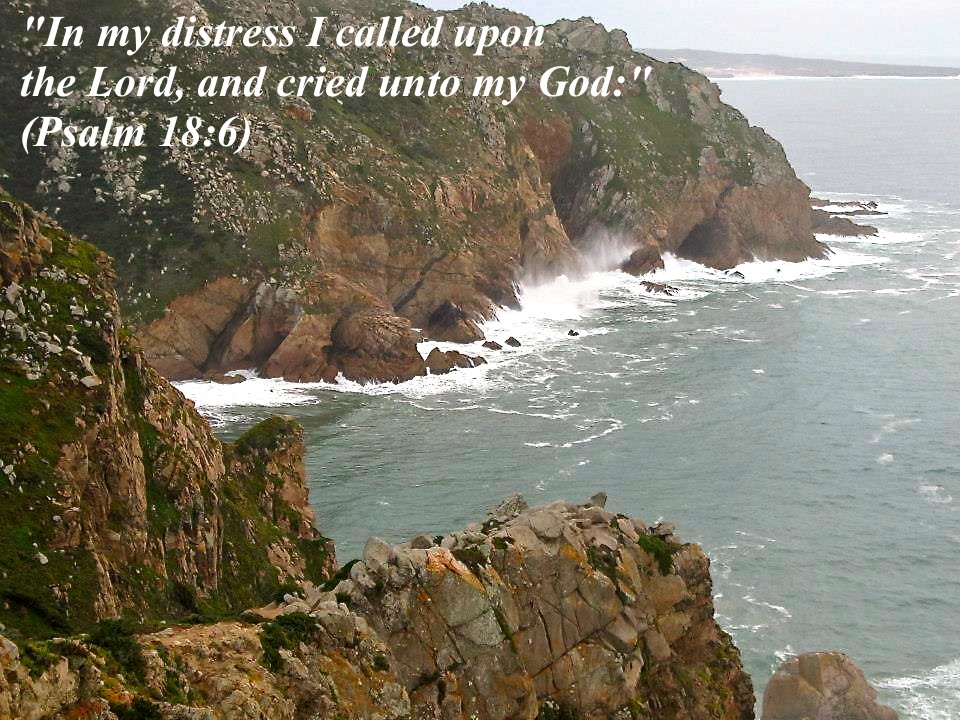
Cabo da Roca, Portugal Photo by: Mark J. Booth
Cabo da Roca, Portugal
Photo by: Mark J. Booth

“In my distress I called upon the LORD, and cried unto my God: he heard my voice out of his temple, and my cry came before him, even into his ears.” (Psalm 18:6)

“Will anybody listen to me?”  Have you ever caught yourself thinking this very thought?  Yes, throughout life there are times when we feel alone.  We think no one understands.  When these times occur, we must not forget that there is One who is always available to listen.  He understands exactly how we feel.  Are we prepared to confide in Him?

When we confide in the Lord, we are saying:  “I trust you, and I know that you care about me.  I pour out my heart to you, because I know that you understand.  Please show me what I need to do.”

Why do we need to confide in the Lord?

Has a situation ever come our way and we don’t know what to do?  We feel helpless in the midst of what is happening around us.  Many years ago, King Jehoshaphat of Judah faced the near certain defeat of his army.  Within himself there was no strength or wisdom to handle this dire situation.  He did what we all must do when we are confused and helpless. He went to the Lord. “O our God, wilt thou not judge them? for we have no might against this great company that cometh against us; neither know we what to do: but our eyes are upon thee.” (2 Chronicles 20:12) God is waiting for us to confide in Him in the midst of our confusion.  At times, we don’t confide in God because we are reluctant to admit our need of Him.

Another reason we need to confide in the Lord is that our own viewpoint can lead us astray.  You have heard the saying: “Let your heart be your guide.”  However, God tells us why our heart is not a reliable guide for our life. “The heart is deceitful above all things, and desperately wicked: who can know it? ” (Jeremiah 17:9)  God makes it clear that our heart is not to be trusted.  We often make decisions based upon our own selfishness or bias.  When we confide in God, we will see life from His perspective.

Trials, heartaches, and difficulties fill our life.  We can’t travel the hard road of this life without continually confiding in our Lord.  Jesus said: “These things I have spoken unto you, that in me ye might have peace. In the world ye shall have tribulation: but be of good cheer; I have overcome the world.” (John 16:33)  When tribulations come, do we forget that the Lord is greater than any trial that comes into our life?  When we cry out to Him in midst of our pain, He responds to us.  When an emergency happens in this life we call 911.  Why are we so reluctant to cry out to the Lord in the midst of our pain?

People say: “I  would be a good Christian, if it wasn’t for other people.”  Yes, other people may hurt us, misunderstand us, ignore us and dislike us, but there is a friend who is always there.  His name is Jesus!  David confided in God when he faced powerful enemies; so can we. “Attend unto me, and hear me: I mourn in my complaint, and make a noise;” (Psalm 55:2) The Lord is a Friend who will never leave us or disappoint us.  Will we learn to confide in Him when we have problems with others?

Finally, we need to confide in God because of His Greatness.  He is worthy of our faith.  God is our all-knowing, all-wise, all-powerful Lord and Friend.  He is our High Priest to whom we can go at any time. He is a refuge in the midst of any storm. “Trust in him at all times; ye people, pour out your heart before him: God is a refuge for us.” (Psalm 62:8) God’s greatness is like a magnet that draws us to Him.  He can handle any situation that we take to Him. 

How do we confide in the Lord?

Confiding in the Lord is simply to share our requests openly with Him. He already knows what is happening in our lives, but He wants us to come before Him in complete faith and honesty. “Deliver me from mine enemies, O my God.” (Psalm 59:1)  The Psalmist understood that he could share any request with God, and He would hear him.  Our God desires us to seek Him.  His love means that His ears are always open to our cries unto Him.

As we confide in Him, we must also remember the importance of having a grateful heart. Gratitude is a way of confiding in the Lord that we are totally dependent upon Him.  In Philippians 4:6, Paul writes: “In everything by prayer and supplication, with thanksgiving.” When we cry out to God, we thank Him for all that He is doing in our lives, and all that He will do in our lives.

Confiding in God is also demonstrated when we come before Him in desperation.  We don’t see God as part of the solution, or maybe a possible solution. No! God is the only solution.  The Psalmist writes: “This poor man cried, and the Lord heard him, and saved him out of all his troubles.” (Psalm 34:6) Our desperate cry is saying: “I need you, Lord.  You alone can help me.”  God will respond to this humble cry.

We are often tempted to seek to handle life in our own wisdom and strength.  Yet, the Lord is always there. He is always ready to listen.  Why do we choose failure in our own strength and wisdom, instead of choosing success in His strength and wisdom?  God is waiting to hear from us today!  Will we confide in Him?

Am I Suffering from Spiritual Amnesia?

A Boca do Inferno in Portugal.  Photo by: Mark J Booth
A Boca do Inferno in Portugal. Photo by: Mark J Booth

“They forgot God their savior, which had done great things in Egypt;”
(Psalm 106:21)

The terror of forgetting not only affects people with dementia, but also people who experience amnesia. The word “amnesia” comes from two Greek words which mean “without memory”. When a person loses their memory, they lose not only their past, but also they often forget recent events. This can create confusion, a lack of peace and problems with others.

In the spiritual realm, we can also suffer amnesia. This amnesia is much like the physical amnesia that people suffer.  A person with spiritual amnesia may feel confused spiritually.  They may become anxious. This person has some vague memory of God, but they have lost the vibrancy of the Christian faith.

The nation of Israel witnessed the power of God when He poured out the ten plagues upon Egypt. They saw his salvation during the night of Passover. They also saw God’s power when He parted the Red Sea. Throughout their wanderings in the Wilderness, God constantly provided for them. Would they remember these blessings from God? No! God says of His people: “They forgot God their saviour, which had done great things in Egypt;” (Psalm 106:21). 

Israel suffered spiritual amnesia. They had forgotten God, His blessings, His promises and His commands. How did this happen? Israel had taken their eyes off of the Lord. Their focus was upon the heathen nations around them. They conveniently forgot God; so that they could live their lives as they pleased.

Today, we often suffer spiritual amnesia. We conveniently forget God and His Word when we choose to live our lives to please ourselves and not to please God. We open the door to sin when we suffer from spiritual amnesia. Thankfully, God has provided a cure for our spiritual amnesia.

Jonah, God’s prophet, had a case of spiritual amnesia when he decided to forget God’s command to go to Nineveh by going the other direction. God disciplined Jonah when He placed him in belly of the great fish.  While there, Jonah repented of his spiritual amnesia with these words: When my soul fainted within me I remembered the Lord: and my prayer came in unto thee, into thine holy temple.” (Jonah 2:7)

Like Jonah, we find ourselves experiencing tough times as a result of our spiritual amnesia. We realize that forgetting God has brought us to a place of desperation. We often make matters worse by trying to resolve the matter without God. We feel that we are quite distant from God. What can we do in this situation?

First of all, like Jonah, we need to see our desperate situation. Jonah understood that his spiritual amnesia had created this problem. He was now awake to the fact that God was His only hope. He was suffering the consequences of his sin. We begin to experience the cure for our spiritual amnesia when we see our hopelessness without the Lord.

After recognizing our hopeless situation, we need to remember God. Jonah chose to remember God in the most difficult time of his life. Remembering God means that we remember not only who He is, but also all that His has done for us. The list below gives us some truths that we often forget when we suffer from spiritual amnesia. How many of these have we forgotten? Will we choose to remember these?

  • God’s attributes
  • God’s presence
  • God’s power
  • God’s promises
  • God’s commands
  • God’s love for us
  • The Gospel of salvation
  • God’s view of man
  • The Indwelling Holy Spirit

Thirdly, Jonah remembered the gift of prayer. From inside the fish, Jonah found a prayer closet and poured out his heart to God. Jonah’ s prayer was not casual or flippant. It  was desperate and dependent. Spiritual amnesia results in little or no prayer. God places us in a tight spot; so that we can not only remember Him, but that we also remember the gift of fervent prayer. If our prayers are dry, it is a sure sign that we are suffering from spiritual amnesia.

Have we seen the reality of spiritual amnesia in our life? God will go to great extremes to bring back our memory. He is waiting for us to turn back to Him, and remember Him!

“Dear Lord, I often choose to suffer with spiritual amnesia. I forget your presence in my life, as well as your commands and your blessings. I focus upon myself and my desires. I have a fear of man instead of a fear of you. Anxiety fills my life because I have forgotten your peace. Despair fills my life because I have forgotten your joy. Like Jonah, I need to remember you again. I need to seek you with my whole heart. Thank you for your forgiveness. Please keep me close to you so that I may not suffer from spiritual amnesia again. Amen”

What is a Dad?

Dads come in all shapes, colors, and sizes. Some dads have lots of money. Others don’t.  Some dads are quite handsome and energetic. Others are rather ordinary looking and a bit lethargic. Some dads like the outdoors. Others like to read, or watch television. Some dads make amazing things with their hands. Others don’t.

Every dad is different! The qualification for being a dad goes beyond being the physical father of a child. There are many men who are fathers but have never been a dad. A dad is a special title for a father who has graduated to the name “Dad”.

A dad is a person who takes you in his arm when you are born and has that special smile on his face that says: “I love you. You are God’s special gift to me.” He shows your photo to everybody he knows, because you are the most beautiful baby ever born.

When you get home from the hospital dad makes sure everything is ready at home.  He already has bought a sleeper for you of his favorite sports team.  He starts to dream of what you will be like as you grow up. He may avoid changing your diaper, or giving you a bath, but he is patiently waiting for the day when you can do fun things with him.

As you become a toddler, dad makes sure that you have the most important thing in life which is a ball. He teaches you what to do with the ball.  If you throw well, he sees you playing in the World Series. If you kick well, he sees you eventually playing in the World Cup.

When school begins, dad will tell you how important an education is.  He may even say: “You don’t want to grow up to be like me.” The funny thing is that if he is a true dad, you do want to grow up and be like him.  Dad sometimes embarrasses you when he cheers for you loudly at a soccer or a baseball game.  He means well, but you wish he would be a bit quieter with his cheering.

Dad may not only care for your physical, educational, financial, and emotional needs, but He may also teach you from the Word of God. Dad has found wisdom, guidance, and comfort from the Word of God, and he wants to share this aspect of his life with you.

In the teenage years, dad finds his role changing. You no longer look up to him as an expert in everything. Dad tries to adjust to this new role. He continues to tell you what is the best thing to do, but something has changed, and dad knows it.  He feels the pain of seeing you reject his wise counsel.  He may respond in anger, silence or in prayer.  In whatever way dad responds, he still loves you and longs to keep you from the pain of making bad decisions.

During the teenage years, dad is still willing to support you financially. Often, dad accepts the fact that you are not grateful. A dad’s love stays strong though you may not appreciate it during this stage of your life. Dad will love you no matter how many mistakes you make, because you are his child.

When dad says goodbye to you as you leave home as an adult.  It is a day of mixed emotions.  Dad is happy to see you able to make wise choices, but he will miss hearing his beloved child say: “Dad” every day. He will miss playing catch, riding bikes, the family vacations, and just those times of being together. Above all, dad will miss saying: “This is how you do it.”

As the years pass, and we become parents, we soon understand what being a dad is all about. When the time comes for us to say goodbye to dad, as he leaves this life. We think back upon all the things we wish we had said. We wish we could have one more day with him and say: “I love you” one last time. Now, we are left with our memories, photos and those famous words that we learned from dad that we now say to our children: “This is how you do it.”

Remembering Mom: June Solomon Booth (1923-2003)

Mom and I shortly after my birth.

June 9, 1923 was a very special day for me. This was the day that Annie Solomon gave birth to the last of the many children that she and Charles brought into the world. They would call this last child June Leona Solomon. June spent the first eighteen years of her life in the small coal-mining town of Patton, Pennsylvania. However, there weren’t many opportunities in Patton; so June followed her married sister, Frances, to Detroit.

Mom as a young child in Patton, PA.  She is the one in the middle.
Mom as a young child in Patton, PA. She is the one in the middle.

The big city was a contrast to the small laid back life back in Patton. She often spoke about working in the Guardian Building and living on Grand Blvd. In time, June would meet Arthur Booth and in 1950 they would become husband and wife. I would be the last child born to my parents in August of 1955.

Dad and Mom before I came on the scene.

In life, we can choose whom we marry, we can choose our friends, but we can’t choose our mothers. I am very grateful for the mother that God gave to me. She wasn’t a perfect person, but she was the perfect mother for me.

My mother was able to stay home with the three of us because my Dad sacrificed by working two jobs. Mom took her role as mother quite seriously. She took care of all of our basic needs. She always fixed our meals without complaints. She packed my sack lunch with loving care  She took care of our clothes. I still remember her ironing in the dining room as she would spray water on the clothes before she would pass the iron over them.  She also took us to all the places that we needed to go.

Mom did much more than take care of our basic needs. She loved us. She showed her love in how she sacrificed her time for us. She made it a point to give each of us special attention. Often, we would gather around the table with Mom and play Scrabble, Password or Jeopardy. The highlight of my day was bedtime, because Mom would tuck me into my bed and then read a story to me. She started with stories from Uncle Remus or Dr. Seuss.  When I was older she would read biographies and historical novels. She taught me to have a love for reading and history.

My Mom also enjoyed being involved in different community organizations.  She was involved in the Midland Elementary School PTA. She also was a den mother for the Cub Scouts for a couple of years. I still remember her working on the craft projects that her pack would do that day. Mom also taught Sunday School for a couple of years at the Highland Park Congregational Church. I was proud to be in her Junior High class.

Holidays and birthdays were always special to Mom. She would decorate our house special on each holiday. She enjoyed hiding the Easter baskets for Easter. She also was right there cleaning out the pumpkin for Halloween. Thanksgiving dinner was always a special treat. To this day, I can still taste her stuffing that would come right out of the turkey.

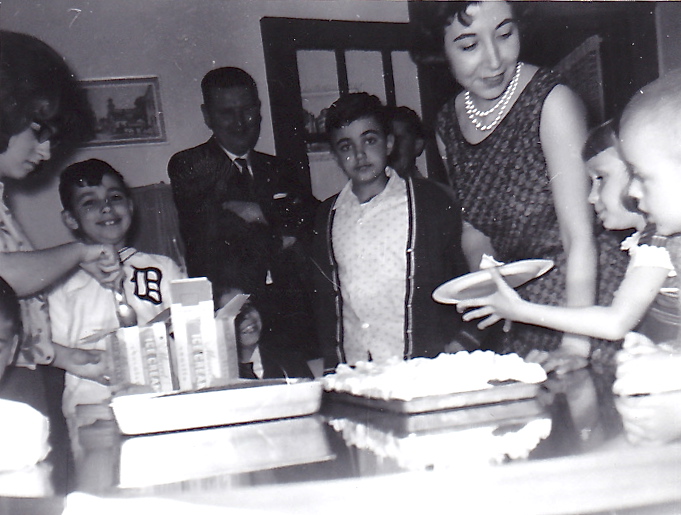
As for birthdays, she always prepared a big party. One year when Batman was popular on TV, she gave me a Batman party with Batman hats, plates, and cups.  She always invited our rather large extended family to the party as well as my friends.  She made each birthday like one gigantic celebration.

Mom enjoying hosting one of my birthday parties.

Mom also had a real gift of hospitality. She always seemed to have some family member at our house. She always welcomed my friends into the house. I never heard her complain about the noise that we made while we were playing.  She never said, “I wish you and your friends would go somewhere else.”

Mom was not always comfortable driving. She didn’t mind Woodward Avenue or Oakland Avenue, but the Davison and the Lodge expressways were off-limits in her mind. One day, Mom made a wrong turn and somehow she was driving on the Davison Expressway entering the Lodge. I was standing in my usual position in the back seat (Remember no seat belts or car seats in those days). I felt the panic of Mom as she asked me what to do?  As a seven-year old, I sure didn’t have the answer. Somehow, we made it off the Lodge Expressway. I never again remember Mom driving on one of the expressways. If she did, I am glad that I wasn’t with her.

The greatest contribution that Mom made in my life was that she taught me about God.  She didn’t read the Bible to me, but she did take me to church and gave me a prayer to repeat when I went to bed. She always told me not to put anything on top of the Bible because it was God’s Word. Because of Mom’s influence, when I was in high school, I started to read my Bible in search of God and how I could be right with Him. By the time, I was a student in college, I had placed my faith in Jesus Christ as my Savior.

After accepting Christ, I took Mom to Coltman Memorial Baptist Church which was a small Baptist church on Hamilton near Puritan. The people in the church really loved Mom and she loved them. She would soon accept the Lord as her Savior and she was also baptized.  Being younger than most of the people in the church, Mom would have a ministry of helps to many of the older women in the church. She would learn much from the Word of God as result of the good teaching she would receive.

Mom with the ladies of Coltman Memorial Baptist Church

When we left to minister in South Africa in 1983, Mom found it difficult to adjust. She would miss us, especially as her grandchildren would grow up in another land. Mom would send us cassette tapes of her thoughts and memories, as well as having Dad read a story to our children. This helped the children to relate to family back in the States. We would visit every couple of years. This would be a special time for our children to bond with their grandparents.

In 1996, we would return to the States. Mom was finding it difficult to get out, but she still found a certain joy when we would come and visit her. She loved our three children. With sadness, we would say goodbye to Mom in July of 2003. It has been ten years since I have been able to kiss Mom and say: “I love you.” I probably didn’t do this enough in this life.  However, I thank God that I could call June Booth, “Mom”.

When I am Afraid

Guincho Beach outside of Cascais, Portugal (Photo by Mark J Booth)

“What time I am afraid, I will trust in thee.” (Psalm 56:3)

“Mom, please leave the hall light on and don’t close the door.” These words were almost a nightly ritual when I was a child. Growing up I was afraid of many things. When I went to bed, I was afraid of the dark. When I went to school, I was afraid of failure. When I tried to become friends with someone, I was afraid of rejection. When I heard about somebody having cancer, I was afraid that I would get cancer. Being afraid is something that we struggle with throughout our lives.  We may outgrow some of our childhood fears, but we replace them with new fears.

As adults, we may suppress our fears before others, but deep down, we have to admit that we are still afraid of many things. We are afraid of what the future holds in our lives.  We fear rejection by people around us. Fear can overtake us as we contemplate death.  Sickness or financial reversal always seem to be lurking around the corner. We dread what will happen next.

Being afraid has been a reality since the fall of man. Adam and Eve were afraid of God after they had eaten the forbidden fruit. Abraham was afraid of Pharaoh when he and Sarah fled to Egypt to escape a famine. Moses was afraid of being executed for murder; so he fled to the wilderness. The disciples were afraid of the storm, and cried out to the Lord. Peter was afraid of those who were warming up by the fire; so he  denied the Lord.  John Mark was afraid of persecution for preaching the Gospel; so he abandoned his mission work.

David faced several events in his life that caused him to be afraid.  How did he handle those times of fear. In Psalm 56:3, David writes: “What time I am afraid, I will trust in thee.”  David understood the reality of his fear, but he also remembered the reality of God. Let’s join David and see how we are to handle those times when we are afraid.

Before we can share our fear with God, we must recognize that we are afraid. Most of the time we are afraid of the “What ifs” in life. “What if something happens to me?” “What if I lose my job?” “What if I can’t complete my assignment?” Our fears often creep up upon us in an unexpected way. Soon, we become paralyzed by our fear, like a deer staring into the headlights of an oncoming car.

Other times, we become afraid of something that is not imaginary, but very real. We receive bad news from the doctor. We receive a notice in our mailbox that our house will soon be repossessed. David recognizes these times of being afraid. He doesn’t face his fear with a false bravado, but he recognizes his fear. He knows that the relief from his fear doesn’t come from within himself, but in the Living God.

After recognizing his fear, David focuses upon the One who can take care of his fear. God alone has the power, strength, love, and wisdom to carry us through our fear.  When the disciples were afraid of the storm, they went to Jesus who was sleeping in the boat. They knew that He alone could calm the storm about them. Yes, the storm was threatening. Yes, the storm was violent, but they knew that the Lord would carry them through this storm.

Our fears often control us because we forget the greatness of our God. David, as he faced Goliath, recognized that there was One greater than Goliath. Our God can deal with whatever Goliath we are facing. The more we grow in our knowledge of God, the more we will live a life free from fear.

After recognizing his fear, and focusing upon God’s greatness, David now entrusts his life to God. The word “trust” in Psalm 56:3 has the idea of leaning upon. David understands that the only way to conquer his fear is to totally lean upon God as he walks through the dangerous path that is before him.

As David wrote in Psalm 23, “Yea, though I walk through the valley of the shadow of death, I will fear no evil: for thou art with me;” Even in the most dangerous road of all, death, David is not afraid because he is leaning upon the Lord who is walking with him through this very dark valley.

Like David, we face many dangerous roads. Yes, some of the dangers are imaginary, but many of the dangers are real. If we choose to walk those dangerous roads alone. our fears will consume us. However, if we choose to lean upon Our Loving, All-Powerful Lord, we can walk upon the most dangerous road with courage.

“Dear Lord, we live in a world filled with danger. We find it easy allow fear to control us.  especially when we forget you. Help us to lean upon you completely, as we travel every dangerous road that is before us.  We do not ask to live a life without danger, but please be with us as we travel into danger. Thank you for allowing us to lean upon you no matter how dark the path is before us. Teach us that we don’t have to be afraid, because you are greater than any fear. Amen”

God’s Waiting Room

782711_entrance_waiting_room-1

A doctor’s waiting room is not a pleasant place. Yes, there are comfortable chairs, a TV, and magazines. However, somebody is sitting in the office waiting for test results that will bring bad news.  Another person is waiting for a procedure that may or may not work. Another person is fidgeting because they are growing very impatient. Another person is anxious because they don’t know how they will pay their large medical bills. Another person looks completely bored as they continually look at the clock.

God’s waiting room is much like a doctor’s waiting room.  As we wait upon God, fear and anxiety can creep into our lives.  We don’t know what plans God has for us. For this reason, we worry about our future.  We are filled with pain, whether it be physical, emotional or spiritual. We wonder how long must I continue with this pain. We can become upset with God because He is keeping us in His waiting room longer than we would like.

God’s waiting room is one of the most difficult places for a believer. We want God to come and relieve us of our fear and anxiety quickly. We want God to change our lives now and make us a super Christian.  We get tired of the daily drudgery of our lives. The pain is constant and no relief is in sight. We feel like we are drowning and coming up for air one last time, and God’s hand is not there to pull us out.

David had some of these feelings throughout his life. He faced a lengthy time of persecution by King Saul. He struggled with his own guilt over his sin with Bathsheba.  He faced many other fearful, anxious and painful situations. How did David respond to being in God’s waiting room?  Psalm 40 helps us to join David in God’s waiting room.

“I waited patiently for the Lord; and he inclined unto me, and heard my cry. He brought me up also out of an horrible pit, out of the miry clay, and set my feet upon a rock, and established my goings.  And he hath put a new song in my mouth,even praise unto our God: many shall see it, and fear, and shall trust in the Lord. (Psalm 40:1-3)

David understood that there are times in life in which we must spend time in God’s waiting room.  In David’s case, it was a deep pit from which he couldn’t escape. God often makes us wait so that He can teach us some very important lessons about ourselves and His person. He makes us wait because it is part of His perfect plan for our lives. God’s waiting room is also a place to teach us faith and patience.

God in His timing will take us out of His waiting room and respond to our cries. God heard David’s cry and took him out of the pit and placed him upon the solid rock. God gave David the grace to continue serving Him and ministering to others. Likewise, our waiting room experience will enable us to have a greater capacity to serve the Lord and minister to others. We will have learned the art of dependence upon God in the waiting room.

The greatest blessing of being in God’s waiting room is to share our experience with others. David’s experience caused him to give praise unto God. When people saw David’s response to God’s working in his life, they learned the lesson of trust for their own lives. They understood that if God was with David in the waiting room, He will also be with me.

John Bunyan spent several years in the Bedford jail. His crime was that he preached the gospel of Jesus Christ. While in jail, Bunyan produced one of the greatest Christian books ever written, called “The Pilgrim’s Progress.”  Even today, many people have been blessed by John Bunyan’s waiting room experience.

Like Bunyan, God will give us a message to share with others while we are in His waiting room.  It may not be a book, but it will be a message about God’s faithfulness, love and deliverance.  Faith means that no matter what happens in my life, God is in control and He will ultimately use it for His glory and the benefit of others.

Today, if you feel as though you would like to escape God’s waiting room, don’t!  God is right there with you in the waiting room though you may not see Him working or understand what He is doing. The waiting room is a place of patience and faith. God’s timing is not always our timing, but it is the best timing.

“Dear Lord, I am in pit that is dark, deep and hopeless. I know that you tell me to wait, but I can’t stay in your waiting room much longer. Please give me the faith to see that this waiting room is your will for my life. I know that you hear my cry. Help me to believe that one day, you will set me on the solid rock. Thank you for being with me in this waiting room.  Thank you for the opportunity to give praise to your name and have a ministry to others. Even in this waiting room, I love you, Lord. Amen.”