What about Bad Tidings in the Season of Good Tidings? (Psalm 112:7)

Storm brewing over Downriver Area of Metro Detroit.
Storm brewing over Downriver Area of Metro Detroit (2011)

“He shall not be afraid of evil tidings: his heart is fixed, trusting in the Lord.” (Psalm 112:7)

“We Wish You a Merry Christmas and a Happy New Year” is a Christmas Carol that people sang since the 16th century in England.  If is a song of joy as expressed in the words: “Good tidings we bring to you and your kin. We wish you a Merry Christmas and a Happy New Year.”  However, not everybody receives good tidings during this time of year.  We still face trials, sorrow, and pain.  Many people even feel a deeper sense of loneliness during this time of year than at any other time of the year.  Yes, evil tidings don’t stop during this time of year: however there is good news from God in the midst of evil tidings that may come our way.

In the Bible, we see many people who triumphed over the evil tidings in their lives.  Joseph overcame many evil tidings, including betrayal, slavery, and prison, to become the prime minister of Egypt.  Ruth overcame the evil tidings of the death of her husband and living in poverty.  She would soon marry Boaz and become the great-grandmother of King David.

God gives us his Word to encourage us as we face the evil tidings of life that may come our way.  Every day, “bad news” can surprise us. We don’t ask for it, but it is a package delivered to the doorway of our lives.   How can we triumph even in the midst of bad news?  How can we see good news come out of the bad news?  Psalm 112:7 gives us some answers to these questions.

Normally, our first response to bad news is to be afraid or fearful.  Fear paralyzes us.  It causes us to focus upon the bad news instead of our Great God.  God tells us that we do not have to be afraid of the “evil tidings” that enter into our life.  God knows that fear will keep us from seeing Him clearly.  Fear causes us to doubt the goodness and the power of God.  For this reason God gives us many verses that command us to “fear not”.

  • But now thus saith the Lord that created thee, O Jacob,and he that formed thee, O Israel, FEAR NOT: for I have redeemed thee, I have called thee by thy name; thou art mine.” (Isaiah 43:1)
  • ” FEAR THOU NOT; for I am with thee: be not dismayed; for I am thy God:I will strengthen thee; yea, I will help thee; yea, I will uphold thee with the right hand of my righteousness.” (Isaiah 41:10)
  • “Peace I leave with you, my peace I give unto you: not as the world giveth, give I unto you. Let not your heart be troubled, NEITHER LET IT BE AFRAID.” (John 14:27)

When fear departs in the midst of the bad news, then we are able to do the next step in facing our bad news.  We now can “fix our heart” upon the Lord.  Our bad news is an opportunity to focus upon God.  We can focus upon all of His attributes and promises.  When we fix our heart upon the Lord, it may not change our circumstances, but it will change how we face our circumstances.  We will understand with the Apostle Paul that
God’s grace is sufficient for the “evil tidings” that may come in our life.

Once fear has departed and we have fixed our heart upon the Lord, then we can have faith in Him.  Faith is responding to all that we know about God.  The more we know the Lord, the more we will be able to trust Him.  True faith knows that God will never leave us, nor forsake us regardless of the “bad news” that may come our way.  His love is an unchanging love.  He loves us with an “everlasting love.”.  Faith in our Lord will dispel any fear in our life.  It will enable us to bear whatever “bad news” that comes our way.

In summary, when we receive bad news, Psalm 112: 7 tells us three ways to respond to the “evil tidings”

  1. Do not allow fear to dominate our thoughts and actions.
  2. Fix our heart upon the Lord.  Let our thoughts focus on the Lord.
  3. Place our faith in the Lord.  He will carry us as we face the “bad news’ in our life.

When the “evil tidings” enter into our live, God has a way of turning those evil tidings into an opportunity to see Him work in our life and in the lives of those around us.  God will turn those “evil tidings” into “good tidings” that will draw us closer to Him, and bring glory to His name.

“Dear Lord, the news that I receive is not always good.  I see people who are suffering.  I visit those who have marital problems.  I talk with those who have a loved one who is dying.  I see people who have turned away from you.  I also face difficulties from time to time in my life.  My tendency is to face the bad news with fear.  Help me, to turn my eyes off the “bad news” and fix my heart upon you.  Please, increase my faith.  Help me to believe that you will take this “bad news” and make it into something good. Thank you for your great plan for my life. Amen”


 

Jesus is Knocking. Will I Answer? (Enjoying the Presence of God)

Rogue River Trail-Rockford, MI (Photo by: Mark J Booth)

The Christian life encounters many pitfalls. One unsuspecting pitfall is that we lose the joy of being a Christian.  We become lukewarm in our relationship with Christ.   Prayer is routine.  Bible study is a chore.  Our worship has become cold and formal. What has happened to our lives?

There was a church in the New Testament that had these same problems.  Jesus spoke these words to the church at Laodicea: “I know thy works, that thou art neither cold nor hot: I would thou wert cold or hot.  So then because thou art lukewarm, and neither cold nor hot, I will spue thee out of my mouth.”(Revelation 3:15-16)  This church was religious, but they no longer enjoyed Christ’s presence. They had lost a vibrant relationship with their living Lord.

What was Christ’s answer to their problem? “Behold, I stand at the door, and knock: if any man hear my voice, and open the door, I will come in to him, and will sup with him, and he with me.” (Revelation 3:20) Christ was telling the church that they were leaving Him out of their lives.  He politely was knocking on the door of their hearts; so that they would once again enjoy having fellowship with Him.

Chateau-Abbadia (Southwestern France)Photo by: Mark J Booth
Chateau-Abbadia (Southwestern France)
Photo by: Mark J Booth

 A meal in Bible times was a time-consuming event where people enjoyed talking and listening to one another.  Jesus longs for this kind of communion with us.  Have we opened the door?  Christ has prepared a meal for us with His presence and blessings. Have we sat down and taken the time to enjoy His presence?  He is waiting. 

When we take the time to enjoy Christ’s presence, we will view life and our circumstances from a totally different perspective.  We will see life as God sees life.  We will see our problems as God sees our problems.  God has prepared a banquet for us. Here is what He offers to us as take time to enjoy His presence.

1. We have guidance in our life.  “O send out thy light and thy truth: let them lead me;” (Psalm 43:3a) The question is often asked: “How can I know the will of God?”  To understand the will of God means more than following a formula, but we follow the Lord.  As we commune with the Lord, we will discover what pleases Him and what doesn’t please Him.  God’s greatest priority for our lives is that we know Him.  His light and truth will guide us. 

2. We enjoy true worship of God. “let them bring me unto thy holy hill, and to thy tabernacles.” (Psalm 43:3b) The Psalmist in the midst of all that was happening in his life saw the importance of worshiping God. Worship is not to please ourselves, but to please our Lord.  He desires worship because He is worthy of our worship.  Our worship is bringing glory to God in all that we say and do.  When we worship God, we recognize His presence and majesty.  

3. We have joy in spite of the circumstances in our life.  “Then will I go unto the altar of God, unto God my exceeding joy:” (Psalm 43:4a) The Psalmist faced many trials in his life which caused him to become to discouraged and depressed.  He understood that in God’s presence there is great joy.  No matter what is happening in our lives, if we remember that God is with us, we can experience a joy that is not based upon circumstances, but based upon a relationship.

4. We have an attitude of praise.  “yea, upon the harp will I praise thee, O God my God.” (Psalm 43:4b)  We often give praise for the blessings that we receive from God, but what about giving praise to the giver of those blessings.  When we enjoy God’s presence, we will focus upon all that God is.  We will praise HIm for His attributes and titles.  Every day, we should take the time to praise God for all that He is and does.

5. We have a contented spirit.  They shall be abundantly satisfied with the fatness of thy house; and thou shalt make them drink of the river of thy pleasures.” (Psalm 36:8)  A lack of contentment is a warning sign that we are not enjoying God’s presence.  When we are walking with God, we will be totally content. When we are close to the Lord, everything else will fall in place. 

6. We receive comfort from God. I will fear no evil: for thou art with me; thy rod and thy staff they comfort me.” (Psalm 23:4) Comfort is not based on circumstances, but upon our relationship with our Living God.  His rod shows his protection against our enemies.  His staff shows His guidance and help in our lives.  When we have His protection and guidance, we are sure of His comfort and love even in the most trying times. 

Enjoying God’s presence begins with salvation, but it continues for all eternity.  We enjoy His presence as we listen to him, communicate with Him, meditate upon Him and pour out our heart unto Him.  Are enjoying His presence today?

“Dear Lord, my life often becomes filled with the routine.  I have lost the joy of being Christian. I haven’t taken the time or effort to enjoy your presence.  Thank you for knocking on the door of my heart.  Thank you for your desire to fellowship with me.  I now open up the door of my heart to you.  Please come in!  I know that the greatest joy in life comes from being in your presence.  Amen.”

Preparing My Heart for Thanksgiving (Psalm 95)

Near Cascais, Portugal-Photo by: Mark J Booth

The food has been bought.  The guests have been invited.  The television is ready for NFL football.  Preparations are being made for the Black Friday sales.  However, something is missing in our Thanksgiving preparations.  Have we prepared our hearts to give thanks unto our Lord God?

One person has defined gratefulness as: “Making known to God and others in what ways they have benefited my life.”  We prepare our hearts for Thanksgiving by taking the time to reflect upon God’s blessings and then give thanks unto Him for those blessings.  It is also an opportunity to thank others for the ways they have benefited our lives.

Psalm 95 helps us to prepare our hearts for Thanksgiving.  The focus of this Psalm is upon giving thanks to God.  “Let us come before His presence with Thanksgiving.” (Psalm 95:2)  God desires thankfulness in His people.  Thanksgiving is not a once year reflection upon God’s blessings, but it is a daily giving of thanks to God for his blessings and provision.

We prepare our hearts for Thanksgiving as we reflect upon the reasons we can give thanks to God.  Take a few moments to meditate upon the following verses in Psalm 95. These verses will encourage us to give thanks to God for all that He is and all that He has done.

1. We give thanks to God for His Greatness. “For the Lord is a great God.” (Psalm 95:3a)  God demonstrates His Greatness in all that He is and all that He does.  We find it easy to lose the wonder of God as we grow older.  Our faith becomes routine and ritualistic.  It is time that we meditate upon God’s greatness again, and thank Him for His attributes and all that He has done.

Cabo Da Roca-Portugal; Photo by: Mark J Booth

2. We give thanks God for His Sovereignty. “A great King above all gods.” (Psalm 95:3b) God is in control.  Yes, he sometimes refines us as by fire, but we can thank Him  that nothing passes into our lives apart from His loving will and plan. When we understand that He is in control: then we can commit the trial unto Him and see Him work.  We can thank Him not only for the good times, but also for the difficult times because He is working in our lives.

3. We give thanks to God for His Power.  “The strength of the hills is his also.” (Psalm 95:4) Our God brings spiritual, emotional and physical strength to our lives.  We can give thanks in a difficult situation, because God is there to give us his strength.  Paul understood this as he was in prison when he wrote: “I can do all things through Christ which strengtheneth me.” (Philippians 4:13) 

4. We give thanks to God because He is Personal.  “For He is our God.” (Psalm 95:7a)  God desires to have a personal relationship with us.  He wants to walk with us, talk with us and listen to us.  He loves His children with an everlasting love.  He will never forsake us, in spite of the situation.  We can give thanks that we have a vital relationship with our Living God.  

5. We give thanks to God because He is our Provider. “We are the people of his pasture.” (Psalm 95:7b) We can be confident that the Lord is our loving Shepherd who will provide for our needs, whether they be spiritual, emotional, social or physical.  The Lord Jesus Christ in the Sermon on the Mount reminds us that God will take care of the smallest matter in our lives.  When we focus on how the Lord meets our every need, we are eager to give thanks unto Him. 

6. We give thanks to God because He is our Guide.  “and the sheep of his hand.” (Psalm 95:7c)  Our Good Shepherd not only provides for us, but also leads us.  We can thank the Lord for the times that He gave us direction through His Word in some important decision.  As we look back upon our lives, God’s hand can be seen in His guidance and through the circumstances that He allowed in our lives.  Likewise, as we look forward to the future, we know that He will continue to guide us. 

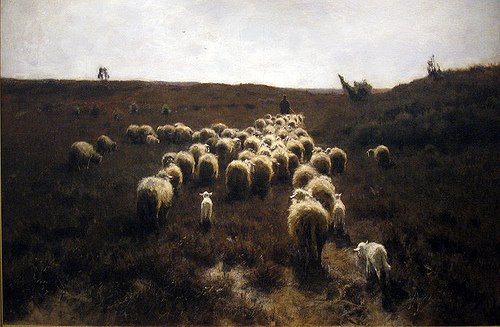
Return of the Flock” by Anton Mauve (19th Century) From the Philadelphia Museum of Art.

The first step to turning away from the Lord is to develop an ungrateful heart.  As we prepare our hearts for this Thanksgiving, let us look upon our Savior, the Lord Jesus Christ and all of His blessings.  Yes, there may food, family, and football for this Thanksgiving, but don’t forget the most important “f” for Thanksgiving, which is focusing upon the Lord and His Blessings.

“Dear Lord, I so often go through my days without thinking about all the blessings that I have as your child.  Thank you for all that you are to me.  Thank you for my great salvation and all the blessings that come with my salvation.  Thank you for your desire to have a personal relationship with me.  Help me not to forget you this Thanksgiving, but to focus upon you and all that you are. Amen.”

Imagine….Being with Jesus

The Garden of Gethsemane-photo by: Mark J. Booth

Imagine…being with Jesus!  What would my life be like, if I had walked with Jesus two thousand years ago? Yesterday, I read 1 John 1:1: “That which was from the beginning, which we have heard, which we have seen with our eyes, which we have looked upon, and our hands have handled, of the Word of life;” As I read this verse, I had the desire to place myself in the Apostle John’s sandals.  I imagined walking and living with the Savior during His time upon the earth.

“Which we have heard.”  Imagine the things that John heard as he walked with Jesus.  He heard the Sermon on the Mount, the Parables, Christ’s teachings about His Second Coming, and the Upper Room Discourse.  Can you imagine what it was like to hear Jesus praying.  As John travelled with Jesus, he probably heard Jesus talk about His Father, His creation, history and many other topics.  John never lost the wonder of listening to Jesus.  What about me? Have I lost the wonder of listening to Jesus?  Am I eager to listen to the His words in scripture.

Which we have seen with our eyes.”  Imagine the things that John saw as he walked with Jesus.  He saw the feeding of the five thousand, the calming of the storm, many healings, the resurrection of Lazarus, and many other miracles.  He would have also seen Jesus embracing the little children, and showing love to the outcasts.  What about me?  Have I lost the wonder of the works of Christ.  Am I able to imagine seeing those wondrous deeds of Jesus that John saw?

“Which we have looked upon”.  Imagine joining John and looking upon Jesus on the cross.  John saw the suffering, the ridicule, the crying out from the cross, the words of encouragement to the one thief.  Then three days later, he would behold this same Jesus, who had conquered death.  John witnessed the most important act in human history. Jesus died for the sins of the world. His life would be forever changed.  What about me?  Have I lost the wonder that God, the Son, came to earth and died on the cross for me?  Have I lost the wonder of the resurrection of Christ?  Have I lost the wonder of the greatness of my salvation?

“Our hands have handled, of the Word of life.” Imagine John leaning on the Lord’s breast during the last supper.  Imagine the embraces that Jesus gave John during their time together.  Imagine Jesus holding John up with his hand as John stumbles while walking.  What about me?  Have I lost the wonder of the fact that Jesus touches my life in many ways, whether through His Word, through His Holy Spirit, or through other believers?  Am I looking forward to one day when Jesus will embrace me in heaven?

“Lord, thank you for these words of the Apostle John.  You used them to help me see that I often lose the wonder of all that you have done, said, and promised.  Teach me, to imagine being with you as John was with you.  Help me not to read the gospels as a disinterested bystander, but as one who is walking with you.  Amen”

Prayers of Comfort from Psalm 37

Near Marshall, MI: Photo by: Mark J Booth

Trials are a part of every person’s life.  These trials can be self-induced or they can be caused by events beyond our control.  The question isn’t if we will have trials, but how will we face these trials.  Psalm 37 is written from the perspective of a man filled with trials.  God shows him the way he is to navigate through these trials.  Here are some prayers that go along with this very encouraging Psalm.  May God use Psalm 37 to help give direction and comfort to each of us.

“Fret not thyself because of evildoers, neither be thou envious against the workers of iniquity.” (Psalm 37:1)  “Lord, I find myself filled with worry.  I worry about my walk with you.  I worry about my family, and the church.  I worry about my future.  I sometimes look at others and feel as though I am lacking something.  I also fret because evil seems to be gaining ground every day in our nation.  Help me to gain perspective upon the things that trouble me.  I need to grow in faith; so that I know in my heart that you are in control of everything.  I can trust you with my life and with what is happening in the world around me.  Amen”

“Delight thyself also in the LORD: and he shall thee the desires of thine heart.” (Psalm 37:4) “Lord, I often focus on my circumstances instead of focusing upon you. I forget to take delight in all that you are. Help me to focus upon all that you are and all that you do. May I delight in you today regardless of my circumstances. Amen.”

“Commit thy way unto the Lord; trust also in Him; and he shall bring it to pass.” (Psalm 37:5) “Lord, I often want to chart my own course in life.  I look at my future from my perspective and not from yours. Why do I find it difficult to commit my way to you? Lord, you do know what is best for my life. Your love for me is beyond question.  For this reason, I need to commit unto you everything I do.  Help me to trust you regardless of what may happen in my life. Amen”

“Rest in the Lord, and wait patiently for him.” (Psalm 37:7) “Dear Lord, I often live in anxiety because I don’t place my burdens upon you. I often run ahead of you instead of waiting for your perfect timing. Help me, to trust you enough to allow you to work in and through my life.  In the midst of my busyness, enable me to stop and remember that you are right here with me. Thank you for allowing me to rest in your everlasting arms! Amen”

“Cease from anger, and forsake wrath:fret not thyself in any wise to do evil.” (Psalm 37:8)  “My Lord, when I face difficult circumstances and people, I can easily become angry.  Usually I keep this anger within, but it does affect me.  It keeps me from pleasing you and ministering to others.  Thank you for your great example on the cross how you forgive those who placed you upon the cross.  Teach me to respond to others with graciousness and love.  Teach me to yield my rights unto you, because my anger is often a warning sign of some right that I haven’t yielded unto you.

“Though he fall, he shall not be utterly cast down: for the Lord upholdeth him with his hand.” (Psalm 37:24) “Lord, I have stumbled and even fallen many times in my life; yet, you are always there to pull me up with your loving hand. Help me to never let go of your hand as I walk through this life. Thank you for your great love in watching over me. Amen.”

“And the Lord shall help them, and deliver them: he shall deliver them from the wicked,and save them, because they trust in him.” (Psalm 37:40)  “Thank you for the concluding words of this Psalm of comfort and guidance.  Thank you for the times that you have delivered me from myself and others.  Thank you for all that you are, because you are truly worthy of my trust.  I gladly commit my ways to you today. Amen”

P.S. I often write prayers with the verse that I write out in my Journible.  If you are interested in learning more about the Journibles, here is my post about this excellent Bible study tool.
http://markjemilbooth.com/2012/07/29/how-to-profit-more-from-your-bible-reading-the-journibles/

Five Things that Will not Change after Today’s Election

“Jesus Christ the same yesterday, and today, and for ever.” (Hebrews 13:8)

Election Day is finally here. The money has been spent by the candidates,  The commercials are done.  The phone calls have ended.  Now, it is up to the American people to decide who will lead our nation for the next four years.

Tomorrow, there will be joy for many people and there will be sadness for many others. Whether your candidate wins or loses, it is important that we remember that the most important things in life will not change after today.

1. Jesus Christ has not changed. He is still the Savior of the world.  He is still the Good Shepherd that cares for His sheep.  He still is “the way, the truth and the life.”  Our presidents change, governmental policies change, but Jesus Christ is our Rock who will never change.  “Jesus Christ the same yesterday, today, and for ever.” (Hebrews 13:7)

2. The Word of God has not change.  The laws of our land may change.  The Supreme Court may uphold laws or reject them. However in the midst of our changing laws, God’s Word never changes.  The promises of God do not change.  The doctrines of the Word of God do not change.  The Word of God should always remain in our hearts. “O how love I thy law! It is my meditation all the day.” (Psalm 119:97)

3. The Promise of Christ’s Second Coming has not changed.  One day, there will be no elections. There will be only one ruler, Jesus Christ.  The promise of His coming is seen throughout the Word of God.  “And he hath on his vesture and on his thigh a name written, KING OF KINGS, AND LORD OF LORDS.”  (Revelation 19:16)  When Jesus reigns, it will be with total righteousness!

4. The Mission of the Church has not changed.  The mission of the church is not to change society by political means.  We often get carried away with politics that we forget that our main mission is to reach the world with the Gospel of Jesus Christ.  Christ’s final command has not changed.  “Go ye therefore, and teach all nations, baptizing them in the name of the Father, and of the Son, and of the Holy Ghost.”  (Matthew 28:19) The Gospel changes people, but we mustn’t let people change the Gospel.

5. God’s plan for the family has not changed.   Our laws may change concerning marriage, but we can still follow what God’s Word says concerning our family.  Yes, husbands and wives are to love another. We can still be committed to the permanance of our own marriage. The family can still worship the Lord together. The family can still be a place of learning about the Lord and life itself.  God’s view and purpose for your family will not change after this election.  

No matter who wins the election tonight, I am fully confident that God is on the throne.  His Word has not changed.  His plan has not changed.  This is a great time to put our focus back on those things that are above.  “If ye then be risen with Christ, seek those things which are above, where Christ sitteth on the right hand of God!”

‘Dear Lord, help me to keep my eyes on you.  I do not what the future holds for my life or for our nation, but I do know that your ways are best.  Help me, to surrender my heart completely unto you. Amen”

Enjoying Life or Enduring Life?

Evening Sky-Photo by: Mark J. Booth

The jail cell was damp and cold.  The quality of the food was dismal.  The Apostle Paul didn’t know if he would soon be executed.  How could he enjoy life in the midst of such dismal circumstances?

The Apostle Paul faced many trying times in his life, but he enjoyed life instead of enduring life.  Many of us no longer enjoy life. We complain about our circumstances. Self-pity controls our thought patterns.  Anxiety keeps us from enjoying God’s presence.  We have the idea that enjoying life is based upon our circumstances.  Paul’s circumstances were dismal in the Roman jail; yet he enjoyed his life.  Let’s look at why Paul enjoyed life even while he was suffering in a Roman jail.

1. Paul enjoyed his life because he had a purpose in life.  “Paul and Timotheus, the servants of Jesus Christ” (Philippians 1:1)

Many people don’t have a life purpose.  They have a vague idea that they should be doing something for themselves, for their family. and for their community; however, they have no real purpose.  Paul enjoyed his life because he had a purpose!  His purpose was to serve His Lord and Savior, Jesus Christ.  Paul enjoyed life because he knew that he belonged to the King of Kings. Paul wasn’t pulled in many different directions.  He received his directions from Christ.  He even understood that his time in prison was for the glory of His Master.  He wrote in another letter.  “Paul, a prisoner of Jesus Christ”.   We will enjoy life when we live each day in light of the fact that “I am a servant of Jesus Christ”.

2. Paul enjoyed his life because he experienced God’s grace and peace.  “Grace be unto you, and peace from God our Father and from the Lord Jesus Christ.” (Philippians 1:2)  

Paul wasn’t alone in his jail cell.  The Lord was with him.  Paul enjoyed his life because he was aware of God’s presence even in the most difficult of times.  God’s grace enabled Paul not only to survive in his trials, but also to thrive.  God’s peace gave him the knowledge that no matter what was happening in his life, God was in control.  We enjoy  life when we experience God’s grace and peace in even the greatest storm of our life.

3. Paul enjoyed his life because he invested his life in others“I thank my God upon every remembrance of you,” (Philippians 1:3)

Even in prison, Paul was ministering to others.  He wrote his letter to the believers at Philippi to encourage them.  He was willing to sacrifice his life for others.  He prayed for others.  He shared the Word of God with others.  He loved others.  Paul didn’t focus upon his problems, but he used his problems as a means of ministering to others.  There is great enjoyment in seeing God use us in the lives of others.  We minister to others through our testimony, our prayers, our words of encouragement, our expressions of love, and our sharing the truths of God’s Word.

4. Paul enjoyed his life, because he understood that his trials brought glory to God.  “But I would ye should understand, brethren, that the things which happened unto me have fallen out rather unto the furtherance of the gospel” (Philippians 1:12)

Paul’s time in jail was part of God’s overall plan.  God used Paul as a witness to the many people with whom he came into contact.  God also used Paul’s imprisonment to encourage other believers to go out and share the gospel.  God doesn’t allow things to enter into our lives for our harm, but for the good of ourselves and others.  We can enjoy life when we surrender to God’s purpose for our trial.

5. Paul enjoyed his life because he knew the future.  “For to me to live is Christ, and to die is gain.” (Philippians 1:21)

Paul showed joy even in facing death, because he knew that death was the door through which he would enter heaven.  We enjoy our life on earth when we live for Christ and keep our focus upon the eternal reward that waits for us in heaven.  When we live our lives for ourselves, our focus is upon this life alone.  Paul saw the big picture, do we?

“Dear Lord, I often feel as though I am enduring life.  I focus on my problems.  I focus on my needs.  I focus on the faults of others. Thank you for Paul’s example to me of a man who enjoyed his life in spite of the dire circumstances he faced.  Please help to enjoy my life in you regardless of the circumstances that I face. Thank you for your great patience and love towards me.  Amen”

Moving Beyond Anger to Meekness

Elbow Lake in Alberta, Canada-Photo by: Mark J. Booth

Anger is a common human emotion that negatively affects us and others.  Anger often leads to emotional, social, spiritual and physical problems in our lives.  We would like to control our anger, but we constantly fall back into the same trap.

Anger is a choice.  We may blame others for our anger, but we can move beyond our anger and live a life of meekness.  Meekness is: “Yielding all of my rights and expectations to God.”  Whenever we become angry, it shows that there is an area in our life that we have yet to yield to God.  Here are three ways that we can move beyond anger and live a life of meekness.

UNDERSTAND GOD’S VIEW OF OUR ANGER

1. God’s commands us to put aside anger. Psalm 37:8 says: “Cease from anger, and forsake wrath: fret not thyself in any wise to do evil.” Anger leads to wrath which leads to evil actions.  Anger destroys our Christian testimony. Our anger shows that we are defending our rights.  Our focus is not upon Christ, but upon ourselves.

2. God tells us that anger causes strife with others.  “A wrathful man stirreth up strife: but he that is slow to anger appeaseth strife.” (Proverbs 15:18) Anger creates strife in marriages, in parent-child relationships, in friendships, in work relationships as well as church relationships.  Our anger is divisive and very self-centered.  This is the very opposite of love.

3. God tells us to avoid friendship with angry people.  “Make no friendship with an angry man; and with a furious man thou shalt not go: Lest thou learn his ways, and get a snare to thy soul.”  An angry person not only causes strife, but he also causes others to take up his angry cause.  Anger is like a contagious disease that goes from one person to another.  For this reason, we are not to develop close friendships with this type of person.

TRANSFORM YOUR ANGER TO MEEKNESS

1. Meekness is one of the fruit of the Holy Spirit.  “But the fruit of the Spirit is love, joy, peace, longsuffering, gentleness, goodness, faith, meekness, temperance: against such there is no law.” (Galatians 5:22-23)  Anger is often the symptom of something seriously wrong in our lives.  When the Holy Spirit controls us, anger will no longer control us.   Meekness must come from the Holy Spirit because it isn’t natural for us to yield up our rights to God.  

2. Meekness learns to pass over a transgression against us.  When somebody wrongs us, we react in anger.  Yes, this is natural, but it is also very destructive to us and to others.   Jesus Christ said: “But I say unto you, Love your enemies, bless them that curse you, do good to them that hate you, and pray for them which despitefully use you, and persecute you;” (Matthew 5:44) This is only possible when we yield the right to our time, possessions, reputation, etc. unto God.   Is this not what Joseph did in response to the treachery of his brothers?

3. Meekness remembers who we are in the eyes of God.   Angry people have an inflated view of their own importance.  We develop meekness when we look at ourselves from God’s perspective.  Paul didn’t become angry throughout his trials with others because he remembered that he was the greatest of all sinners, whom God saved.

4. Meekness is seen in the life of Christ “Let this mind be in you, which was also in Christ Jesus” (Philippians 2:5)  When Christ came to earth, he gave up many of His rights “  He would experience hunger, pain, rejection and eventually death.  Why did he do this?  Christ demonstrated meekness because He saw that His rights were much less important than His mission to die on the cross for our sin.

Our anger says that my rights are more important than ministering to others.  Where would we be if Christ choose not yield his rights?  When Christ prayed to the Father, he laid down his rights.  “Father, if thou be willing, remove this cup from me: nevertheless not my will, but thine, be done.” (Luke 22:42) Can we say the same prayer?

FOCUS ON THE FRUITS OF MEEKNESS

1. We will enjoy God’s presence and teaching: “The meek will he guide in judgment: and the meek will he teach his way.” (Psalm 25:9)

2. We will walk in God’s peace and joy. “But the meek shall inherit the earth; and shall delight themselves in the abundance of peace.” (Psalm 37:11)

3. We will respond eagerly to God’s Word. “Wherefore lay apart all filthiness and superfluity of naughtiness, and receive with meekness the engrafted word, which is able to save your souls.” (James 1:21)

4. We will experience contentment. “The meek shall eat and be satisfied: they shall praise the Lord that seek him:” (Psalm 22:26)

“Lord, I find it easy to become angry with difficult circumstances and difficult people.  My anger keeps me from enjoying your presence, peace and power.  I need to learn to yield all of my rights to you.  Please help me to develop a meek spirit.  Thank you for sending Your Son, the Lord Jesus Christ, who yielded His rights for my salvation. Amen”


A Heart to Walk with God

Sleepy Hollow State Park-Michigan USA-Photo by: Mark J. Booth

Imagine taking a walk with God. One of the most unusual people in the Bible is Enoch.  He is one of two Old Testament characters who never died.  What is it that makes Enoch unique?  The Bible says:  “And Enoch walked with God: and he was not; for God took him.” (Genesis 5:24)  Enoch loved listening to God.  He enjoyed sharing his heart with God. He made his relationship with God the number one priority in his life.  Enoch’s walk with God meant that he had an intimate relationship with God.

We often find ourselves too busy to take time to walk with God.  Our culture focuses on  instant gratification.  We don’t like to slow down.  We have fast food, fast cars, instant photos, instant communication and microwave ovens.  We think that we can also have a microwave relationship with God.  We  read a few verses, and say a quick prayer and think that we have a close relationship with God.  We have lost the joy and the benefit of slowing down and learning to walk with God.

How can we develop a heart that longs to walk with God?  Here are five ways that we can cultivate a heart that desires to walk with God.

1. We need to develop a heart that agrees with God.  Agreeing with God enables us to view our life from His perspective.  We enjoy our time with God because we aren’t arguing with Him. We are learning from Him.  The nation of Israel had a problem of agreeing with God.  They wanted to go their own way.  The prophet Amos said: “Can two walk together, except they be agreed?” (Amos 3:3) Do we agree with God concerning our goals, our future, our family, our time, our money and other areas of our lives? We can’t walk in our own way and walk with God at the same time. 

2. We need to develop a heart that is humble before God.  Pride causes us to think that we don’t need to walk with God.  We are able to handle our life without God.  The prophet Micah says:  “He hath shewed thee, O man, what is good; and what doth the LORD require of thee, but to do justly, and to love mercy, and to walk humbly with thy God?(Micah 6:8) A humble spirit is a dependent spirit.  A dependent believer sees their great need to walk very close with God.

3. We need to develop heart that is pure before God.  Because God is holy, sin keeps us from walking with God.  The Apostle John says: “If we say that we have fellowship with him, and walk in darkness, we lie, and do not the truth: But if we walk in the light, as he is in the light, we have fellowship one with another, and the blood of Jesus Christ his Son cleanseth us from all sin.(1 John 1:6-7) Sin is choosing to walk in darkness, instead of walking in God’s light.  However, God has provided the way of restoration in our walk with Him. “If we confess our sin, he is faithful and just to forgive us our sin, and to cleanse us from all unrighteousness.” (1 John 1:9) A pure heart is a heart that enjoys walking with God, who is Light. 

4. We need to develop a heart that loves as God loves.  When our hearts are full of anger, bitterness, hatred, and selfishness, we are unable to walk with God, who is love.
And walk in love, as Christ also hath loved us, and hath given himself for us an offering and a sacrifice to God for a sweetsmelling savour.” A believer that loves God and others feels very comfortable walking with God.  They look for opportunities to pour out the love they receive from God unto others. 

5. We need to develop a heart that is quiet before God.  God’s Word encourages us to slow down and be still.  We need to learn the art of waiting upon God. “Be still, and know that I am God:” (Psalm 46:10) A patient and quiet heart is saying to God: “I am ready to walk with you with my undivided attention.” 

Woldumar Nature Center-Lansing, Michigan (Photo by: Mark J. Booth)

Enoch made a choice that he would walk with God.  This meant the sacrifice of his time.  It meant that he would be misunderstood by others.  However, he desired a close walk with His God. God took pleasure in His time Enoch. As a result, He just took Enoch right up to heaven to be with Him.  What about us?  How is our walk with God?

“Dear Lord, I am tempted to hurry my time with you.  I find myself walking this life without you.  Then something happens and I wonder where are you.  Help me, to see my need to walk close with you.  I know that the greatest enjoyment in life is when I take the time to walk with you.  Thank you for always being available to walk side by side with me.  I love you, Lord. Amen”


Making the Debates Personal

Photo by: The Washington Post

The first two debates are now history.  The debates have been helpful to hear the candidates and learn their positions.  They have also been helpful to see how the candidates interact with each other. Many people have written about the debates, but no one has asked the question:  “What can we learn about ourselves from the debates?”  Here are several questions that we can ask to help us make these debates personal.

1. What is the most important thing in my life? 

The debates, thus far, have focused a lot upon our economy.  The candidates in their own way are saying that money is the most element for being a happy, contented citizen. Is this correct? God says:  “For the love of money is the root of all evil: which while some coveted after, they have erred from the faith, and pierced themselves through with many sorrows.” (1 Timothy 6:10)

When money becomes the main focus in our life, it keeps us from focusing upon God.  Jesus understood this when He said:  “But seek ye first the kingdom of God, and his righteousness; and all these things shall be added unto you.” (Matthew 6:33)
The Lord desires our focus to be upon Him, anything else can quickly become an idol in our life.

2. Do I have a fear of man or a fear of God? 

The candidates use the debates to state their positions to please a certain group of people.  The candidates develop a fear of man because they are looking for votes.  We can often be controlled by the fear of man as well.  The Bible says: “The fear of man bringeth a snare: but whoso putteth his trust in the LORD shall be safe.” (Proverbs 29:25) The fear of man keeps us from pleasing God.  It keeps us from serving God fully.

True freedom is found when we have a fear of God instead of a fear of man.  When we fear God, He is the one that we need to please. “Be not wise in thine own eyes: fear the LORD, and depart from evil.” (Proverbs 3:7) Unlike the politicians, the opinion of others should not enslave our thoughts and actions.  We find true freedom in submission to Our Lord and Savior, Jesus Christ.

3. Do I build people up or do I tear them down?

The debates have illustrated the great art of tearing down another person to build up one self.  We find this to be great entertainment.  We cheer for “our side” to win.  Is it Biblical to tear down another person?  Is this pleasing to God?  Do we have the habit of running over people?  There are many examples in the Bible of people who made it their goal to tear people down.  Ahab hated Elijah.  Saul was out to get David.  Satan wanted to destroy Jesus’ ministry.

Unlike the candidates, we are to seek to build up others.  The word “discourage” has the idea of taking the heart out of a person.  Encouragement means “to put the heart into a person” Barnabas was a biblical character who encouraged others.  He encouraged the early church by his example. He encouraged Paul by befriending him.  He encouraged the church at Antioch by his teaching.  He encouraged John Mark by helping to restore him after his failure.  Love means to encourage others.  We don’t see a lot of love in the debates, but do we see this love and encouragement in our own lives?

4. Am I self-centered or God-centered?

By listening to the debates, you would think that Americans are the most self-centered people in the world.  Our politicians keep trying to pander to what each of us wants.  They appeal to our selfish nature.  I haven’t heard President Kennedy’s quote: “And so, my fellow Americans: ask not what your country can do for you — ask what you can do for your country.

It is easy for a Christian to develop this attitude of self-centeredness in this culture: however Christ has called his disciples to a life of self-denial.  “Then said Jesus unto his disciples, If any man will come after me, let him deny himself, and take up his cross, and follow me.” (Matthew 16:24).  Our lives are to be centered upon Christ.  Our goal is not to follow our desires, but His will. 

5. Am I more concerned about my physical well-being or my spiritual well-being?

One of the greatest issues of the debates and this campaign is the health care crisis in this nation.  Yes, we do have crisis in America concerning our health care. The physical health of Americans in general is quite poor.  However, the greatest crisis is not the physical well-being of Americans, but our spiritual well-being.

How healthy am I spiritually is a question, that we often neglect.  God is very concerned about our spiritual health.  He has given us His Word as food that will nourish our soul.  Here are some questions to help us evaluate our spiritual health:

  • Do I truly desire to walk with God daily?
  • Do I read the Bible with an open heart and mind?
  • Am I quick to obey the commands of Christ?
  • Do I quickly confess my sins to God?
  • Do I love God with all of my heart?
  • Do I love others as God loves me?

There are two more debates in this election cycle.  However, let’s not just look at President   Obama and Governor Romney in these debates, but also we need to think about our own lives and our relationship with God

“Dear Lord, I am thankful that I live in a nation in which I can worship you freely.  I also thank you for the great salvation that I have in your Son, Jesus Christ.  Help me to view this life from your perspective.  Help me to center my life upon you because it is easy to take my focus from you.  While you are working in my life, please guide the leaders of our nation to make wise decisions. Amen”